
Printable checklist
Knob and tube insurance and quote checklist
For a Boston-area house with knob and tube, when an insurer, a buyer or a Mass Save assessment has asked about the wiring, or when you are comparing rewiring quotes. It lists the papers to gather, what a written scope should cover, the Mass Save barrier steps in order, the Boston permit and inspection records to keep, and the questions that make quotes comparable.
Made to print, fill in and keep with the house papers.
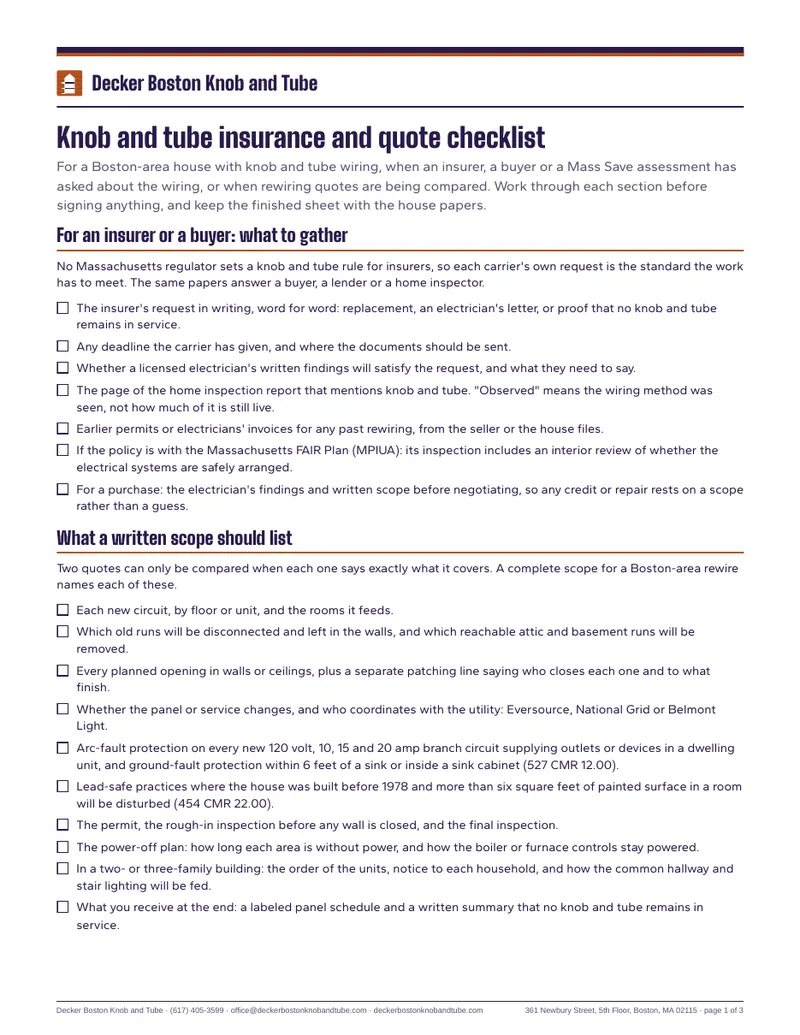
What the checklist covers
For an insurer or a buyer: what to gather
No Massachusetts regulator sets a knob and tube rule for insurers, so each carrier's own request is the standard the work has to meet. The same papers answer a buyer, a lender or a home inspector.
- The insurer's request in writing, word for word: replacement, an electrician's letter, or proof that no knob and tube remains in service.
- Any deadline the carrier has given, and where the documents should be sent.
- Whether a licensed electrician's written findings will satisfy the request, and what they need to say.
- The page of the home inspection report that mentions knob and tube. "Observed" means the wiring method was seen, not how much of it is still live.
- Earlier permits or electricians' invoices for any past rewiring, from the seller or the house files.
- If the policy is with the Massachusetts FAIR Plan (MPIUA): its inspection includes an interior review of whether the electrical systems are safely arranged.
- For a purchase: the electrician's findings and written scope before negotiating, so any credit or repair rests on a scope rather than a guess.
What a written scope should list
Two quotes can only be compared when each one says exactly what it covers. A complete scope for a Boston-area rewire names each of these.
- Each new circuit, by floor or unit, and the rooms it feeds.
- Which old runs will be disconnected and left in the walls, and which reachable attic and basement runs will be removed.
- Every planned opening in walls or ceilings, plus a separate patching line saying who closes each one and to what finish.
- Whether the panel or service changes, and who coordinates with the utility: Eversource, National Grid or Belmont Light.
- Arc-fault protection on every new 120 volt, 10, 15 and 20 amp branch circuit supplying outlets or devices in a dwelling unit, and ground-fault protection within 6 feet of a sink or inside a sink cabinet (527 CMR 12.00).
- Lead-safe practices where the house was built before 1978 and more than six square feet of painted surface in a room will be disturbed (454 CMR 22.00).
- The permit, the rough-in inspection before any wall is closed, and the final inspection.
- The power-off plan: how long each area is without power, and how the boiler or furnace controls stay powered.
- In a two- or three-family building: the order of the units, notice to each household, and how the common hallway and stair lighting will be fed.
- What you receive at the end: a labeled panel schedule and a written summary that no knob and tube remains in service.
Mass Save insulation barrier steps
A Mass Save Home Energy Assessment that finds knob and tube stops wall and attic insulation until a licensed electrician addresses the wiring. Work through these in order; doing them out of order can cost you an incentive.
- Keep the assessment report that lists the recommended insulation or air sealing and notes the knob and tube.
- Ask the program, in writing, what the electrician must certify for your house. The standard asks that the areas where work is recommended be free of active knob and tube.
- Check eligibility before signing a contract: the enhanced barrier incentive for moderate-income households in one- to four-unit homes needs income verification, and the HEAT Loan's 0% financing for barrier work is for homeowners with a residential account from a Mass Save sponsor.
- Get a signed proposal from a licensed electrician before work starts. The HEAT Loan asks for it on contractor letterhead.
- After the work, collect the signed completion form, the paid invoice and the electrician's written certification for the work areas. The HEAT Loan also requires a verification inspection.
- Then book the insulation and finish the rest of the recommended weatherization.
- In Belmont and other municipal-light towns, Mass Save's electric offers don't apply. A home heated with natural gas from a Mass Save sponsor may still qualify, so confirm with the program first.
Source: Mass Save HEAT Loan.
Boston permit and inspection records
In Boston, Inspectional Services issues the electrical permit and only a licensed contractor can apply for it. Cambridge, Somerville and the other cities and towns have their own wire offices; the records worth keeping are the same.
- The permit, issued before any work began. Boston Inspectional Services warns that starting early can mean double the permit cost or a code violation.
- The name of the licensed contractor on the permit application.
- The rough-in inspection, passed before any wall or ceiling was closed. The state code allows up to 72 hours after notice for it, weekends and holidays excluded.
- The final inspection that closes the permit. In Boston the licensed contractor has to be on site for it.
- If the service or meter changed, the utility's confirmation of the new service.
- Outside Boston, the record from that city's or town's own wire office. Ask the contractor which office issued the permit.
- The contractor's written summary: circuits replaced, runs left disconnected in place, and anything that could not be reached or verified.
Source: Boston Inspectional Services, electrical permit.
Questions for comparing quotes
Ask every contractor the same questions and write the answers beside each quote. Compare the answers before the totals.
- Does the price cover every live knob and tube circuit, or only those in certain rooms?
- How were the circuits traced, and what could not be reached or verified?
- What happens to the old wiring: disconnected in place, or removed where it can be reached?
- How many openings, where, and who patches them to what finish? Is the patching in this price?
- Does the panel or service change, and is the utility's part included or separate?
- Are the permit fee and both inspections included?
- How long will each area be without power, and how will the heating system stay on?
- In a house built before 1978, are lead-safe practices included wherever the openings need them?
- What documents come at the end, and will they answer the insurer's or Mass Save's request as written?
- Which licensed electrician will pull the permit?
Fill in before you call
A few facts make the first conversation far more useful.
- Property address and ZIP
- Building type and number of units
- Year built (approximate)
- Who flagged the wiring, and when
- Insurer or buyer request (exact words) and any date
- Mass Save assessment: date and areas listed
- Electric utility: Eversource, National Grid or Belmont Light
- Attic access: walkable, tight, or none
- Basement ceiling: open or finished
- Panel: fuses or breakers
- Anything already rewired, and when
Download the checklist
Send the short form and the download link appears right under it. If you would also like the circuits traced, say so in the message and mention what prompted it.
Call (617) 405-3599Decker Boston Knob and Tube361 Newbury Street, 5th Floor, Boston, MA 02115
office@deckerbostonknobandtube.com
Monday to Friday, 8 AM to 6 PM; Saturday and Sunday, 9 AM to 2 PM
Outside these hours, emergency calls only
Photos of the attic, the basement ceiling and the panel help most.