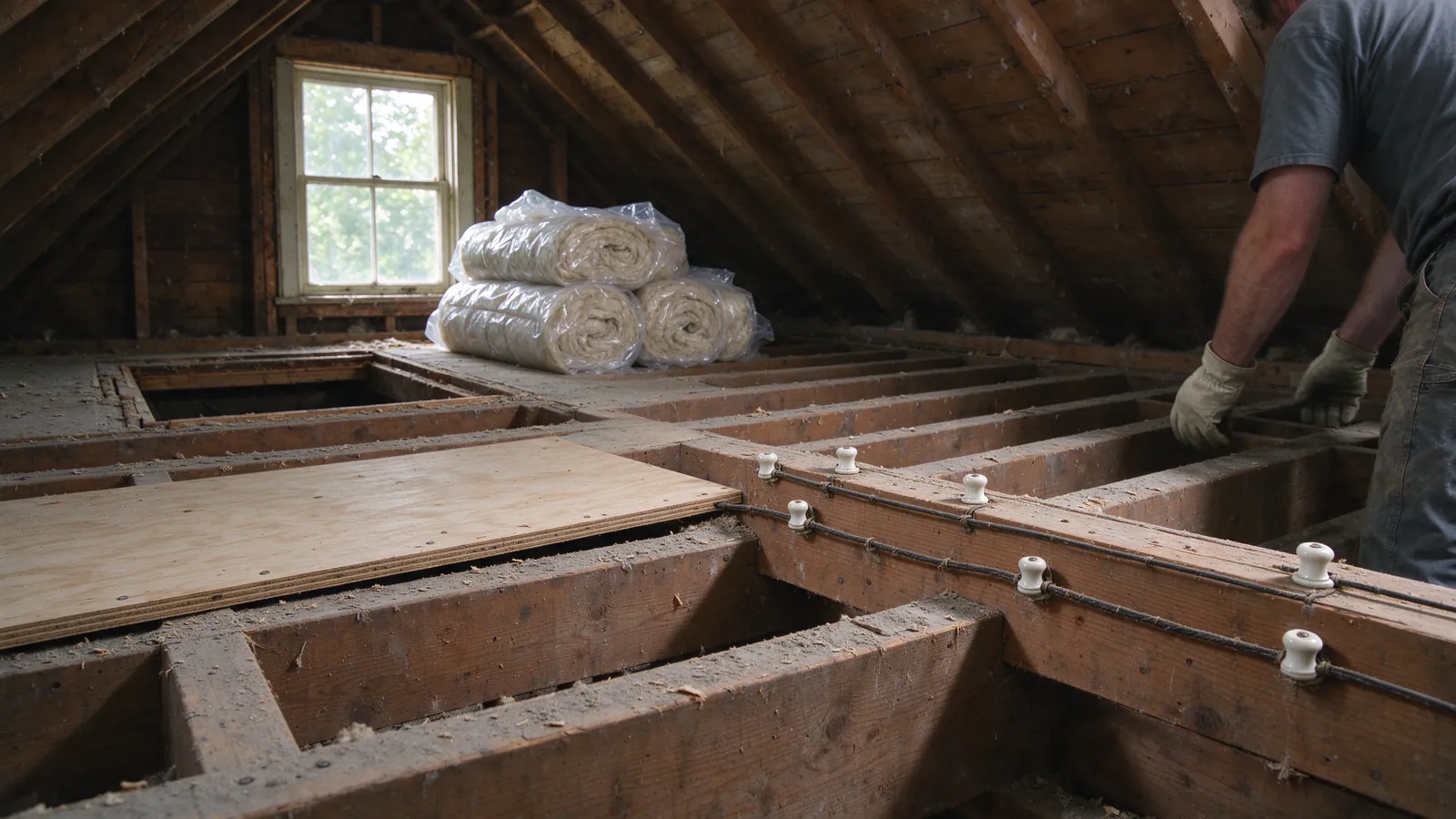
Decker Boston Knob and Tube arranges knob and tube insulation barrier work for homes across Boston, Cambridge, Somerville and nearby cities, carried out by licensed and insured electricians. The job exists because of one rule. Where a Mass Save energy specialist finds evidence of knob and tube, no insulation goes in until a licensed electrician deals with the wiring.
Barrier work is what the electrician does to clear that hold, plus the written certification that proves it. Mass Save sets the rule and the electrician meets it; there is no affiliation implied, and no incentive is guaranteed. The sections below cover why the rule exists, what the visit involves, the order things happen in and the programs that help pay.
Why insulation and knob and tube don’t mix
Knob and tube was designed to cool itself in open air. Insulation packed around it takes that away, which is the whole reason the barrier exists.
How the old wiring sheds heat
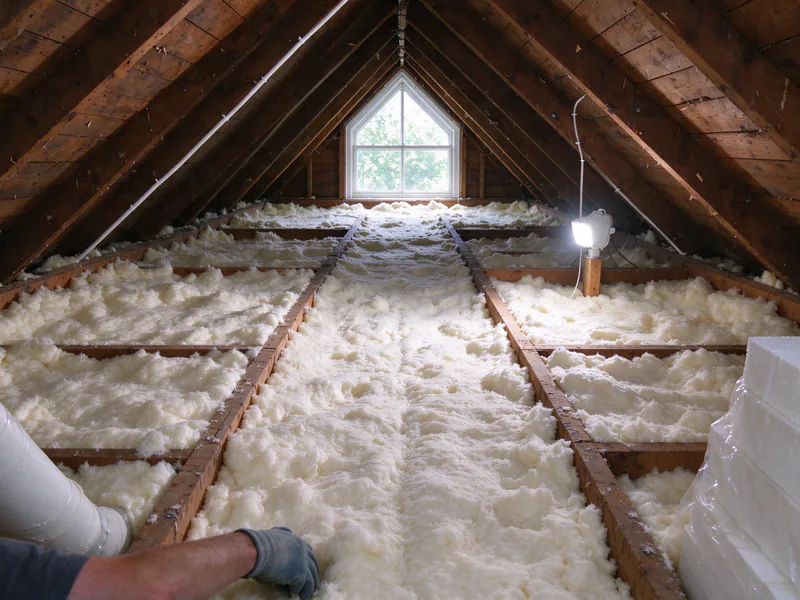
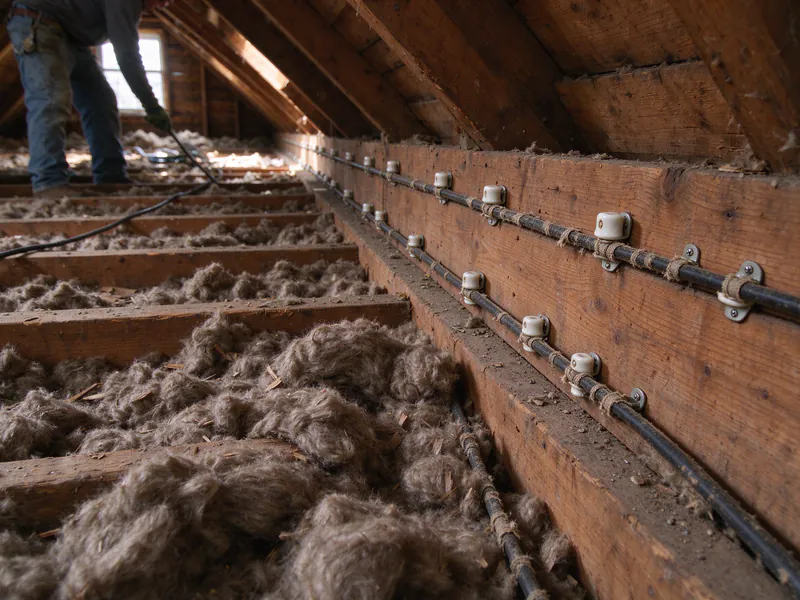
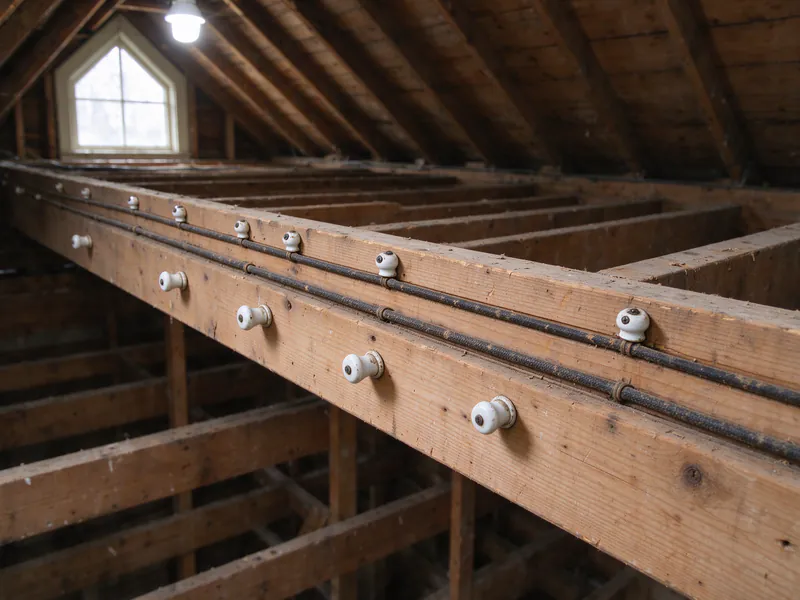
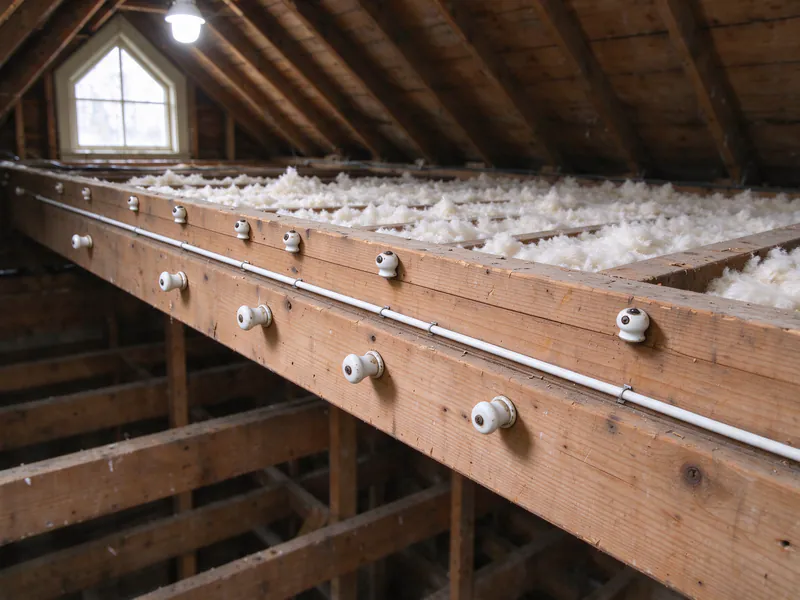
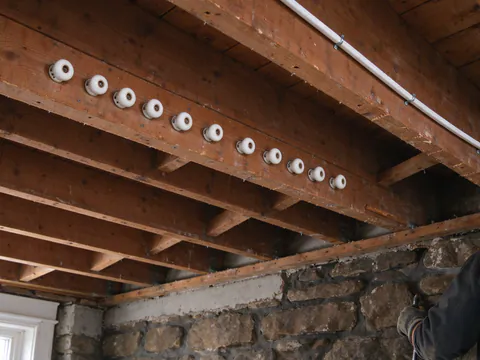
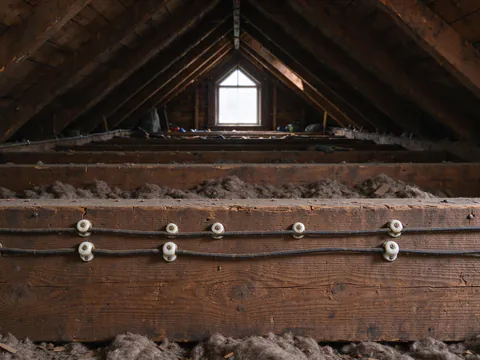
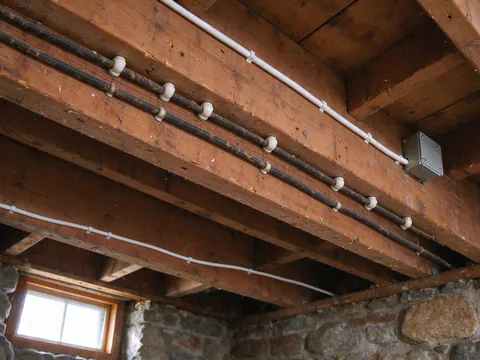
Knob and tube runs each conductor on its own path, spaced apart on porcelain knobs, with no outer sheath. Current warms the copper, and the heat drifts off into the air of the cavity. Bury that run in blown-in cellulose or fiberglass and the heat stays at the conductor. Rubber insulation ages faster when it runs hot, and brittle insulation is how bare copper ends up resting against wood framing.
What the code and the program each say
Massachusetts adopts the National Electrical Code’s knob and tube article, Article 394, without amendment, and no separate state rule on insulating over it was found. For weatherization, the rule that actually stops work is Mass Save’s. Under its assessment standards, an energy specialist is told knob and tube “should always be suspected in pre-1955 houses.” Once any is found, it blocks insulation throughout the home, apart from open, uninsulated cavities the specialist can see into fully. Work that leaves the wiring alone, such as sealing ducts or wrapping pipes, can still proceed.
New cable in insulated cavities
Replacement circuits face their own rule. Under section 334.80 of the state code, cable run through thermal insulation is rated at its lower 60°C value, so new circuits in an insulated attic floor or wall are sized with that in mind. That is one reason the electrical plan comes before the insulation plan, not after it.
What happens on the first visit
The visit starts with the assessment’s work plan, because the certification only has to cover the areas where insulation or air sealing is recommended.
Matching the trace to the work areas
The electrician begins at the panel and traces every circuit, then checks the attic floor and the basement routes against the plan. The focus is on runs inside the attic floor and the exterior walls, plus any knee walls or floors the plan names. A run elsewhere in the house may stay as it is, as long as it sits outside the areas being insulated. The guide to telling whether knob and tube is live explains why that question is settled at the panel, not by looking.
Three outcomes for each area
- Verify: no knob and tube is found, or only runs already dead. The electrician confirms and certifies.
- Disconnect: old runs are present but feed nothing. They are cut free at every source and tested dead, and the reachable attic runs are removed. The knob and tube removal page covers that step.
- Rewire: old runs still power rooms. New circuits take over those loads, the old runs are retired, and the work is permitted and inspected. Often this is a partial replacement limited to the top floor; where old wiring runs through every room, a whole house rewire clears the barrier everywhere at once.
The certification
The deliverable is a written statement from a licensed electrician that the work areas are free of active knob and tube. Contractors arranged through this site can supply the licensed-electrician proposal and completion documents that the barrier incentive and the HEAT Loan ask for.
Insulation on hold?
Share the assessment's work plan and find out whether you need a certification, a disconnection or new circuits.
Sequencing barrier work with weatherization
The order is fixed: assessment, electrical work, certification, then insulation. Starting the electrical work before the paperwork is in place can put the incentive at risk.
The steps in order
- A Mass Save Home Energy Assessment recommends insulation or air sealing and flags knob and tube.
- For the incentive, a licensed electrician’s signed proposal and income verification go in before the work.
- The electrical work is done, with a permit and a rough-in inspection where new circuits are installed; Massachusetts rules keep new wiring uncovered until the inspector of wires has seen it, as the Boston permit guide explains.
- The electrician signs the certification for the work areas.
- The insulation contractor completes the recommended weatherization.
Fall and winter jobs
When barrier work falls in winter, the weather shapes it. Boston’s Logan Airport averages about 92 days a year at or below freezing, according to NOAA, so any power-off window during electrical work is planned to keep the boiler or furnace controls running.
What the local records show
Permit descriptions show insulation driving knob and tube work across the inner core. Several Cambridge permits tie the work to insulation in so many words, such as removing knob and tube from a basement and attic in preparation for insulating. A Somerville permit eliminates knob and tube on a second floor for insulation. The Cambridge and Somerville pages cover each city’s permit office.
Belmont is different
Belmont buys its power from Belmont Light, the town’s own utility, not from Eversource or National Grid. Gas-heated homes there apply to Mass Save for insulation, while oil- and electric-heated homes use Belmont Light’s own weatherization incentives. The Belmont page explains which path a house is on.
Paying for barrier work
Which program helps depends mostly on household income and on who supplies the house with power and gas.
Mass Save barrier incentive
Where knob and tube blocks insulation that an assessment recommended, a moderate-income household in a building of up to four units may qualify for as much as $7,000 toward eligible removal costs. It is paid upfront as two checks, one to you and one to the contractor, after income verification and with a licensed electrician’s signed proposal. Mass Save publishes the income bands by household size and ZIP code, and program terms can change, so confirm the current offer before signing. The incentive also covers vermiculite attic fill, which the asbestos and lead paint guide discusses.
HEAT Loan and other households
The Mass Save HEAT Loan offers 0% financing for pre-weatherization barriers, including knob and tube, within a $25,000 lifetime cap. A Home Energy Assessment is required, the recommended insulation has to be completed, and the applicant must be the homeowner with a residential account from a Mass Save sponsor. Mass Save’s published offers don’t include a separate knob and tube incentive for market-rate homes, so the loan is the main option for them.
Boston’s own program
Income-eligible Boston owner-occupants can also look at the Boston Home Center’s Home Repair and Improvement Loan. It is deferred and interest-free, goes up to $50,000, and names knob and tube removal as eligible work. It doesn’t reimburse work done before approval, so apply first. The grants guide covers eligibility for each program, and the Boston cost guide explains what the electrical work itself costs.