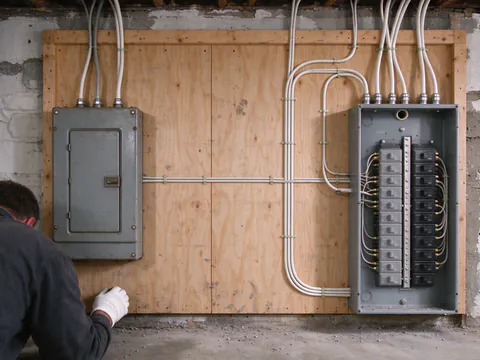
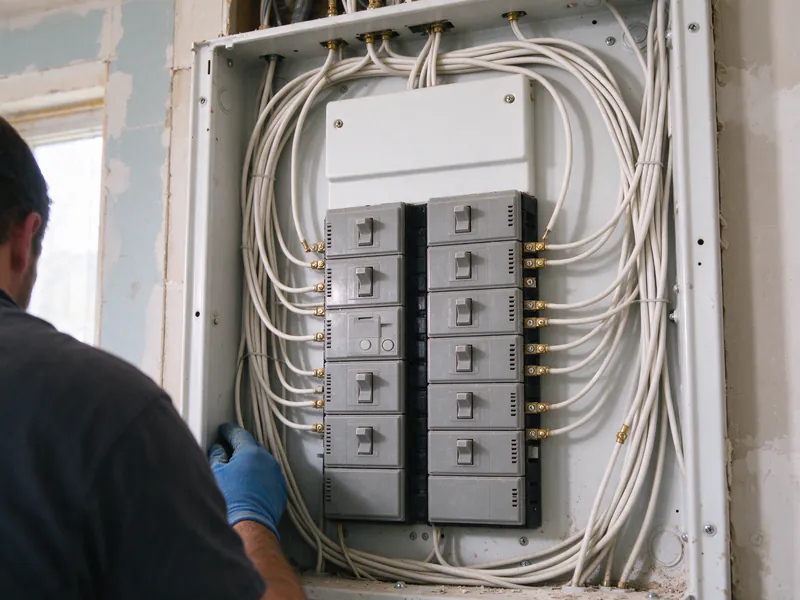
Taking a house from a fuse box or small service to a 200 amp breaker panel, including the new service equipment, falls in a typical Massachusetts range of $3,000 to $6,500. Replacing only the panel, where the existing service is big enough, comes in lower, and anything the utility does is extra. Decker Boston Knob and Tube arranges panel and service upgrades alongside knob and tube replacement in Boston and nearby cities, with the work done by licensed and insured electricians.
That range is a budgeting figure, not a quote. Where a house lands depends on what the existing service looks like from the street to the panel, where the new equipment can go, and how many circuits have to move over to it.
Typical ranges for Boston-area panel work
Only one kind of panel work has a published budgeting range. The rest gets priced from the house, because the scope varies too much for a single figure.
| Work | Budgeting figure | What it usually includes |
|---|---|---|
| Fuse box or small service to a 200 amp panel | $3,000 to $6,500 (typical Massachusetts range) | New breaker panel, meter socket and service-entrance cable, grounding and bonding, circuits moved over and labeled |
| Panel-only replacement | Less than a full upgrade; priced from the job | A new panel on the existing service, reusing the meter and service cable |
| Sub-panel for a floor or unit | Priced from the job | A smaller panel fed from the main one, often used in multi-family rewires |
| Utility drop and meter | Set by the utility | Disconnecting and reconnecting the service; simple connections and larger infrastructure changes are handled differently |
| Permit | Agency formula (see below) | Application fee plus a per-amp service charge |
What moves a panel upgrade price
The spread inside the range comes from physical facts about the service and the building. Each one changes the hours, the parts or both.
| Factor | Why it changes the price | Boston-area context |
|---|---|---|
| Existing service size | A 60 or 100 amp service usually needs a new service-entrance cable and meter socket to reach 200 amps | Cambridge permit records list existing services of 60 amps on some knob and tube jobs |
| Overhead or underground feed | An overhead mast may need replacing; an underground feed involves different work | The utility decides what its side requires |
| Panel location | Moving the panel means extending every circuit to its new spot | A cramped basement corner or a closet under the stairs can force a move |
| Arc-fault breakers | Each one costs more than a standard breaker, and the state code wants one (or another listed method) on every 120 volt, 10, 15 and 20 amp branch circuit in the home | The Massachusetts amendment covers all dwelling circuits, not only listed rooms |
| Circuits moved over | Each circuit needs landing, testing and labeling; old knob and tube circuits may need splice work at the panel | A whole house rewire done at the same time removes this step for the replaced circuits |
| Multiple meters | Two- and three-family houses carry a meter and often a panel per unit | 23.5% of Boston’s housing units sit in three- and four-unit buildings (U.S. Census Bureau), many of them triple-deckers |
| Historic district review | Visible exterior service equipment may need design approval first | In the Back Bay district, electrical equipment can’t go on a primary elevation and wiring should be black (historic district guide) |
| Wall repair | Removing an old panel or running a new feed can leave openings | No public figure; confirm who closes them |
What’s inside a Boston panel upgrade price
One panel quote bundles several costs. A few are set or measured by public agencies, so you can check them; the others only become clear when the scope spells them out.
| Piece of the job | Driven by | Public figure for the Boston area |
|---|---|---|
| Labor | Hours at the panel and meter, plus a helper on bigger services | The mean hourly wage for electricians in the Boston-Cambridge-Newton metro is $40.08, compared with $34.37 nationally, roughly 17% higher; median wages are $38.42 here and $30.38 nationally (U.S. Bureau of Labor Statistics) |
| Breakers the code calls for | How many branch circuits land on the panel | Arc-fault breakers (or another listed means) for each 120 volt dwelling circuit rated 10, 15 or 20 amps, and ground-fault protection for kitchen and bath receptacles near a sink bowl, under the state electrical code |
| Outdoor disconnect | Whether the state’s emergency disconnect rule reaches the job | Massachusetts limits the outdoor service-disconnect rule mainly to one- and two-family dwellings and new double-occupancy buildings, and exempts jobs that replace only meter sockets, service conductors, main breakers or related raceways; check the wording for your address with the inspector |
| Permit | Amperage of the new service | Boston Inspectional Services charges a $20 application fee and 25 cents an amp for services up to 240 volts, all due at filing; work begun ahead of the permit risks a doubled fee |
| Inspection | When the inspector of wires can come | Interior work stays uncovered until the inspector sees it, and the code gives the inspector up to 72 business hours after notice to do so (Rule 10) |
| Utility work | Who owns the service drop and meter | Eversource handles service upgrades in Boston, Cambridge and Somerville by work request after the municipal inspection; National Grid in Medford, Malden and Quincy uses an Electric Service Request Form and charges nothing for simple connections; Belmont Light serves Belmont |
| Patching | Holes left where the old panel or feed came out | Nothing published; get it named in the quote |
A wage is not a billing rate: the hourly rate on an invoice also pays for insurance, licensing, trucks, permits and the office behind the job. Still, local pay is one reason a panel upgrade near Boston budgets higher than the same work elsewhere. Mean pay for electricians here is about 17% over the national figure, and median pay about 26% over.
Permit fees in Boston, Cambridge and Somerville
Every city in the area runs its own wire office. The lines below are the ones that apply to a service change; a licensed electrician files in all three.
| City | Service upgrade fee | Other lines and penalties |
|---|---|---|
| Boston (ISD) | $45 for a 100 amp service and $70 for 200 amps, from the per-amp formula | Early starts risk paying twice |
| Cambridge (ISD) | $10 per 100 amps of service plus $5 per meter, so $20 for a 200 amp service on its own | The fee triples if work begins first; no application fee appears on the city’s page, so ask Cambridge ISD |
| Somerville (ISD) | The posted schedule is from 2010 | Ask Somerville ISD for the current figures before budgeting |
Brookline, Newton and Medford and Malden publish their own schedules, not verified here; ask the wire office or have the quote carry the permit as a line.
A worked Boston example
Illustrative only. Taking a house from 100 to 200 amps at 240 volts: $20 + (200 × $0.25) = $70 for the service line. When rewired circuits with new fixtures, plugs and outlets ride on the same permit, ask ISD whether its per-device line is added on top. Next to a $3,000 to $6,500 job, the filing is a rounding error.
A new panel leaves the knob and tube behind
Swapping the panel replaces the fuses and the service. It does nothing to the branch wiring behind the walls. The state’s code interpretation committee confirmed that a service with knob and tube circuits may be replaced without replacing those circuits, so an upgrade can legally leave every old run in service.
That has two consequences for a budget. First, an insurer or Mass Save assessor who asks about knob and tube still gets the same answer after the panel work. Second, if you plan to rewire, doing both together avoids moving old circuits onto a new panel only to replace them later. Replacing the circuits themselves is budgeted on its own, in a typical Boston-area budgeting range of $8,000 to $25,000 or more (cost breakdown), and the panel upgrade guide explains the difference in scope.
Help with the cost
Few programs pay for a panel on its own, and most help depends on income, an energy assessment or both.
| Program | Run by | Terms | Does it reach panel work? |
|---|---|---|---|
| Boston Home Center repair loan | City of Boston | Interest-free, deferred until the house is sold, transferred or refinanced, as much as $50,000 | Its list of eligible work includes electrical upgrades; Boston owner-occupants within 135% of area median income |
| Energy Saver Home Loan | MassHousing | Low-interest second mortgages from $10,000 to $100,000 | Enabling measures include electrical and panel upgrades; the project must cut total energy use at least 20%, one- to four-family primary homes, no condos |
| MassHousing home improvement loan | MassHousing | A fixed rate on $7,500 to $50,000 | Covers safety repairs; income cap $139,000 |
| Mass Save barrier incentive | Utility sponsors of Mass Save | As much as $7,000 for moderate-income households whose insulation is blocked by the wiring | Written around removing the old wiring; confirm before counting on it for a panel (grants guide) |
| Federal 25C credit | IRS | Included up to $600 for a panel upgrade that supported qualifying energy equipment | Closed to improvements made after December 31, 2025 |
Illustrative budgets, not quotes
Labeled illustrative because they are: each one is assembled from the range and agency fees on this page, not from a priced house.
| Illustrative house | How the budget builds | Check separately |
|---|---|---|
| Single-family house on a 100 amp fuse panel, circuits rewired decades ago | The $3,000 to $6,500 Massachusetts range, plus the $70 Boston permit inside it | Utility scheduling, any panel relocation |
| Older house whose branch circuits are still largely knob and tube | Add the rewire range to the panel range: at least $11,000 combined, with no fixed ceiling | Plaster restoration and lead-safe practices in a pre-1978 house |
| Three-family house with one meter per unit | Priced per service and panel from the site visit; the permit’s service line applies to each upgraded service | Common hallway lighting, which the state code lets an existing three-family building feed from a unit’s equipment |
| Back Bay condominium | An in-unit panel or sub-panel priced from the building’s existing service | Commission review for any visible exterior equipment |
Questions to put to every quote
- Does it replace the meter socket, service-entrance cable and mast, or only the panel?
- How many circuits move over, and does it include arc-fault and ground-fault breakers for them?
- Who files the permit, and who coordinates with Eversource, National Grid or Belmont Light?
- Does the price include grounding and bonding, a labeled panel schedule and wall repair?
- Are any knob and tube circuits being left on the new panel, and are they listed?
The quote comparison guide covers the same questions for a full rewire, and the load guide explains why service size and circuit count matter. If you’d like your own service sized and scoped, phone (617) 405-3599 or request an estimate online; the electrical panel upgrade page describes the work itself.