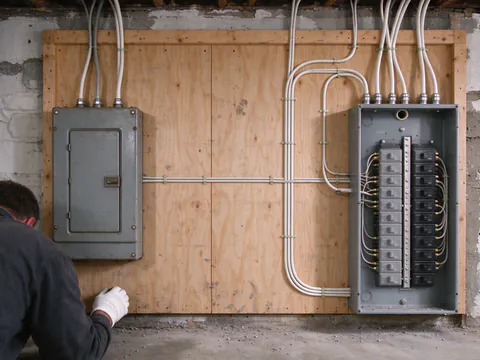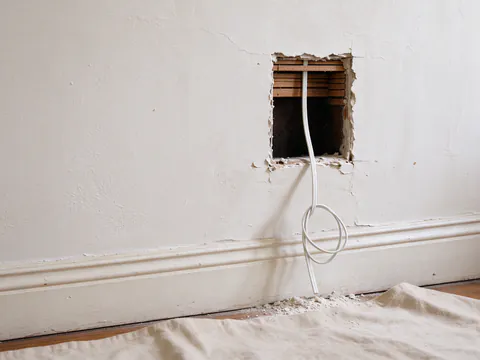

Decker Boston Knob and Tube arranges whole house rewiring for older homes across Boston, Cambridge, Somerville and nearby cities, carried out by licensed and insured electrical contractors. A whole house rewire replaces every branch circuit in the house, not only the ones on porcelain knobs, with new grounded cable from the panel to each outlet, switch and light. It is the right scope when the old system runs through most rooms or has been patched by several generations of owners. When only a few original circuits remain, a partial replacement usually costs less and opens fewer walls.
What happens on the first visit
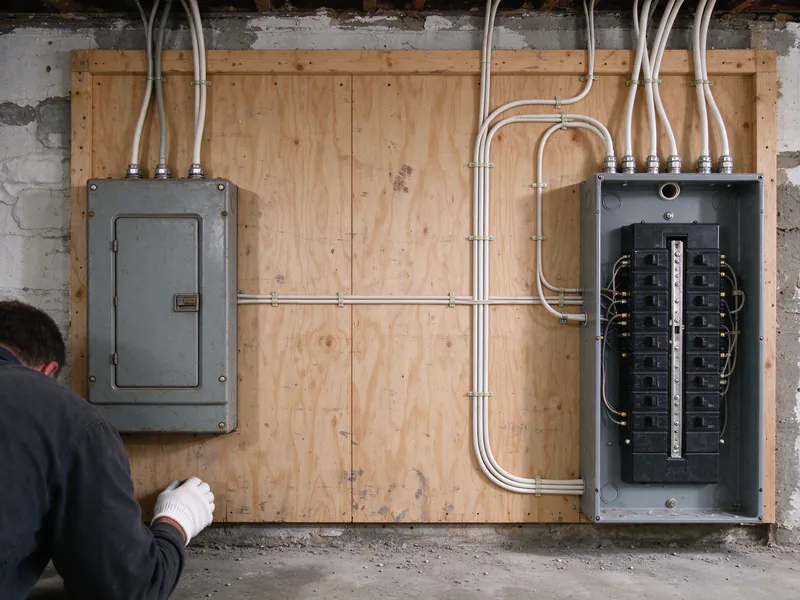
The first visit finds out what the house actually has. A home inspection that says “knob and tube observed” confirms the wiring method exists, not how much of it is live, so the visit starts at the panel and works outward.
Circuits first, then access
The electrician traces each circuit to the rooms it feeds and records what it is made of: knob and tube, cloth-sheathed cable, early armored cable or later cable, and where one was spliced into another. The knob and tube inspection page describes that tracing in detail. Then the visit turns to routes: whether the attic can be walked, whether the basement ceiling is open, where closets stack between floors, and whether blown-in insulation already covers old runs.
What you get back
You get a written scope. It lists each new circuit, each old run to be disconnected and left in place, the openings the routes need, whether the panel stays, and what patching is included. That document is also the fairest way to compare prices, because it shows exactly what each one covers; the quote comparison guide lists what to check.
When a whole house rewire is the right scope
A full rewire is decided by the condition and mix of the wiring, not the age of the house. Nearly half of Boston’s housing units were built before 1940, according to Census figures, but that is a reason to look, not proof of what any one house contains.
Three eras of wiring in one house
Knob and tube ran separate hot and neutral conductors on porcelain through the framing, with no ground. It held up for decades partly because the wires sat in open air and shed heat. The risk usually comes from what was added later: cloth-sheathed cable from mid-century remodels, early armored cable, and splices joining all three, sometimes buried in a wall with no box. When a house has all of that, replacing one type at a time means returning to the same walls again and again. The cloth wiring replacement page covers the mid-century cable on its own.
Circuits sized for a different load
Original circuits were laid out for lights and a few outlets. Space heaters, window air conditioners and kitchen appliances now land on the same runs, and oversized fuses fitted when the originals kept blowing remove the protection that matched the wire. A rewire is when the circuit count is planned around the loads the house actually runs, and a load calculation decides whether the service can carry them. The guide to how many amps knob and tube can handle explains why those old circuits overheat.
When it isn’t needed
The Massachusetts code does not by itself force a full rewire. Rule 3 of 527 CMR 12.00 lets new work be added without bringing the rest of an installation up to code, so long as it doesn’t create or worsen a violation. Where earlier owners already rewired most rooms, the remaining knob and tube may feed a bedroom and a few ceiling lights. Tracing shows that, and the partial vs full guide weighs the two.
Getting new cable through plaster, strapping and three floors
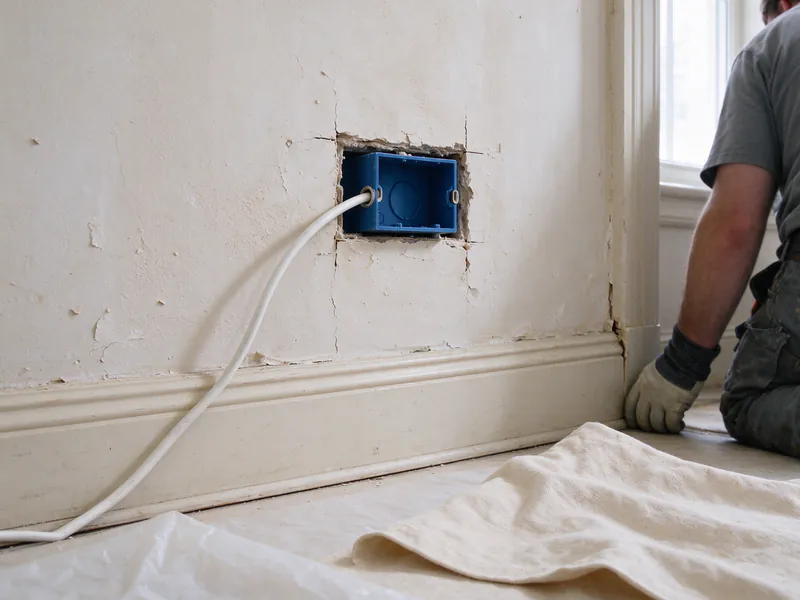
Most of a rewire is fished, not torn open. The Massachusetts text of the code allows cable to be fished between access points for concealed work in finished buildings where strapping it to the framing is impracticable, which is what makes a plaster-preserving rewire possible.
Attic down, basement up
Where the attic is walkable, top-floor circuits run across the joists and drop into wall cavities. Where the basement ceiling is open, main-floor circuits come up from below. Closets that stack over each other and old chases carry cable between floors without crossing finished walls. Openings are still needed at outlet and switch locations and wherever a fire block or header stops the cable.
Strapped ceilings and taller buildings
Where a ceiling was plastered over wood furring strips, the state code treats cable run diagonally behind strapping of about three-quarters of an inch as supported, provided it isn’t pulled taut. In a three-decker, each floor is usually its own dwelling unit and is often rewired as its own stage. In buildings over three stories, cable circuits generally may not leave the floor or unit they start from, which changes the plan in the taller rowhouses covered on the Back Bay, Beacon Hill and South End page.
Openings, lead paint and who patches
In a house built before 1978, opening more than six square feet of painted surface per room turns the job into lead-safe renovation work under the state’s Department of Labor Standards rules, with a licensed lead-safe renovation contractor and containment. Small fishing holes can stay under that line, while a gut rewire usually can’t. The plaster wall rewiring page covers how openings are cut and closed.
What the Massachusetts code asks of the new system
Every whole house rewire permitted in Massachusetts after April 24, 2026 is inspected to 527 CMR 12.00, which adopts the 2026 National Electrical Code with the state’s amendments. A few of those rules shape the job more than the rest.
| Rule | What it means for a rewire |
|---|---|
| MA 210.12(B), arc-fault protection | Every 120 volt, 10, 15 and 20 amp branch circuit in a dwelling unit needs arc-fault protection, not only bedrooms and living rooms. That sets the breaker count and often the panel. |
| MA 210.8, ground-fault protection | Receptacles within 6 feet of a sink, or inside a cabinet supporting one, need ground-fault protection. |
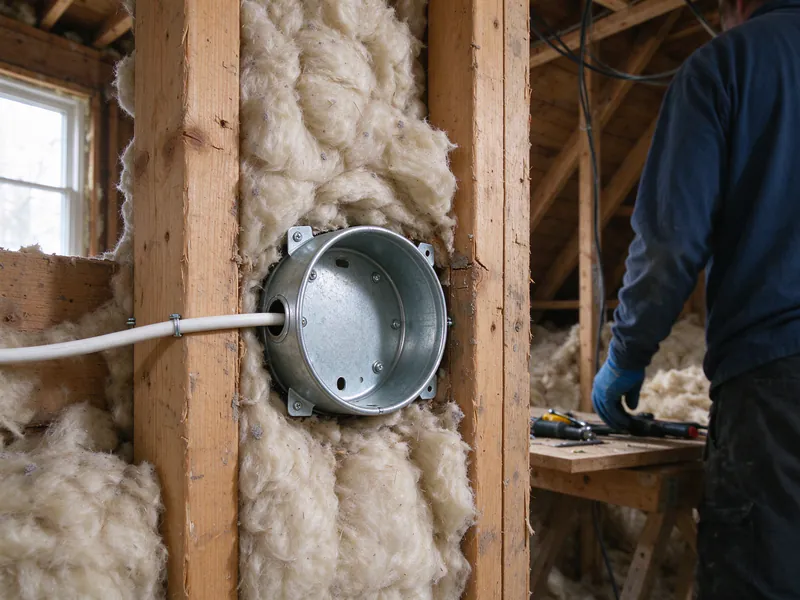
| 334.80, cable in insulation | Where new cable runs through thermal insulation, its rating is taken at the lower 60°C value, which affects wire size on loaded circuits. |
| Rule 10, inspection before cover | Wiring can’t be concealed until the inspector of wires has seen it, within 72 hours of notice, weekends and holidays excluded. Plaster patching waits for that. |
The Boston permit
In Boston, Inspectional Services requires a licensed contractor to apply for the electrical permit and do the work; a homeowner can’t pull it. ISD’s fee is a $20 application fee plus $1 per fixture, plug or outlet and $5 per meter when the service doesn’t change, or $0.25 per amp when it does. Work may not start until the permit is issued. Other cities have their own wire inspectors and fees, covered in the Boston permit guide.
Start with what's still live
Tracing the circuits tells you whether this is a full rewire, a partial job or something smaller.
Living in the house while it’s rewired
Most households stay put. The work moves area by area, so a given room loses power for part of a day rather than for the whole project, and each floor’s circuits are switched to the new panel as they are finished. Say up front which loads matter most, such as a home office, a medical device or the refrigerator, so those circuits are planned first.
Winter work needs one more check. Boston’s Logan Airport station averages about 92 days a year at or below freezing, according to NOAA, so any shutdown has to keep the boiler or furnace controls powered. The living at home guide covers dust, furniture and the practical side.
Insurance, Mass Save and paying for the work
A rewire usually starts because someone else asked about the wiring. What matters afterwards is the paperwork: the closed permit with the final inspection, the panel schedule and a written summary that no knob and tube remains in service.
Insurers
No Massachusetts regulator sets a knob and tube rule for insurers. Carriers set their own terms, and the state’s FAIR Plan inspection reviews whether electrical systems are safely arranged. Homeowners report deadlines at purchase or renewal, so ask for the request in writing and check it against the scope before work starts. A completed rewire answers the question; no one can promise a carrier’s decision. The Massachusetts insurance guide explains what to ask.
Mass Save
A Mass Save Home Energy Assessment that finds knob and tube stops wall and attic insulation until a licensed electrician certifies the work areas are free of active knob and tube. A whole house rewire clears that for the whole house at once. Moderate-income households in 1 to 4 unit homes can get Mass Save’s barrier incentive of up to $7,000, and the Mass Save HEAT Loan offers 0% financing for pre-weatherization barriers after an assessment. The grants guide covers eligibility and the insulation barrier service covers the certification itself.
What moves the price
A typical Boston-area budgeting range for a whole house rewire is $8,000 to $25,000 or more, and larger, plaster-heavy or service-upgrade jobs can run well past it. The biggest factors are how many circuits are live, the number of floors, attic and basement access, plaster versus drywall, and whether the panel changes; a panel or service upgrade alongside the job falls in a typical Massachusetts range of $3,000 to $6,500. Labor is part of it: electricians in the Boston metro earn a mean $40.08 an hour, about 17% above the $34.37 national mean, according to the Bureau of Labor Statistics. A wage is not a billing rate, which also carries insurance, licensing, vehicles and overhead. The Boston cost guide breaks the price into parts, and the cost estimator gives a range without a phone call.