
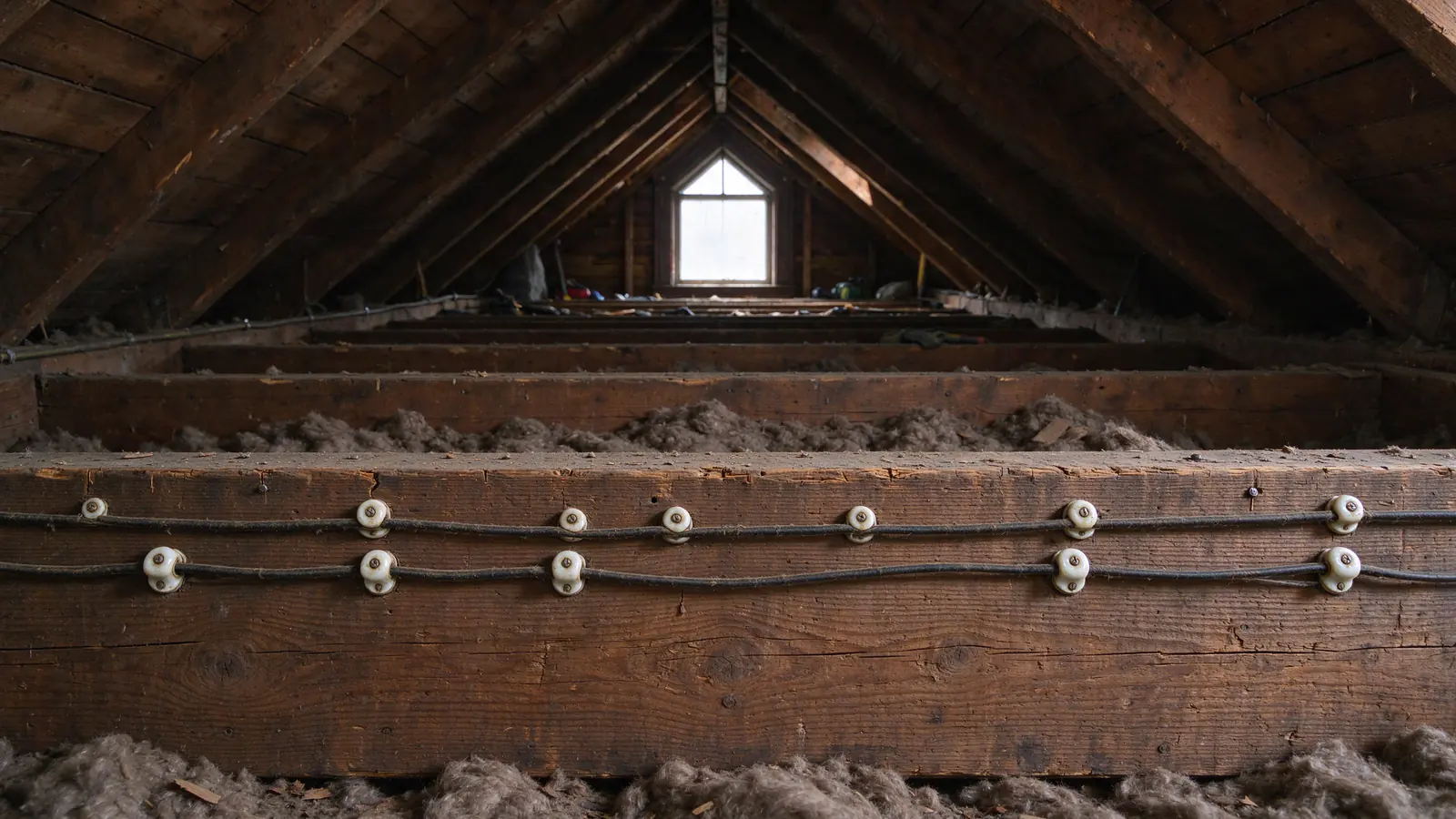
Knob and tube is the wiring method found in most Boston-area houses built before 1940: single copper conductors in rubber and cloth insulation, held off the framing on porcelain knobs, passed through joists and studs in porcelain tubes, and cooled by the open air around them. It has no ground wire. Decker Boston Knob and Tube arranges knob and tube inspection, removal and replacement across Boston and nearby cities, carried out by licensed and insured electrical contractors, and this guide covers what the system is before anyone decides what to do with it.
The short version for an owner: knob and tube isn’t illegal in Massachusetts and isn’t automatically unsafe. What matters is whether it’s still live, what has been done to it over the decades, and whether an insurer or a Mass Save assessment is now asking about it.
What knob and tube wiring is
Knob and tube is an open wiring system: each circuit’s two conductors travel separately through the framing instead of together in one cable. It formed the original branch circuits of most pre-war houses, the runs from the fuse box to every light and outlet.
The parts you can see
- Knobs: porcelain insulators nailed to joists and rafters, with the conductor wrapped or tied on, holding it clear of the wood.
- Tubes: porcelain sleeves pushed through holes in studs and joists, so the wire never touches framing where it passes through.
- Loom: flexible protective tubing slipped over the conductors where they enter a box or fixture or need extra protection.
- Conductors: solid copper wire wrapped in rubber, then cloth, one hot and one neutral per circuit, often spaced several inches apart.
What it doesn’t have
There is no third wire. Modern cable carries an equipment grounding conductor that gives fault current a path back to the panel so a breaker trips. Knob and tube circuits are ungrounded by design, which is why a three-prong outlet on an old circuit proves nothing about grounding. The original circuits also ran to far fewer outlets than a house uses now.
When it was installed, and why Boston has so much of it
Knob and tube was standard in the decades when most of Boston’s housing went up. Nearly half of the city’s homes, 145,114 of 310,625 units, were built in 1939 or earlier, against 30.5% statewide and 11.7% nationally (U.S. Census Bureau, American Community Survey).
The inner core is older still
| City or neighborhood | Housing built before 1940 |
|---|---|
| Beacon Hill (02108) | 75.0% |
| Dorchester, Fields Corner and Savin Hill area (02122) | 60.0% |
| Somerville | 59.0% |
| Jamaica Plain (02130) | 57.7% |
| Belmont | 57.1% |
| Brookline | 51.7% |
| Medford and Newton | 48.8% each |
| Cambridge | 47.0% |
| Boston citywide | 46.7% |
Source: U.S. Census Bureau, American Community Survey 2020-2024 five-year estimates.
Triple-deckers and the knob and tube era
The Boston Preservation Alliance estimates that about 15,000 triple-deckers were built between 1880 and 1930, mostly wood-frame and strung along the trolley lines into Dorchester, Roxbury and Mattapan, and that construction had all but stopped by the 1930s. Today 23.5% of Boston’s housing units sit in three- and four-unit buildings, against 4.3% nationally. That makes the stacked, occupied, three-meter building a common setting for knob and tube here, and the reason triple-decker rewiring is its own kind of job.
Age is a reason to look, not proof
Mass Save’s assessment standards say knob and tube “should always be suspected in pre-1955 houses.” Many of those houses were partly or fully rewired long ago, though. Building age tells you to check; it doesn’t tell you what is behind a particular wall.
How knob and tube works
Every knob and tube circuit is a pair of separate conductors that leave the fuse panel, travel through attics, basements and wall cavities on porcelain, and branch off to lights and outlets through splices. The design depends on spacing and air.
Separation does the insulating
With hot and neutral run inches apart, a failure of one wire’s covering doesn’t immediately put it against the other. The porcelain keeps both wires off the wood, which matters because the rubber and cloth covering was never meant to bear on framing.
Open air does the cooling
Current warms a conductor. In an open attic or an uninsulated wall cavity, that heat drifts off into the surrounding air. The system’s rating assumes that air is there. Pack the cavity with insulation and the wire can no longer shed heat the way it was designed to, which is the reasoning behind Mass Save’s rule against insulating over live knob and tube.
Fuses protect the wire
Each circuit was protected by a fuse sized to the wire. That pairing is the system’s main safety device: if a circuit draws more than its wire can safely carry, the fuse opens. The arrangement works only as long as the fuse stays matched to the wire.
Splices tie it together
Branches were joined to the main runs with splices made along the route. Those original splices were part of the design. The later ones, added during renovations, often aren’t (more below).
What it did well
Knob and tube earned its long life honestly. Undisturbed runs in a dry attic or basement can still carry power today, generations after they went in.
- Durable supports: porcelain doesn’t rot or corrode, and the knobs and tubes often stay intact even where something else in the circuit has failed.
- Heat handling in open air: separated conductors in free air run cool at the loads they were built for.
- Easy to see: in unfinished spaces the whole layout is visible, which helps when an electrician is tracing what goes where.
Where its limits show today
The system was laid out for a house with a few lights per room and a handful of outlets. The way people live now strains it in several ways at once.
| Limit | Why it matters now |
|---|---|
| No equipment ground | No fault path for appliances with metal cases and no grounded outlets for electronics; adding protection takes either new wiring or protective devices (AFCI and GFCI on knob and tube) |
| Few circuits | Kitchens, home offices, window air conditioners and space heaters can load a circuit far beyond its original plan (how many amps it can take) |
| Few outlets | Extension cords and power strips spread load onto circuits and cords that were never planned for it |
| Insulation-dependent ratings | Weatherization puts insulation exactly where the wire needs air |
| Aging rubber and cloth | Insulation that was flexible when new becomes brittle with age and heat, and cracks when moved |
| Small services | Cambridge permit records list existing services as small as 60 amps on some knob and tube jobs |
None of these makes a given circuit unsafe on its own. Together they explain why the question usually isn’t whether the wiring still works, but whether it can keep up with the house safely.
How to recognize it
The surest evidence is in unfinished spaces; the clues in finished rooms prove much less. The identification guide has the detail and photos.
| Where | What points to knob and tube | What it can’t tell you |
|---|---|---|
| Basement ceiling | Single wires on porcelain knobs along joists, porcelain tubes through them | Whether the run is still live |
| Attic | Separate wires across joists or rafters, often under or beside insulation | What feeds it, or what it feeds below |
| Fuse panel | Fuses, or separate single wires entering the panel | Whether later cable has replaced the circuits |
| Outlets and switches | Two-prong outlets, push-button switches, shallow fixture boxes | Anything certain; a three-prong outlet can sit on an old circuit |
Look and photograph, but don’t handle the wiring. Brittle insulation crumbles when moved, and a run that looks abandoned may be live.
Active, abandoned, partial and mixed systems
Whether knob and tube is live changes everything that follows: the safety picture, what an insurer hears, whether Mass Save can insulate, and what the work costs. Four situations turn up in Boston-area houses.
| Situation | What it means | What usually follows |
|---|---|---|
| Active | The original circuits still carry power to lights and outlets | Inspection, then partial or full replacement |
| Abandoned | The runs are disconnected at both ends and carry nothing | Verification and documentation; physical removal only where useful |
| Partial | Some circuits were replaced; others still run on knob and tube | Replacing the remaining circuits, often the hardest-to-reach ones |
| Mixed | Newer cable was spliced onto old runs, so a modern-looking outlet may be fed by knob and tube | Finding every splice, then replacing the old sections |
You can’t tell these apart by looking. Wiring that seems abandoned can still be connected through a hidden splice to a circuit added later. The live wiring guide explains how electricians prove a run is dead, and the guide to knob and tube mixed with newer cable covers the junctions that cause trouble.
How knob and tube fails
Old wiring rarely fails just from age. It fails when age meets disturbance, heat or a change the original design didn’t expect. Each of these mechanisms can be present without any sign in the living space.
Rubber and cloth insulation breaks down
The rubber layer under the cloth hardens and cracks over decades, faster where it runs warm, near light fixtures, or where it has been bent or handled. Rodents chew it. Once the covering falls away, bare conductor is exposed, and the danger guide covers what that means for shock and fire risk.
Connections loosen
Twisted and wrapped joints, and the terminals at old devices, can loosen over decades of heating, cooling and disturbance. A loose connection resists current and heats at that spot, and flickering lights or a warm switch plate are sometimes the only outward signs.
Later splices create arcing points
Renovators extended old circuits with newer cable, often by joining wires inside a wall without a box. Those buried joints can loosen and arc where no one can see or reach them. Mixed-era wiring tends to carry more risk than the original layout.
Oversized fuses let wires overheat
When a fuse kept blowing, someone sometimes screwed in a larger one. The circuit then carries more current than its wire can safely handle, and the one device meant to protect it no longer does.
Insulation traps heat
Blown-in or batt insulation around live conductors removes the open air the system relies on. The insulation barrier service exists because this conflict is so common in weatherization.
What Massachusetts rules say
Existing knob and tube isn’t illegal in Massachusetts. State rules govern new work done to it and who may do that work. The legal guide goes clause by clause.
The electrical code
The Massachusetts Electrical Code, 527 CMR 12.00, adopts the 2026 National Electrical Code with state amendments for installations permitted after April 24, 2026. Its Rule 3 lets additions and modifications be made without bringing the rest of an existing installation up to current code, as long as the new work doesn’t create a violation or make an existing one worse. The state’s amendments leave the national code’s article on concealed knob and tube unchanged.
Replacing the panel doesn’t remove the old circuits
The state’s code interpretation committee confirmed under Rule 3 that a service with knob and tube circuits may be replaced without replacing those circuits, and that solar can be added to such a service when the new circuits don’t attach to the old wiring. A panel upgrade and a rewire are separate scopes.
Licensing and permits
| Rule | What it says | Source |
|---|---|---|
| Licensing | Anyone in the business of installing wiring must be licensed by the state examiners of electricians | M.G.L. c. 141, § 1A |
| Notice to the inspector | Wiring installed for hire requires a permit application to the inspector of wires before or within five days of starting | M.G.L. c. 143, § 3L |
| Boston permits | A homeowner must hire a licensed contractor to apply for the permit and do the work; the contractor must be on site for the inspection | Boston Inspectional Services |
| Concealment | New wiring can’t be covered until the inspector of wires has seen it, within 72 hours of notice, weekends and holidays excluded | 527 CMR 12.00, Rule 10 |
| Nearby cities | Cambridge, Somerville, Medford and the other cities run their own wire offices; Somerville says a licensed electrician must apply for all electrical permits | Each city’s inspectional services |
The Boston permit guide covers fees, filing and inspections in the city.
Insurance and the FAIR Plan
Insurance is where knob and tube most often becomes urgent, even though no Massachusetts law or regulator sets a removal deadline. The pressure comes from each carrier’s own underwriting.
What owners run into
Homeowners report carriers asking about knob and tube and fuse panels at purchase or renewal, and some report deadlines of 30 to 60 days to remove it or show it isn’t live, or a non-renewal notice. These experiences vary by carrier and aren’t a published rule.
The state’s fallback market
The Massachusetts Property Insurance Underwriting Association, the state’s FAIR Plan, inspects a house before writing a policy, and its interior review includes checking that electrical systems are safely arranged. Paperwork helps with any carrier: a written report on which circuits are active, then the closed permit and a completion record once the work is done. No contractor can promise a particular insurer will accept the house afterward. The insurance guide covers the conversation with your carrier.
Mass Save, insulation and knob and tube
For many Boston-area owners, a Mass Save Home Energy Assessment is the first time anyone names the wiring. The program’s standards make live knob and tube a barrier to insulation.
The rule
If an assessor finds any evidence of knob and tube, no insulation goes in until a licensed electrician addresses it. The wiring blocks insulation everywhere except open, uninsulated cavities where the assessor can see there’s none. Before insulation or air sealing that could touch the wiring, an electrician has to certify that the work areas are free of active knob and tube. The City of Boston’s guidance adds that insulation can go ahead once the knob and tube is inactive.
The help
Moderate-income households can get up to $7,000 toward eligible removal costs through Mass Save’s enhanced barrier incentive, and the HEAT Loan offers 0% financing for the work after an assessment. The grants guide explains who qualifies.
How it gets assessed
An assessment answers three questions: which circuits are still knob and tube, which are live, and what condition the accessible runs are in. It usually runs in this order.
- History: building age, earlier rewiring, panel changes and where knob and tube has been seen.
- Panel review: fuse or breaker sizes against wire sizes, available space and the service size.
- Circuit tracing: switching circuits off one at a time with a non-contact tester, meter and circuit tracer to map what each one feeds.
- Accessible runs: checking attic, basement and crawlspace wiring for brittle insulation, splices, insulation contact and damage, sometimes with an inspection camera.
- Devices: sampling outlets, switches and fixture boxes for old wiring behind modern faces.
- Written findings: what was found, what couldn’t be seen without opening walls, and the options.
Concealed wiring has limits no assessment fully removes. A good report says plainly which areas were verified and which were inferred. The inspection service describes what the written findings cover.
The scope options
There’s no single right answer for every house. The circuit map, the insurer’s or Mass Save’s requirement, and your plans for the walls decide the scope.
| Option | When it fits | Trade-offs |
|---|---|---|
| Disconnect and abandon | Runs already replaced elsewhere, or old wiring found dead | Cheapest; the old wire stays in the walls and needs documenting so no one mistakes it for live (removal service) |
| Physical removal | Accessible runs in an attic or basement, especially before insulating | Clears the space and the doubt, but concealed runs are usually left disconnected rather than torn out |
| Partial replacement | A few circuits or one floor left, or a staged plan | Less disruption now; the remaining knob and tube still has to be disclosed and planned for (partial replacement) |
| Whole-house replacement | Most circuits still original, or an insurer wants it gone | Most thorough and the clearest record; the most openings and the biggest budget (whole house rewiring) |
The partial versus full guide works through the decision.
What replacement involves
Replacement follows a fixed order set partly by the code: map, permit, rewire, inspect, disconnect the old wiring, test, then close the walls. The replacement process guide covers each stage.
Running new cable through plaster
Massachusetts code allows cable to be fished between access points in finished buildings where support isn’t practical, so much of a rewire can go through existing cavities from the attic and basement. Small openings are still needed at top plates, blocking and fixture locations. The plaster wall rewiring service explains how openings get planned.
Taller buildings and multi-unit houses
In buildings over three stories, the code limits where standard cable may run: circuits can’t leave the floor or unit where they start. Larger masonry rowhouses and apartment buildings may need other wiring methods, and triple-deckers add unit-by-unit staging and common hallway lighting.
Lead paint and occupied homes
In a house built before 1978, opening more than six square feet of painted surface in a room triggers the state’s lead-safe renovation rules (454 CMR 22.00). When owners stay in the house during the work, power-off windows are planned around heating, especially in a city that averages 91.6 nights a year at or below freezing (NOAA).
What it costs
A whole-house replacement falls in a typical Boston-area budgeting range of $8,000 to $25,000 or more, before plaster restoration and any service upgrade. The cost guide breaks the price into its parts, and the cost estimator shows how a house’s details move it.
Living with it until it’s replaced
If the wiring stays in service for a while, waiting for a renovation or for the budget, a few habits keep the risk down without touching the wiring.
- Keep high-draw appliances such as space heaters and window air conditioners off the old circuits where you can, and don’t run them on extension cords.
- Never replace a fuse with a larger one; a fuse that keeps blowing is a reason to call an electrician.
- Don’t add insulation or store boxes over runs in the attic.
- Treat a warm outlet or switch plate, a burning smell, scorch marks or buzzing as a reason for a prompt electrician visit.
- Keep any electrician’s report, and tell your insurer the truth about what is live.
The signs your house needs rewiring guide covers which symptoms are urgent. If you’re buying, the buying guide explains how to plan around it before closing.
If you want to know what your own walls hold, call Decker Boston Knob and Tube at (617) 405-3599 or ask for an estimate. The first step is finding out which circuits are still live.