Decker Boston Knob and Tube arranges knob and tube inspections for older homes in Boston, Cambridge, Somerville and nearby cities, carried out by licensed and insured electricians. The inspection is an electrician’s evaluation of the wiring itself: which circuits still run on knob and tube, whether they carry power, what condition the conductors and connections are in, and what that means for the next step.
It is not a home inspection and doesn’t replace one. It is the document that lets a partial replacement, a whole house rewire or a decision to leave a sound circuit alone be priced on facts rather than on a line in someone else’s report.
What happens on the first visit
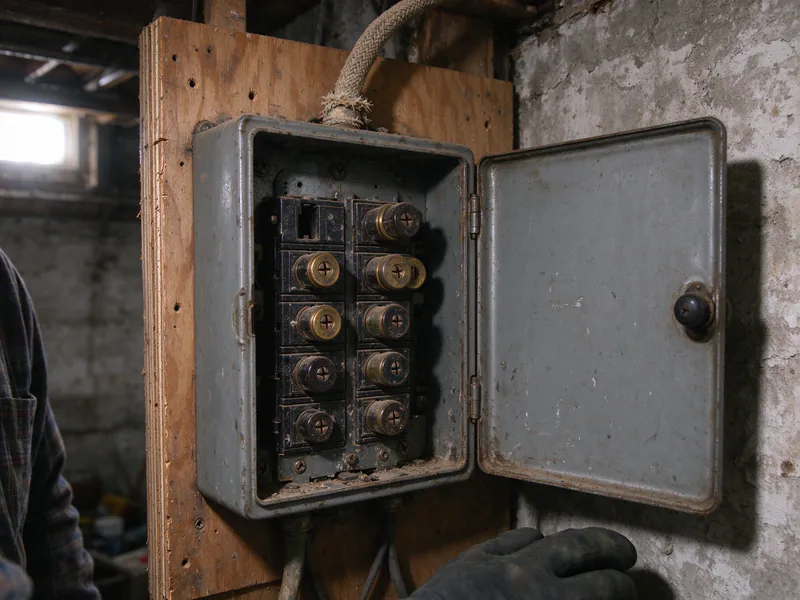
The visit begins at the panel or fuse box, because every circuit in the house starts there, and then works outward to the rooms, the attic and the basement.
From the panel to the last outlet
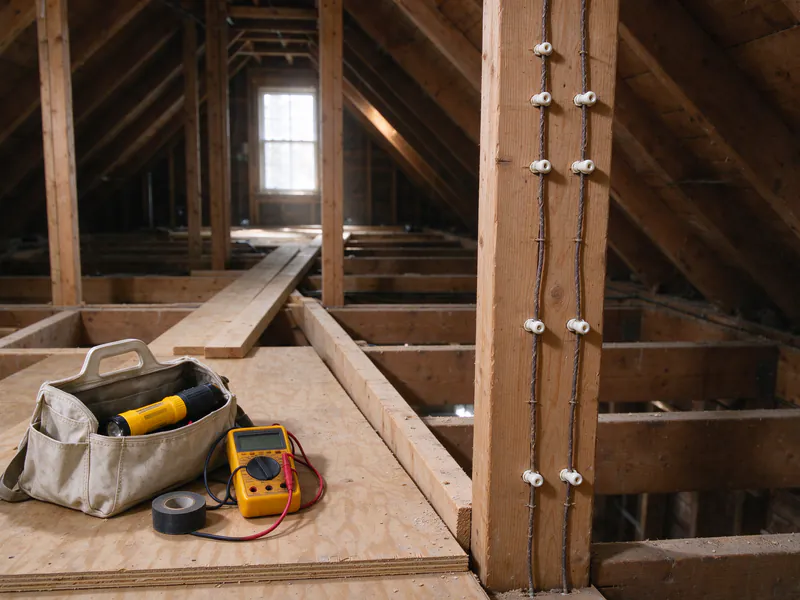
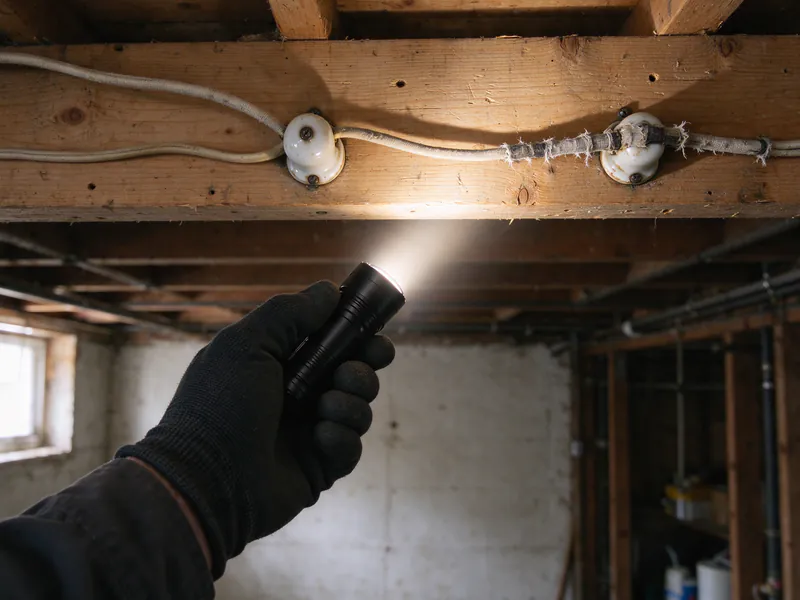
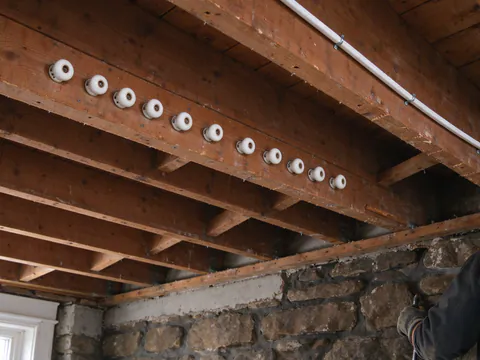
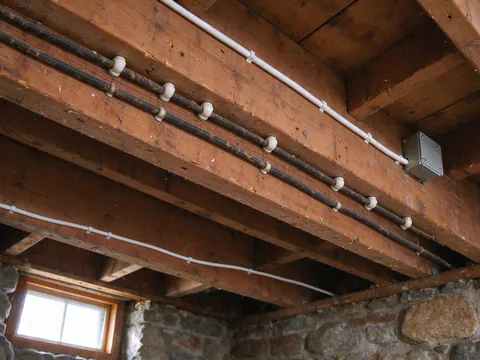
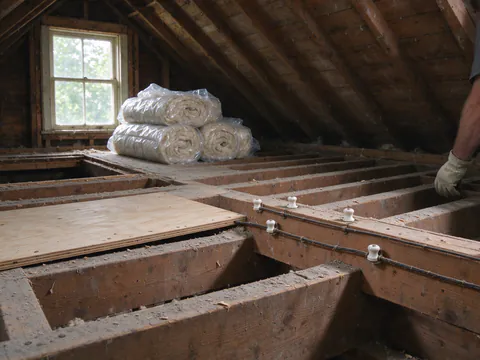
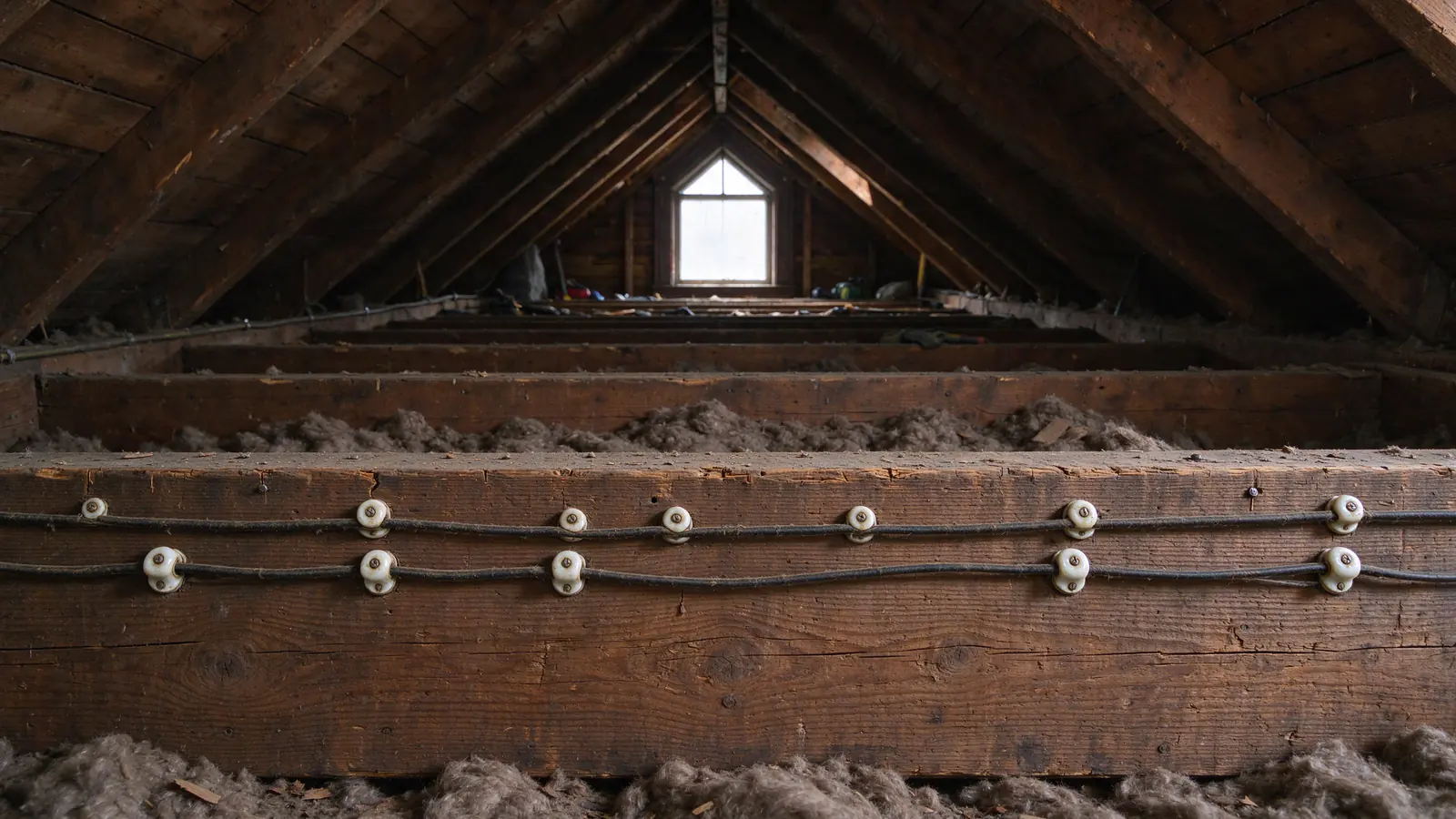
The electrician identifies each fuse or breaker and maps which outlets, lights and switches it feeds. Each circuit is recorded by what it is made of: knob and tube, cloth-sheathed cable from a mid-century update, early armored cable, or later cable. Where an attic floor or a basement ceiling is open, the old runs can be followed by eye from the panel to the point where they disappear into a wall.
What can’t be seen
Plaster walls hide most of a circuit’s length. Good written findings separate what was confirmed from what was inferred, and they list the rooms or cavities that could not be checked. If someone’s decision depends on a concealed run, the report can recommend a small access opening to settle it. That honesty is the point: a report claiming certainty about walls nobody opened isn’t worth much to an insurer or a buyer.
How circuit mapping answers “is my knob and tube live?”
A knob and tube circuit is live when it is connected to a fuse or breaker and carries power, or when a later splice ties it into a newer circuit that does. The second case is the one a quick look misses.
Three results a trace can give
- Active: the old conductors are energized and feed something, often a ceiling light, a bedroom or a switch leg.
- Abandoned: the run is disconnected at its source and nothing else feeds it. It may still sit on its knobs in the attic.
- Mixed: knob and tube and newer cable share a circuit, joined at a splice that may sit in a box or, worse, loose inside a wall.
Why a tester at the outlet isn’t enough
A plug-in tester reports what reaches the outlet, not what’s in the wall behind it. Modern cable at a box can be a short extension spliced onto old conductors upstream, and a run that reads dead in the attic may be dead only because a switch is off. That’s why the trace works in both directions, from the panel out and from the old run back. The guide to telling whether knob and tube is live covers the reasoning in more depth.
What the condition assessment looks for
Once the electrician knows which circuits are knob and tube and which carry power, the question becomes condition, since that decides which circuits can wait and which can’t.
| Finding | Why it matters | What it usually points to |
|---|---|---|
| Cracked or crumbling conductor insulation at knobs, tubes or fixture boxes | Bare copper can arc against framing or the other conductor | Replacing that circuit |
| A fuse or breaker larger than the wire it protects | The wire can overheat before the protection trips | Correcting the protection now, and planning replacement |
| Splices to newer cable buried in a wall or ceiling with no box | A hidden connection, the weak point of a mixed system | Tracing and replacing the mixed circuit |
| Insulation packed around old conductors | The open-air cooling the design depends on is gone | Barrier work before any more insulation |
| Space heaters or window air conditioners on an original bedroom circuit | Old circuits run hot under long, heavy loads | New dedicated circuits |
| Two-prong outlets, or three-prong outlets with nothing behind the ground screw | No fault path for equipment plugged in | A grounding upgrade or circuit replacement |
Keep, monitor or replace
There is no universal rule. A circuit that is dead, or one that is intact, unmodified, correctly fused, clear of insulation and lightly loaded, can sometimes be left in place and recorded. One with damaged insulation, buried splices or insulation over it moves to the top of the list. The guide to whether knob and tube is dangerous explains how those conditions change the risk, and the panel itself is checked for capacity and spare spaces, since every new circuit in a Massachusetts dwelling needs arc-fault protection.
Know which circuits are live before anyone prices a rewire
A traced inspection is the cheapest part of any knob and tube job, and it sets the scope for everything after it.
Which report you need, and who reads it
The same findings serve different readers, and each asks a slightly different question. Say who the report is for when you book, so the written findings answer that question directly.
Insurers
No Massachusetts Division of Insurance rule addresses knob and tube; carriers set their own terms. The state’s FAIR Plan, the Massachusetts Property Insurance Underwriting Association, says its interior review checks that electrical systems are safely arranged. Homeowners report carriers asking, at purchase or renewal, for removal or proof the wiring isn’t in use, sometimes within about 30 days. A letter can state which circuits are active; nobody can promise a carrier’s decision. The Massachusetts insurance guide lists what to ask.
Buyers and sellers
For a buyer, the inspection turns a home inspector’s note into a scope and a budget before the inspection period closes; the buying guide covers timing. For a seller, an inspection before listing gives buyers a defined answer instead of an open question. The selling guide explains the options.
Mass Save
A Home Energy Assessment that finds knob and tube stops insulation until a licensed electrician certifies the work areas are free of active knob and tube. The inspection is often the first half of that job, and the insulation barrier service covers the rest.
Will knob and tube pass inspection?
There is no pass or fail inspection for existing knob and tube in Massachusetts. The local inspector of wires examines new work done under a permit, a home inspector reports what is visible, and insurers and Mass Save each set their own test.
What the state code says
Rule 3 of 527 CMR 12.00 lets new work be added to an existing installation without bringing the rest of it into compliance, provided the new work doesn’t create a violation or make an existing one worse. The state’s interpretation committee has said a service can be replaced without replacing knob and tube circuits. So old wiring isn’t marked as failing simply because it is there. Where new work touches an old circuit, though, the splice point gets the closest look. The guide to whether knob and tube is legal in Massachusetts covers the rule in full.
What sets the price of an inspection
There is no published figure for this visit, because the work behind it varies so much from house to house. These are the things that move it:
- How many dwelling units and meters the building has, since a triple-decker is three systems, not one
- How many circuits leave the panel, and whether it holds fuses or breakers
- Attic, basement and crawl space access, and whether insulation already covers the attic floor
- Whether concealed runs need a small access opening to confirm
- What the report has to satisfy: an insurer’s letter, a buyer’s deadline or a Mass Save certification
If work follows, the inspection’s circuit map becomes the basis of the quote. The Boston cost guide explains how replacement is priced, and the cost estimator gives a range for the work itself without a phone call.