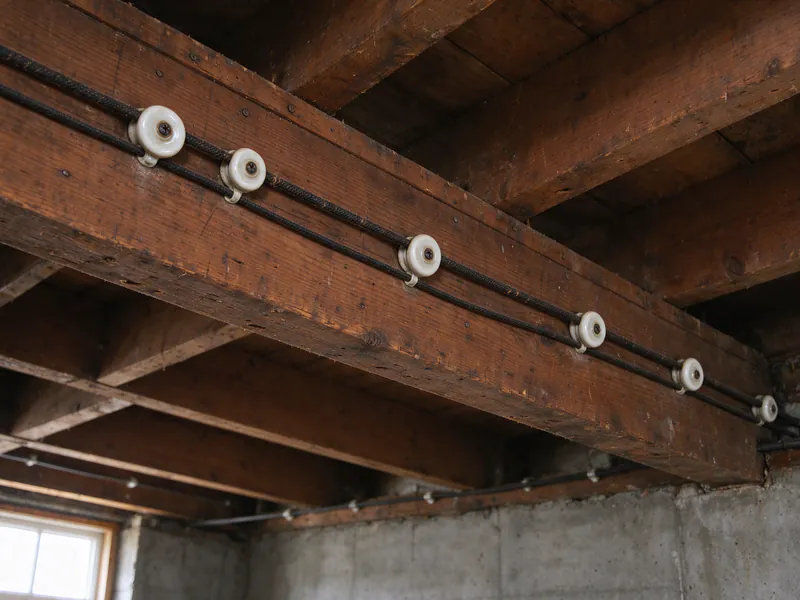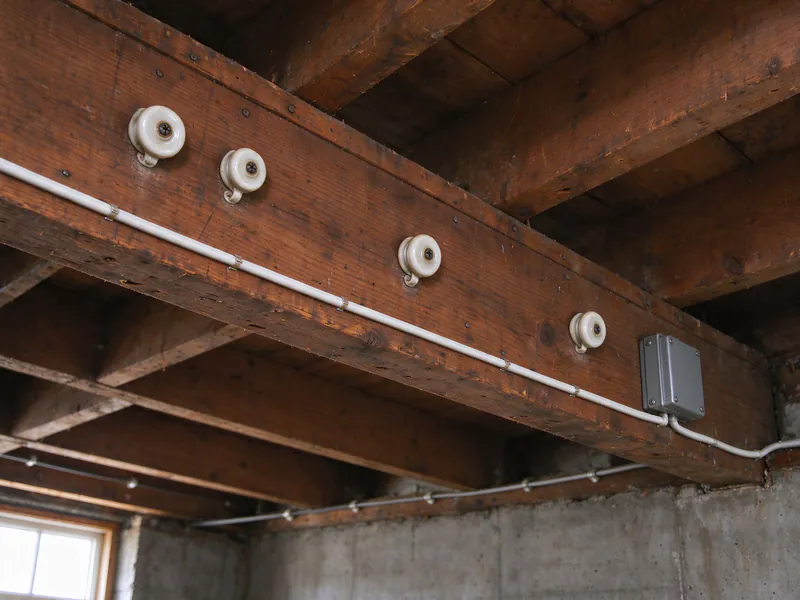
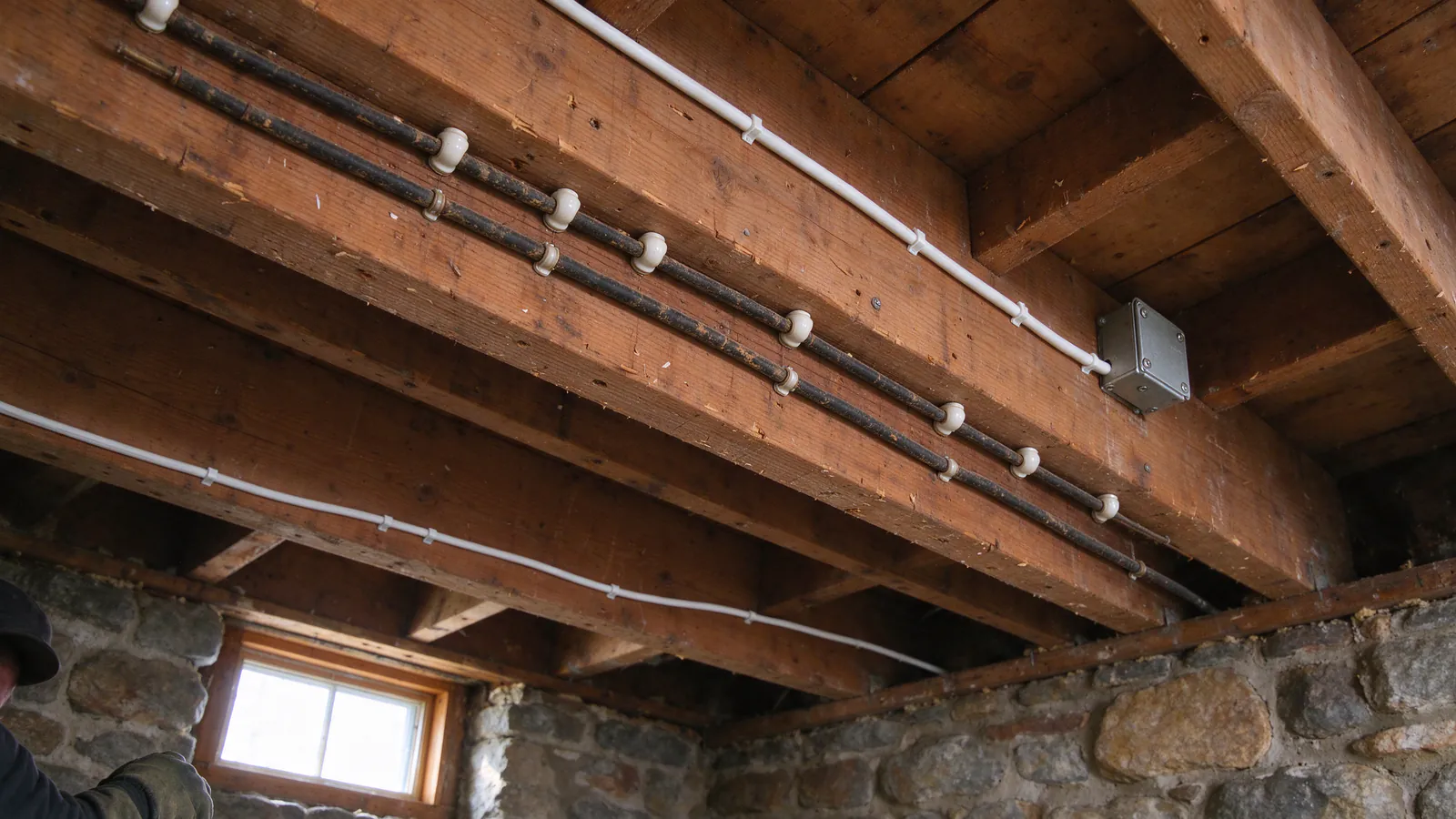
Decker Boston Knob and Tube arranges partial knob and tube replacement across Boston, Cambridge, Somerville and nearby cities, carried out by licensed and insured electricians. A partial replacement takes out the circuits that still run on knob and tube and leaves the wiring that is already modern in place.
It’s the usual scope in a house where earlier owners rewired a kitchen, a bath or a basement and the original system survives in bedrooms, ceiling lights or a single floor. When the old wiring turns out to run through most rooms, a whole house rewire is usually the better plan, because the walls are opened once instead of phase after phase.
What happens on the first visit
The first visit is about finding exactly where the old system stops, because a partial job is defined by that line.
Finding the boundary
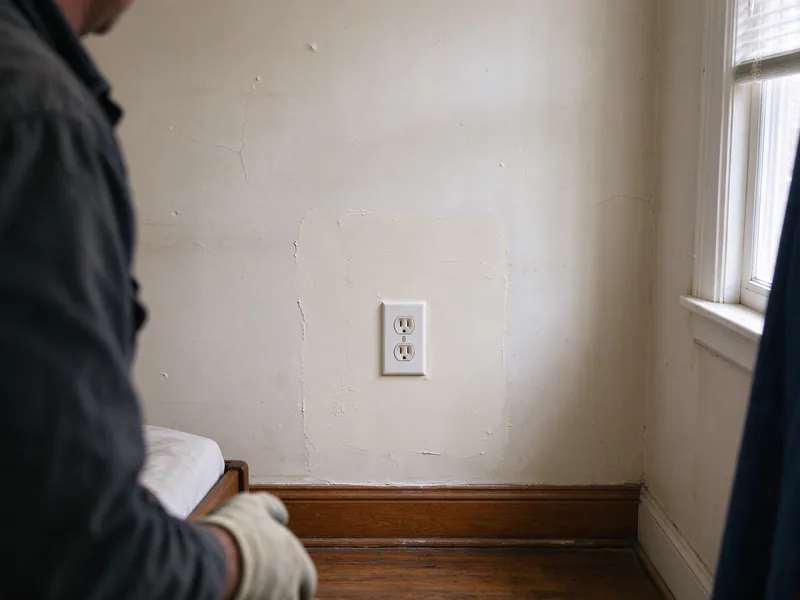
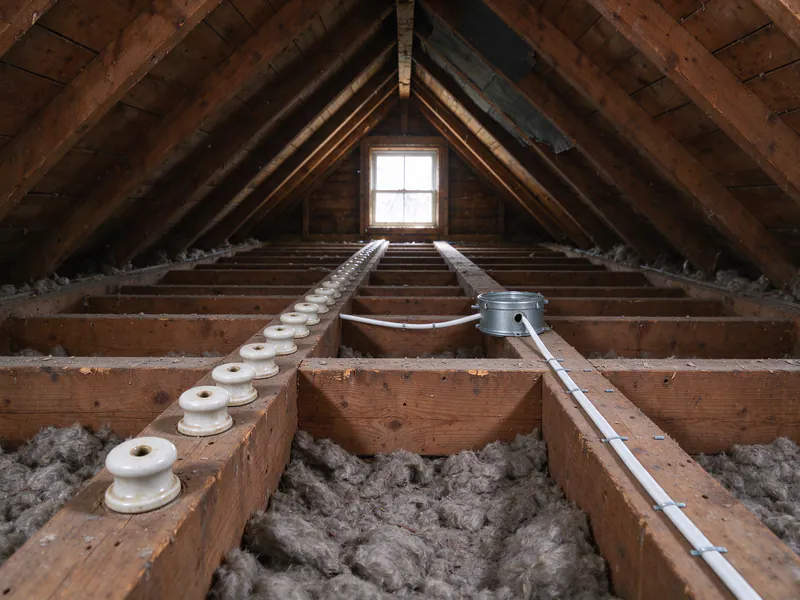
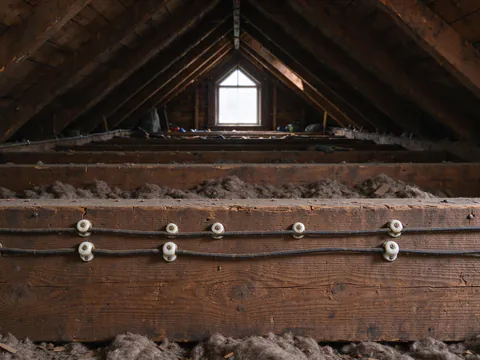
The electrician starts at the panel, traces every circuit and marks each one as knob and tube end to end, mixed, or modern. Then the visit checks attic and basement routes, since remaining knob and tube can hide in ceiling lights fed from the attic, in switch legs, and in rooms that look updated because their outlets were swapped. A three-prong outlet on a bedroom wall says nothing about the wire behind it. The knob and tube inspection page describes the trace itself.
The written boundary
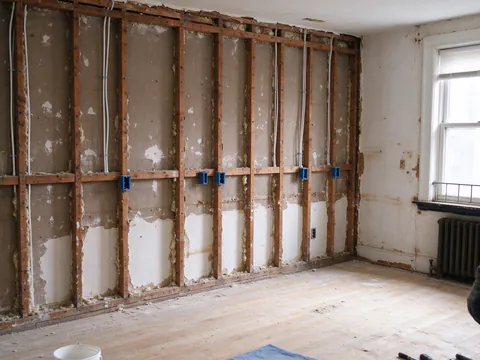
You get a scope that names each circuit to be replaced, each old run to be disconnected and left inside a closed wall, the openings the new routes need, whether the panel has room, and a separate patching line. It also names anything deliberately left for later. That last list is what keeps a partial job honest.
Where partial replacement fits
The state electrical code has no rule that forces working knob and tube out. Rule 3 of 527 CMR 12.00 lets new work be added without bringing the rest of the installation into compliance, so partial replacement is a legitimate scope, not a shortcut, when it’s done circuit by circuit.
What Boston permits show
City permit descriptions show partial scopes written up plainly: a West Roxbury job limited to the outlets and lights still on knob and tube, a Dorchester permit to replace one water-damaged knob and tube circuit on a second floor and add a sub-panel for the new wiring. The Jamaica Plain, Roslindale and West Roxbury page covers the area where Boston’s permit text names knob and tube most often.
When partial holds, and when it doesn’t
Partial tends to hold when:
- the trace finds a short, defined list of old circuits
- the rest of the house is modern cable, not cloth-sheathed or early armored cable
- the panel has room for new arc-fault breakers
It points toward a full rewire when old wiring turns up in most rooms, when cloth cable and knob and tube are spliced together, or when the panel is being replaced anyway. The partial vs full guide weighs the two in detail.
Replacing a circuit end to end
The unit of a partial replacement is the circuit, not the room and not the length of wire you can see in the basement.
Why half a circuit is the risky version
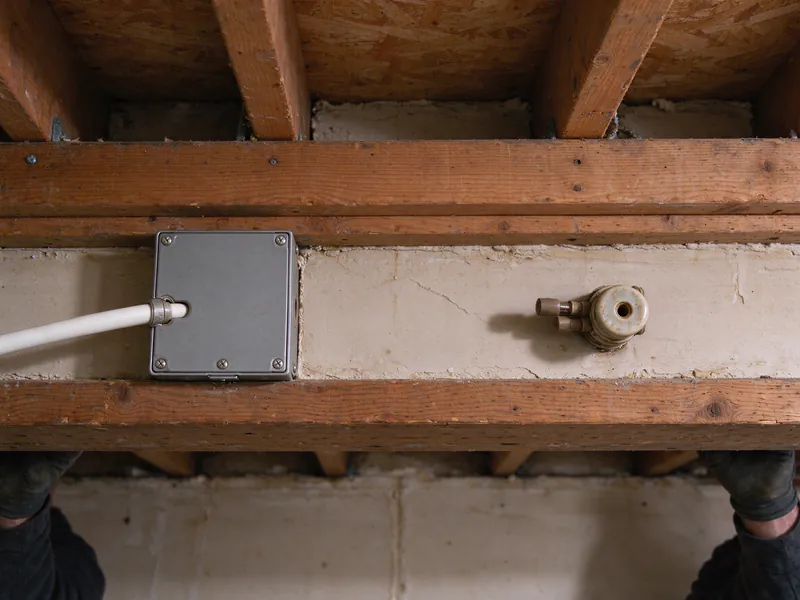
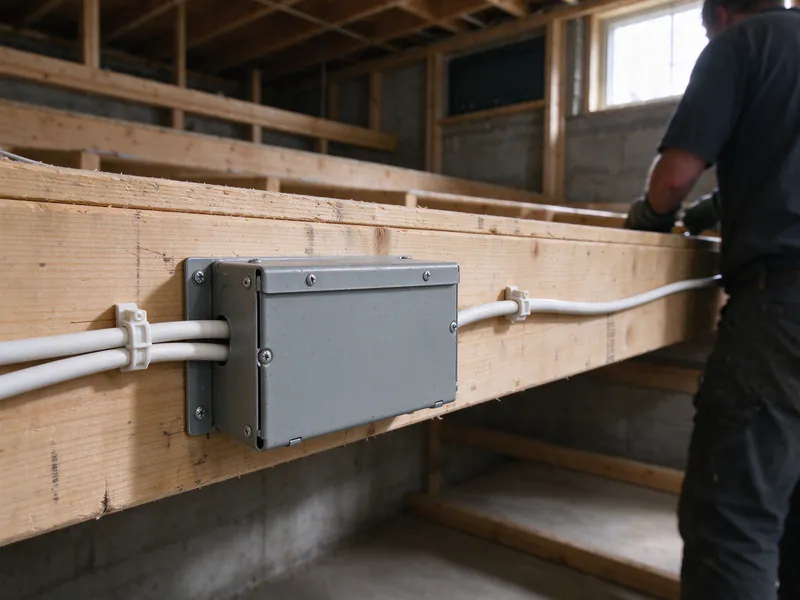
The tempting version replaces only the exposed basement section and joins new cable to old conductors where the run enters a wall. That buries the weakest point of the system, the junction, behind plaster, and leaves live knob and tube upstream that the next owner will assume is gone. A proper partial job runs new cable from the panel to the last device on each circuit, and any junction that must stay sits in an accessible box.
Old wiring mixed with Romex
In a mixed circuit, old knob and tube conductors and modern NM cable (the cable most people call Romex) carry the same circuit, joined wherever a past renovation stopped. Under Rule 3 the change can’t create a violation or make an existing one worse, which is why the splice point gets the closest look. The guide to knob and tube mixed with Romex explains how those circuits are found.
What the new circuits need
Each replaced circuit lands on an arc-fault breaker, because Massachusetts requires that protection on every 120 volt, 10, 15 and 20 amp branch circuit in a dwelling. Receptacles within 6 feet of a sink also need ground-fault protection. If the panel is full or still holds fuses, the panel upgrade page covers what comes next.
Know where the old system ends
A circuit map shows whether two circuits remain or twelve, and the scope follows from it.
Phasing the work
Partial replacement can be split into phases around a budget, a renovation or a household’s schedule, as long as each phase ends cleanly.
What a clean phase end looks like
- No live splice between old and new wiring left buried in a wall or ceiling
- Every replaced circuit labeled at the panel
- A written list of the knob and tube still in service, by room and circuit
- Any junction kept for the next phase inside an accessible box
Permits and timing across phases
In Boston, a licensed contractor files the electrical permit with Inspectional Services before work starts. With no change to the service, ISD’s fee is a $20 application fee plus $1 per fixture, plug or outlet and $5 per meter. Rule 8 lets a permit be treated as abandoned after 12 months without progress, so long gaps between phases usually mean separate permits. New wiring can’t be covered until the inspector of wires has seen it. The Boston permit guide covers the steps.
Lining phases up with other projects
The cheapest phase is the one that coincides with open walls, which is why a kitchen or bath project is a natural first stage; the remodel rewiring page covers that sequence. A Mass Save certification only has to cover the areas where insulation is recommended, so the attic floor and exterior walls can be a phase of their own through the insulation barrier service. In a triple-decker, each floor is often its own phase.
Insurance, sale and the price of a partial job
A partial job answers a narrower question than a full rewire, and the paperwork should say exactly how narrow.
Insurers and buyers
Homeowners report insurers asking whether all of the knob and tube is gone. A partial job can’t truthfully answer yes until its last phase, so give the carrier the written list of what remains rather than a general statement. The same list helps at sale, because a buyer’s electrician starts from a known boundary. The Massachusetts insurance guide explains what to ask the carrier.
What moves the price
There is no reliable published range for partial work. The drivers are the number of circuits still on knob and tube, where they run, attic and basement access, plaster versus drywall, panel space and the number of phases, since each phase carries its own permit and setup. The Boston cost guide explains the parts of a price, and the cost estimator gives a range without a phone call.