
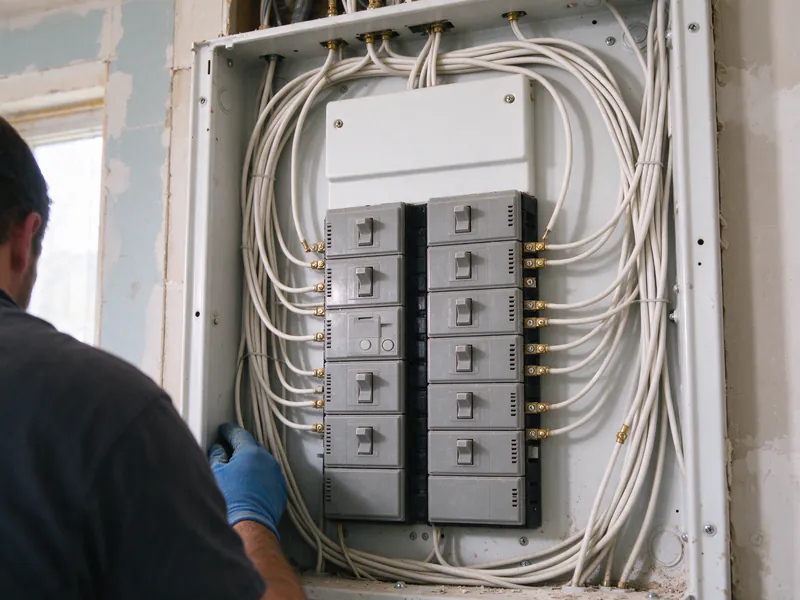
Massachusetts adopted the 2026 edition of the National Electrical Code, with state amendments, as its electrical code: 527 CMR 12.00 applies to every installation permitted after April 24, 2026, replacing the 2023 NEC with Massachusetts amendments. For old wiring, the practical effect is narrow. Knob and tube left alone is not made illegal by the new edition, and the rules that touch it apply only when it is altered, extended or replaced.
Decker Boston Knob and Tube arranges knob and tube replacement across Boston, Cambridge, Somerville and nearby cities, carried out by licensed and insured electricians. This post sets out what the update does, what it doesn’t, and the state amendments that shape a rewire.
What changed
The Board of Fire Prevention Regulations sets the state electrical code, and the Department of Fire Services publishes it. The new text says the Massachusetts Electrical Code “shall be the 2026 National Electrical Code (NEC)”, including the modifications the board made.
The permit date decides the edition
Rule 7 makes the code effective on all installations “for which a permit has been granted subsequent to April 24, 2026”. That means the date the permit is granted decides which edition a job is inspected under, not the age of the house or the day work begins. The code is statewide, so Boston, Cambridge, Somerville and the suburbs all inspect to the same text, through their own local inspectors of wires (Boston permit guide).
What the update doesn’t do
Nothing in the adoption orders existing wiring out of houses. Rule 3 says additions or modifications are made to the current code “without bringing the remaining part of the installation into compliance”, provided the new work creates no violation and doesn’t make an existing one worse.
The fuse box question
The board’s Interpretation Committee has answered that, under Rule 3, a service with knob and tube circuits can be replaced without replacing those circuits, and that solar can be added to such a service as long as the new circuits aren’t attached to the old ones. That letter dates from the previous edition, so treat it as the board’s reading rather than a promise for every job. The panel upgrade guide explains why a new panel still leaves old branch wiring in place.
The state amendments that shape a rewire
A rewire is new work, so it meets the current rules in full. These are the Massachusetts provisions that most often change the plan in an older house.
| Provision in 527 CMR 12.00 | What it means for replacing knob and tube |
|---|---|
| 210.12(B), arc-fault protection | All 120 volt, 10, 15 and 20 amp branch circuits supplying outlets or devices in dwelling units need arc-fault protection, which sets the breaker count and can decide the panel |
| 210.8, ground-fault protection | Receptacles within 6 feet of a sink, or inside a cabinet supporting one, need ground-fault protection |
| 334.17 exception | Cable can be fished between access points for concealed work in finished buildings, which is what makes a plaster-preserving rewire possible |
| 334.30 | Cable run diagonally behind strapping about three-quarters of an inch thick counts as supported, if it isn’t pulled taut |
| 334.10 | In buildings over three stories, cable circuits may not leave the floor or dwelling unit they start from |
| 210.25(B) exception | In an existing three-family building, common-area lighting on a floor may be fed from equipment supplying a unit on that floor |
| 230.70 | The state limits the NEC’s outdoor emergency disconnect rule to one- and two-family dwellings and certain new two-unit buildings, and excepts jobs that replace only meter sockets, service-entrance conductors, main breakers or related raceways |
Grounding shortcuts
The state text also deletes NEC 250.130(C), the subsection the NEC uses for grounding connections when nongrounding receptacles are replaced or a branch circuit is extended. How that applies to a particular old circuit is a question for the inspector of wires before anyone plans around it (ungrounded outlet upgrade).
Knob and tube itself
The amendments leave the NEC article on concealed knob and tube wiring, Article 394, as published. The state hasn’t added its own version. The legal guide covers what that means for a house that keeps some.
Which rules apply to your rewire?
The scope, the permit date and the building decide it. Tracing the circuits is where that starts.
What stays the same
The rhythm of a permitted job hasn’t changed. A licensed electrician files the permit, notifies the inspector of wires, and calls for inspection when the work is ready.
- Before walls close. Wiring can’t be concealed until inspected, within 72 hours of notice, weekends and holidays excluded (Rule 10).
- Stalled permits. A permit can be deemed abandoned if work hasn’t started or progressed within 12 months (Rule 8).
- Notice by law. Under M.G.L. c.143, §3L, anyone installing wiring for hire gives notice to the inspector of wires, and the installer notifies on completion.
- In Boston. Inspectional Services requires a licensed contractor to apply for the permit; a homeowner can’t.
What this post doesn’t claim
It doesn’t list the technical changes in the 2026 NEC. The NFPA publishes those, and how they touch a house depends on the scope and on the state’s amendments. Be cautious with any claim that the new edition bans knob and tube or forces replacement at sale; neither follows from the adoption. Insurers set their own terms, separately from the code (insurance guide).
What to do with this
Plan the scope first and let the permit date fall where it falls. Ask the electrician which edition applies to your permit and have it written into the scope. The AFCI and GFCI guide explains the protection rules in plain terms, and the cost guide shows how they feed the price. If the first question is still what in the house is live, start with an inspection, or call Decker Boston Knob and Tube at (617) 405-3599.