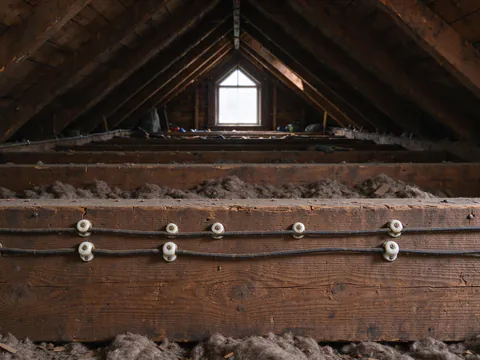
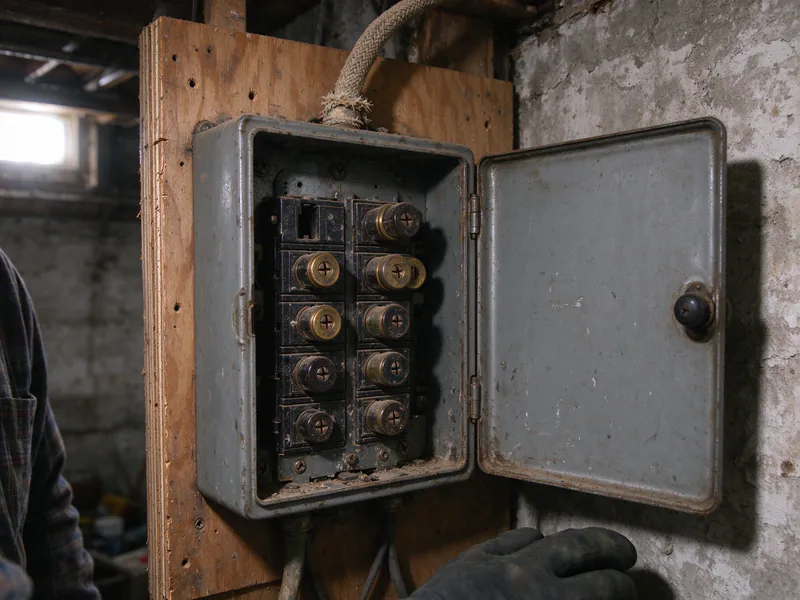
Yes. Existing knob and tube wiring is legal to keep in service in Massachusetts. Under the state electrical code, 527 CMR 12.00, an installation can be added to or altered while the untouched parts stay as they are, provided the change introduces no new violation and doesn’t deepen one already there. Decker Boston Knob and Tube arranges knob and tube assessment and replacement in Boston-area homes, carried out by licensed and insured electricians who pull the permits.
“Legal” here answers three separate questions: can the old wiring stay, what happens when someone works on it, and who is allowed to do that work. The sections below take them in turn, then explain why insurers and Mass Save often matter more than the code.
Which code applies in Massachusetts
The Board of Fire Prevention Regulations publishes the Massachusetts Electrical Code as 527 CMR 12.00. It adopts the 2026 National Electrical Code, with Massachusetts modifications, and applies to installations whose permit was granted after April 24, 2026. The previous edition was built on the 2023 national code.
The national code has an article dedicated to concealed knob and tube. Massachusetts made no amendment to it, so that article applies here as published nationally.
Can existing knob and tube stay?
Rule 3 is the clause that settles it. Its text says additions or modifications are made under the current code “without bringing the remaining part of the installation into compliance,” and that the installation “shall not create a violation of this Code, nor shall it increase the magnitude of an existing violation.”
What that means in a house
- Original circuits that are working may stay in service.
- The code does not set a date by which knob and tube must go.
- New circuits, devices and equipment have to meet today’s rules.
- Work that leans on the old wiring is judged by whether it makes things worse.
The service replacement ruling
In August 2023, under the previous edition, the state’s interpretation committee answered two questions about Rule 3. An electrician who swaps out a service feeding knob and tube circuits may leave those circuits in place, and a solar array may connect to that service too, even with old wiring in poor shape, provided the solar circuits don’t tie into it. The same Rule 3 wording sits in the current edition. The panel upgrade guide explains why a new panel and a rewire are separate jobs.
What new work has to meet
Replacing knob and tube means installing new circuits, and those follow the current code in full. A few Massachusetts provisions shape the work most.
| Requirement | What it says | Effect on a rewire |
|---|---|---|
| Arc-fault protection | Every 120 volt, 10, 15 and 20 amp branch circuit supplying outlets or devices in a dwelling unit needs it | Each replacement circuit needs an arc-fault breaker or another listed means, which affects panel space (AFCI and GFCI) |
| Ground-fault protection | Receptacles within 6 feet of the top inside edge of a sink bowl, or in a cabinet supporting a sink | Kitchen and bath outlets near sinks get GFCI protection |
| Grounding retrofits | Massachusetts deleted the national subsection on equipment-grounding options when non-grounding receptacles are replaced | How that affects a given old circuit is a question for the inspector, not a shortcut to assume (ungrounded outlets) |
| Cable in finished walls | Cable may be fished between access points where supporting it is impractical | Much of a rewire can run through existing cavities (plaster wall rewiring) |
| Taller buildings | Above three stories, a nonmetallic-cable circuit has to stay on the floor or in the unit it begins in | Big masonry rowhouses and apartment blocks may call for conduit or armored cable |
| Inspection before covering | Work can’t be concealed until the inspector of wires sees it, within 72 hours of notice for interior work, weekends and holidays excluded | Walls stay open until the rough-in passes (Rule 10) |
The state also left the national code’s arc-fault provision for modified, replaced or extended branch circuits unchanged, so that national text governs work that extends an old circuit.
Who may work on it
Massachusetts treats wiring as licensed work, and the rules are specific about who files and who is responsible.
- Licensing: under M.G.L. c. 141, § 1A, installing wires for light, heat or power as a business requires a license from the Board of State Examiners of Electricians.
- Notice to the inspector: M.G.L. c. 143, § 3L requires anyone installing wiring for hire to notify the local inspector of wires before starting or within five days after, with a fine of up to $500. The installer reports completion, and the inspector approves or disapproves in writing within five days.
- Boston: Inspectional Services accepts electrical permit applications only from licensed contractors, and tells homeowners to hire one for both the filing and the work (Boston permit guide).
- Nearby cities: Somerville’s inspectional services likewise reserves electrical permits for licensed electricians, and Cambridge, Medford and the rest each keep their own wire office.
Code, insurers and Mass Save are three different authorities
Owners often hear “it has to come out” and assume the code said so. Usually it didn’t.
| Authority | What it can require | Basis |
|---|---|---|
| State electrical code | New work done to current rules, without creating or worsening a violation | 527 CMR 12.00 |
| Insurance carrier | Removal, proof the wiring isn’t live, or a deadline, as a condition of coverage | The carrier’s own underwriting (insurance guide) |
| Mass Save | No insulation where knob and tube is present until a licensed electrician addresses it and certifies the work areas | Mass Save’s assessment standards (insulation barrier) |
When legal still isn’t the end of it
The code describes what is allowed, not what is wise for a particular circuit. Rule 3 protects working wiring; it doesn’t certify that a cracked, overfused or buried-splice run is safe. The danger guide covers which conditions turn old wiring into a hazard, and an inspection shows which ones a house has.
For a reading of how these rules apply to your own circuits and project, phone Decker Boston Knob and Tube on (617) 405-3599 or request an estimate.