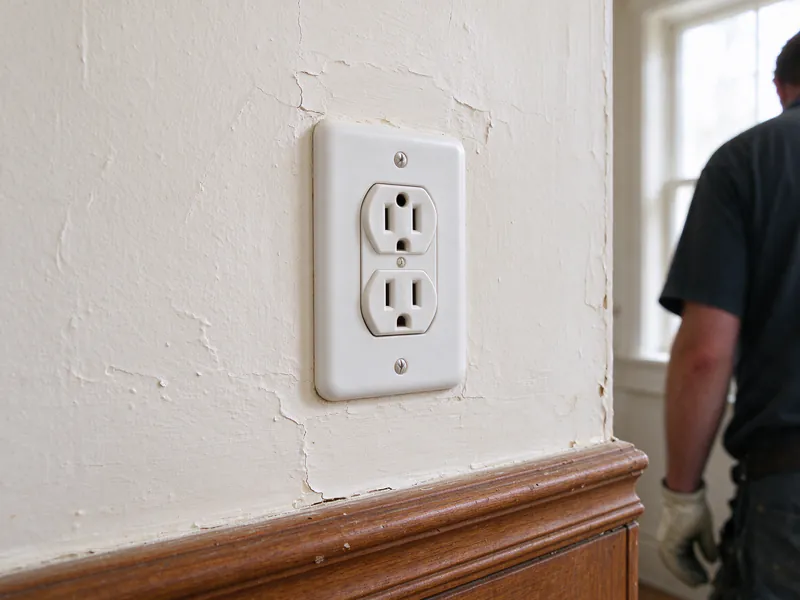
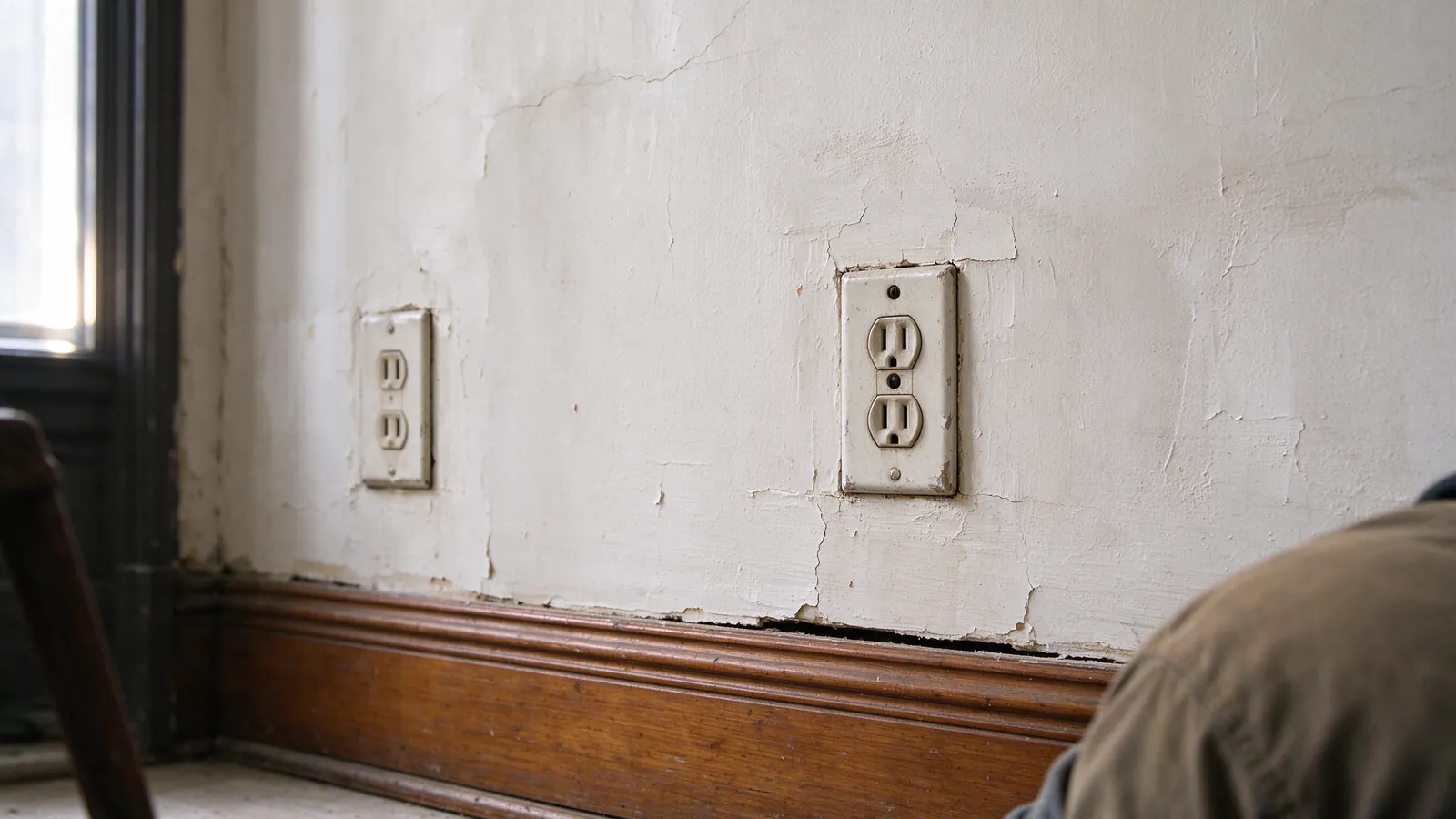
Decker Boston Knob and Tube arranges ungrounded outlet fixes across Boston and nearby cities, carried out by licensed and insured electricians who test what is behind each outlet before deciding what to change. A two-prong outlet, or a three-prong outlet with nothing on its ground screw, is a sign the circuit has no equipment grounding conductor.
In a pre-war house that usually means knob and tube or early two-wire cable. The right fix depends on which, because a device change fixes some circuits and only a new circuit fixes others. Where the circuits turn out to be knob and tube, the job becomes a partial knob and tube replacement.
What happens on the first visit
The first visit sorts outlets into groups by circuit. Testing a few outlets tells you little; knowing which circuit each one is on, and what that circuit is made of, tells you what the fix will be.
At the outlet
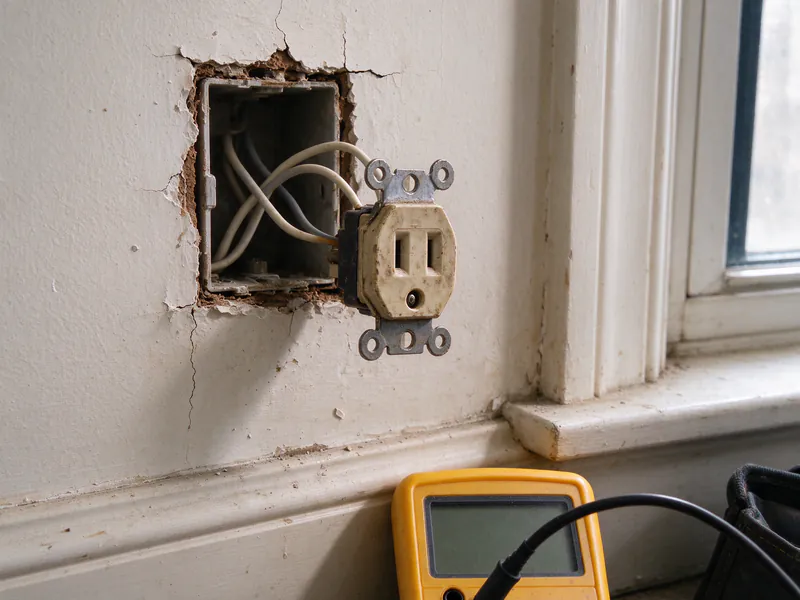
The electrician tests each suspect outlet, then removes the cover and looks. Is there a ground wire in the box at all? Is it connected? Is there a jumper from the neutral terminal to the ground screw? Is the box metal, and if so, is it connected to anything? Old boxes are often too shallow for a modern device with a ground, which matters when the fix is a new receptacle.
At the panel and the service
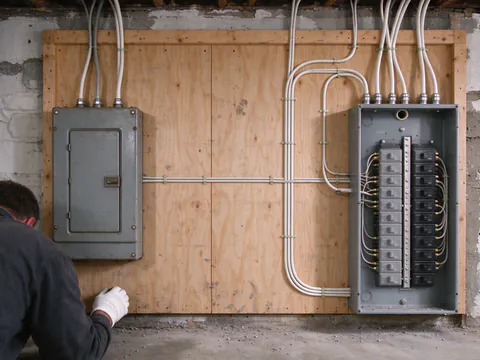
Then the circuits are traced back. The panel shows which circuits have grounding conductors and which don’t, and the service shows how the whole system is grounded: the grounding electrode connection, the bonding of the water and gas piping, and the main bonding inside the panel. A circuit can only be as well grounded as the service it comes from, so this check happens even when the problem looked like one outlet. The knob and tube inspection covers the tracing in more detail.
What you get back
You get a list of outlets by circuit, what each circuit is made of, and a recommended fix for each one, with the circuits that need replacing separated from the ones that can be dealt with at the box.
Why old outlets have no ground
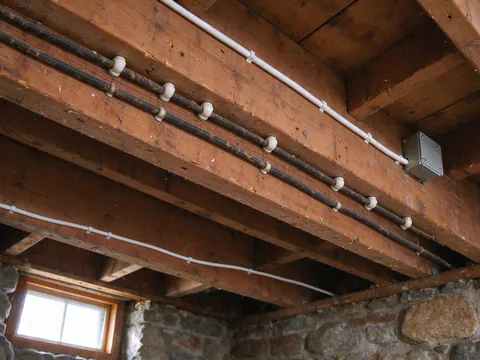
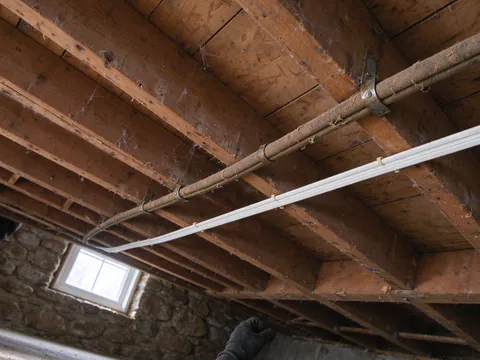
Knob and tube carries two conductors, a hot and a neutral, on separate porcelain supports. There is no third wire, because the system was designed before equipment grounding was part of house wiring. It was built that way, so the missing ground isn’t damage, and on its own it doesn’t show that a circuit is failing. The guide to identifying knob and tube shows what it looks like.
Later wiring did not always fix it. Early cloth-sheathed cable may have only two conductors, and early armored cable may rely on its spiral metal jacket as the only ground path, which is an unreliable one. The cloth wiring replacement page covers both.
What a ground actually does
An equipment grounding conductor gives fault current a low-resistance path back to the panel. If a hot wire touches the metal case of a toaster, a lamp or a washing machine, current rushes down that path and trips the breaker in a fraction of a second. Without it, the case can stay energized until someone touches it and becomes the path instead. That is the shock concern behind ungrounded circuits.
Why a three-prong outlet proves nothing
Where an owner swapped two-prong outlets for three-prong ones so modern plugs would fit, the cover looks current but the ground hole leads nowhere. The shape of the face tells you which plugs fit and nothing more: not whether a grounding conductor reaches the box, not whether the run is later cable or knob and tube, and not whether a jumper is fooling the tester. The mixed wiring guide explains how new outlets end up on old circuits.
How each kind of circuit gets fixed
The fix follows the circuit, not the outlet. Three cases cover most houses.
Knob and tube circuits: replace the circuit
Knob and tube has no grounding means anywhere along the run, and Massachusetts deletes NEC 250.130(C), the subsection that sets out ways of retrofitting a ground connection for existing outlets. Giving those outlets a real ground therefore means running new grounded cable from the panel, which is a circuit replacement. Since the openings are being made anyway, it is usually the moment to replace the rest of that circuit’s knob and tube too.
Sound later two-wire cable: ground-fault protection or new cable
Where the circuit is later two-wire cable in good condition, the options widen. A new grounded cable gives a true ground. Ground-fault protection at the first outlet or the breaker cuts power when current leaks to ground, which protects people without supplying a ground for equipment. Because of the Massachusetts deletion of 250.130(C), any keep-and-protect plan is confirmed with the inspector before work starts. The GFCI and AFCI guide explains what each device does on old circuits.
Kitchens, baths and appliance circuits
Some locations need ground-fault protection regardless. Massachusetts requires it for receptacles within six feet of the top inside edge of a sink bowl, or inside a cabinet supporting a sink. It also adds a condition to the code section that lets older range and dryer circuits keep using the neutral in place of a separate ground: such a circuit must have GFCI protection. New receptacles must be tamper-resistant under NEC 406.12, which Massachusetts leaves unchanged.
Two-prong outlets throughout the house?
Start with which circuits they are on. That tells you whether the fix is a device or a rewire.
Grounding and bonding at the service
Sometimes the problem starts upstream. A house rewired in stages may have a service whose grounding was never brought up to the equipment it now feeds: a ground connection to a water pipe that was later replaced with plastic, a missing bonding jumper around the water meter, or gas piping that was never bonded. Those are checked at the first visit and corrected as part of the job where they fall short. Fixing outlets without fixing the service leaves every circuit with a weaker ground than it appears to have.
If the panel itself is the issue, the fuse box and panel upgrade page covers it. A new panel improves the service end of the ground path, but it adds no ground wire to old branch circuits.
Insurance, Mass Save and price
An outlet-level fix and a circuit replacement can look the same on the wall plate, but they read differently on paper.
What insurers and Mass Save see
Ungrounded outlets often appear on the same home inspection report that mentions knob and tube, and insurers ask about both. A ground-fault outlet on a knob and tube circuit adds protection but leaves the old wiring in service, so it doesn’t settle an insurer’s request or a Mass Save insulation barrier. Replacing the circuit does, and the written summary should say which outlets are now on grounded circuits.
What sets the price
The price follows what the circuits are made of and how many there are. There is no single figure because outlets on sound later cable can sometimes be handled box by box, while outlets on knob and tube mean fishing new cable. When the job grows into a rewire, a typical Boston-area budgeting range for a whole house is $8,000 to $25,000 or more. The signs your house needs rewiring guide helps decide which way it is heading, the danger guide puts the risk in proportion, and the cost estimator gives a starting range.