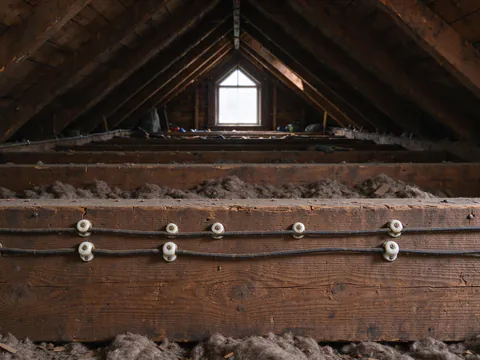

Yes, many Massachusetts houses with knob and tube carry insurance, but on each carrier’s own terms, and some carriers won’t write them at all until the wiring is dealt with. No state law or Division of Insurance rule sets a removal deadline. Decker Boston Knob and Tube arranges knob and tube assessments and replacement for Boston-area owners through licensed and insured electricians, including the written findings insurers tend to ask for.
What follows explains why underwriters ask, what owners have run into, where the state’s FAIR Plan fits, and which records give an agent something concrete to work with. Nothing here can promise how a particular carrier will decide.
Why insurers ask about old wiring
An underwriter prices risk it can’t inspect. Knob and tube tells the carrier the circuits are old, ungrounded and probably on fuses, and that decades of renovations may have spliced new cable into them somewhere out of sight. The carrier has no way to tell an untouched attic run from a buried, overheating splice, so it treats the whole system as uncertain.
That uncertainty is the thing to reduce. A carrier that hears “knob and tube” has a question; a carrier that receives a circuit-by-circuit report has an answer, even if the answer is that work is still to come.
The code isn’t what forces it
Massachusetts’ electrical code, 527 CMR 12.00, allows changes to an existing installation without bringing the rest of it up to current rules, so working knob and tube can legally remain. The legal status guide covers that in detail. An insurer is a private company, though, and can decline risks the law permits.
What Massachusetts homeowners report
These are owner accounts, not published carrier rules, and they vary from company to company and year to year.
- Being asked about knob and tube and fuse panels on the application for a new policy, especially after a purchase.
- A carrier writing the policy, then giving a short window to remove the wiring or prove it isn’t live; reported windows run from about 10 days to 30 or 60 days.
- A renewal notice saying the policy won’t continue unless the wiring is gone.
- Other carriers agreeing to cover the house at a higher price.
- Turning to the FAIR Plan after standard carriers declined.
The common thread is time pressure right after closing or before a renewal date. Planning for it before you need it is the best protection.
Where the FAIR Plan fits
The Massachusetts Property Insurance Underwriting Association runs the state’s FAIR Plan, the market of last resort for property owners who can’t get coverage elsewhere. It sends an inspector before it writes a policy. Its published description of the inspection says the interior review checks that electrical, heating and plumbing systems are safely arranged, and an older inspection pamphlet lists wiring among the items examined.
Homeowners report the FAIR Plan writing houses that standard carriers turned down, and in some cases setting a deadline to fix items its inspector noted. Treat it as a bridge while work is planned, not a permanent answer to the wiring.
The records that answer the question
Different moments call for different paperwork. Each document below does a specific job with an agent or underwriter.
| Document | What it tells the insurer | When you need it |
|---|---|---|
| Written inspection findings | Which circuits are knob and tube, which are live, the condition of reachable runs, and what couldn’t be seen | At purchase, at a renewal question, or before deciding scope (inspection service) |
| Signed scope and schedule | That replacement is contracted, what it covers and when it will be done | When a carrier gives a deadline you can’t meet with finished work |
| Closed permit | That a licensed electrician did the work and the inspector of wires approved it | After the job |
| Labeled panel schedule | Which breaker feeds which rooms on the new wiring | After the job |
| Completion summary | A plain statement that no knob and tube remains in service, or exactly where some still does | After the job, or after each phase of a staged one |
What the completion record covers
When the work is finished, the house should have a labeled panel schedule and a short written summary stating that no knob and tube is left in service, alongside the permit the licensed electrician pulled and closed. Massachusetts law has the installer notify the inspector of wires when the work is done, and the inspector issues written approval or disapproval within five days.
Buying and renewing are different clocks
At purchase
The weak point is the gap between your inspection contingency and closing. Ask for a binding insurance quote that names the wiring before the contingency expires, and have an electrician trace circuits in the same window. The buying guide covers the sequence, including how the findings feed a price negotiation.
At renewal
A renewal letter usually gives more notice than a new policy does, but the work still needs a scope, a permit and an inspection before walls close. If the deadline is tight, a signed contract with a start date may be the first thing to send, followed by the completion records.
Partial work and honest answers
A carrier asking “is there any knob and tube?” deserves a precise answer. After a partial replacement, the right answer names the circuits that remain. Abandoned runs left in the walls are different from live ones, and the record should say they were proven dead, not assumed dead (how live wiring gets verified).
Overstating the work is risky in its own right. If a carrier was told everything was removed and a later loss points to a live old circuit, the mismatch could give the carrier grounds to question the claim. A written boundary of what remains keeps the record and the house in agreement.
When Mass Save and insurance ask the same question
A Mass Save Home Energy Assessment often surfaces the wiring at the same time an insurer does. The two ask slightly different things: Mass Save wants a licensed electrician’s sign-off covering only the spaces scheduled for insulation or air sealing, while an insurer usually asks about the whole house. One assessment can serve both if it is written area by area. The insulation barrier service explains the Mass Save side.
A sensible order of steps
- Get the wiring traced and the findings in writing.
- Share the findings with your agent and ask what the carrier needs, and by when.
- Decide between partial and whole house rewiring with the carrier’s answer in hand.
- Keep every document from the job in one place for the next renewal and the next sale.
For a traced circuit map and a report written for your agent, reach Decker Boston Knob and Tube at (617) 405-3599, or send the details online. The danger guide explains the conditions an underwriter is really worried about.