
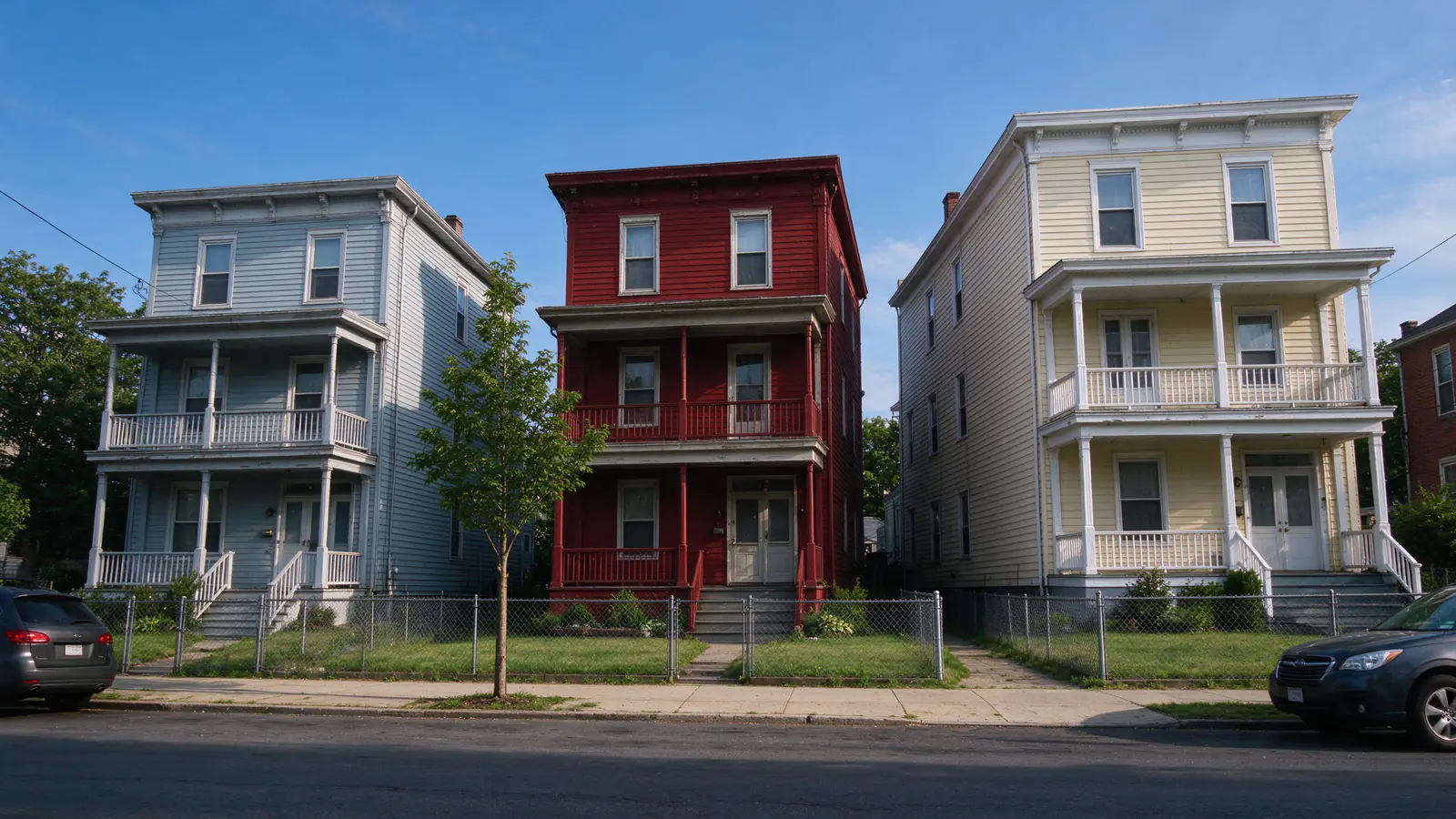
Replacing the knob and tube in a whole house falls in a typical Boston-area budgeting range of $8,000 to $25,000 or more, and larger, plaster-heavy or service-upgrade jobs can run well past it. Decker Boston Knob and Tube arranges knob and tube inspection and replacement across Boston and nearby cities, carried out by licensed and insured electrical contractors. This guide breaks that budget into its parts, so you can see which ones are fixed by public rules and which depend on your house.
The range is a planning figure, not a quote or a company rate. Where a house lands in it depends on how many original circuits are still live, how the new cable can reach each room, and what happens to the walls afterward.
Typical Boston-area ranges
Two kinds of work have a published budgeting range. The rest is priced from the circuit map, because the jobs vary too much for one figure to mean anything.
| Work | Budgeting figure | What it usually covers |
|---|---|---|
| Whole-house knob and tube replacement | $8,000 to $25,000 or more (typical Boston-area range) | New cable, boxes and devices for the active knob and tube circuits in one house or building, with the protection the code now requires |
| Panel or service upgrade alongside the rewire | $3,000 to $6,500 (typical Massachusetts range) | A fuse box or small service replaced with a 200 amp breaker panel plus service work; a panel-only swap costs less, and utility charges are separate |
| Partial replacement | Priced from the circuit map | The circuits left after earlier updates, or one floor or one unit at a time |
| Inspection and written findings | Priced from the house | Circuit tracing and a written report for an insurer, a buyer or a Mass Save certification |
| Plaster and paint restoration | Priced from the access plan | Closing the openings to the finish agreed in writing |
| Boston electrical permit | Boston ISD formula (see below) | Application fee plus device, meter or service charges |
Why the whole-house range is so wide
A one-and-a-half-story house with an open basement, a walkable attic and only a few live circuits left sits near the floor, and may really be a partial job. A three-story house still running mostly on original circuits, with plaster on every floor and little attic access, sits near the top or past it.
Most published whole-house figures leave out plaster restoration and service upgrades. That’s why those two items get their own rows and their own conversation in any quote.
What sets the price
The price follows a few physical facts about the house. Each factor below connects to a decision the electrician makes while planning the routes.
| Factor | Why it moves the price | What to know around Boston |
|---|---|---|
| Active circuit count | Each live circuit is a run to replace and a set of devices to rewire; house size matters mostly through this count | Mass Save asks for certification that the areas being insulated are free of active knob and tube (insulation barrier work), so the count is often set area by area |
| Stories and layout | Each closed floor adds fishing time and openings | Boston has 23.5% of its housing units in three- and four-unit buildings, many of them triple-deckers with three stacked units (U.S. Census Bureau) |
| Attic and basement access | Open joists above and below let cable drop or rise into walls with few openings | A finished basement or a floored attic removes the easy paths |
| Plaster versus drywall | Plaster and lath takes more care to open and more skill to close (plaster wall rewiring) | 46.7% of Boston housing was built before 1940, and no public figure says how much of it keeps original plaster |
| Panel and service capacity | A full or undersized panel may not take the new circuits | In Cambridge, 41 of 155 electrical permits that name knob and tube also mention a service or panel (City of Cambridge open data) |
| New circuits and devices | A rewire is the cheapest time to add outlets and split crowded circuits, and each one adds material and labor | Every new circuit carries arc-fault protection under the state code (see the next table) |
| Patching and painting | Size and number of openings, and the finish expected | Larger openings in pre-1978 houses fall under lead-safe renovation rules |
| Insulation and attic contents | Loose fill over old wiring has to be moved or worked around, and Mass Save treats vermiculite, like knob and tube, as a barrier to insulation | Vermiculite can add its own remediation step (asbestos and lead paint guide) |
| Occupied-home protection | Living in the house during the work means dust control, daily cleanup and planned power-off windows | Boston averages 91.6 days a year with a low at or below freezing (NOAA), so winter work keeps the heating system’s power up |
| Historic finishes and districts | Original trim and decorative plaster need slower, smaller openings | In the Back Bay district, electrical service equipment is subject to commission review and can’t go on a primary elevation (historic district guide) |
| Extent uncertainty | Concealed splices and runs only show up once tracing starts | Homeowners report finding old circuits still spliced into newer wiring in houses that had been mostly rewired (knob and tube mixed with newer cable) |
What’s inside a Boston knob and tube replacement price
A contractor’s price bundles labor, materials, permits and overhead into one number. Several of those parts have public figures you can check yourself; others have none and need to be written into the scope.
| Part of the price | What sets it | Local figure |
|---|---|---|
| Electrician labor | Local wages, hours on site, crew size | Electricians in the Boston-Cambridge-Newton metro earn a mean $40.08 an hour, about 17% above the $34.37 national mean; the median is $38.42 against $30.38 nationally (U.S. Bureau of Labor Statistics) |
| Code-required protection | Arc-fault protection, ground-fault protection near water, tamper-resistant receptacles | Massachusetts requires arc-fault protection on all 120-volt 15 and 20 amp branch circuits supplying outlets or devices in dwelling units, and ground-fault protection within 6 feet of a sink and inside sink cabinets (527 CMR 12.00) |
| Permit | Device count, meters, service size | Boston ISD: $20 application fee plus $1 per fixture, plug or outlet and $5 per approved meter, or $0.25 per amp for a new or upgraded service up to 240 volts; fees due upfront, and starting work before the permit is issued can mean double the cost (Boston Inspectional Services) |
| Inspection timing | Walls stay open until the inspector of wires sees the rough-in | New wiring can’t be covered until inspected, within 72 hours of notice, weekends and holidays excluded (527 CMR 12.00, Rule 10) |
| Lead-safe work | Size of openings in painted plaster in a house built before 1978 | Disturbing more than six square feet of painted surface per room, without lead testing, makes it renovation work for a licensed lead-safe renovation contractor (454 CMR 22.00, Massachusetts Department of Labor Standards) |
| Utility service work | Only when the service size or meter changes | Scheduled and billed by the utility: Eversource in Boston, Cambridge and Somerville, National Grid in Medford, Malden and Quincy, Belmont Light in Belmont |
| Plaster restoration | Number and size of openings, plaster or drywall, finish expected | No public figure, and the U.S. Bureau of Labor Statistics publishes no plasterer wage for the Boston metro; confirm in writing who does it and to what finish |
| Hazard testing | Vermiculite or suspect materials near the work | No public figure; ask whether any testing is needed before work starts |
A wage is not a billing rate. The hourly rate a contractor bills also carries insurance, licensing, vehicles, permits, supervision and overhead. Still, the wage gap explains part of why Boston budgets run above what the same job costs in much of the country: the mean electrician wage here is about 17% higher than the national mean, and the median about 26% higher.
Permit fees in Boston, Cambridge and Somerville
Each city runs its own wire office and fee schedule, and in all three a licensed electrician, not the homeowner, files the permit. The Boston permit guide covers the steps; this table covers the money.
| City | How the fee is set | Late or unpermitted work |
|---|---|---|
| Boston (ISD) | $20 application fee; with no change in service, $1 per fixture, plug or outlet plus $5 per approved meter; for a new or upgraded service, $0.25 per amp up to 240 volts; other cases $10 per $1,000 of estimated cost | Starting before the permit is issued can mean double the permit cost |
| Cambridge (ISD) | $1 per 15 amp receptacle, $4 per 20 amp receptacle, $10 per 100 amps of service, $5 per meter; no application fee or lighting-outlet line is listed, so confirm those with Cambridge ISD | Work started before the permit carries a tripled fee; a reinspection for a code violation is $50 |
| Somerville (ISD) | The fee schedule Somerville posts dates from 2010, so check the current schedule with Somerville ISD before budgeting a figure | Check the current schedule |
Newton, Brookline, Medford, Malden and Quincy set their own fees, which haven’t been confirmed for this guide. Ask the local wire office for the current schedule, or have the contractor include the permit as a line in the quote.
An illustrative Boston permit calculation
Illustrative only; the device count is an example, not an average. A rewire that touches 40 fixtures, plugs and outlets on one meter, with no service change, works out at $20 + $40 + $5 = $65 under the Boston formula. If the same job also upgrades the service to 200 amps at 240 volts, the service line is $20 + 200 × $0.25 = $70. Ask ISD whether both lines apply on one permit. Either way, the permit is a small fraction of the job.
Programs that can lower the net cost
Help exists, but nearly all of it depends on income, on a Mass Save Home Energy Assessment, or both. These are the programs with published terms.
| Program | Who runs it | What it offers | Who qualifies |
|---|---|---|---|
| Enhanced barrier mitigation incentive | Mass Save sponsors | Up to $7,000 of eligible knob and tube removal costs | Moderate-income households in one- to four-unit homes, after a Home Energy Assessment recommends insulation or air sealing that the wiring blocks; income verification required |
| HEAT Loan | Mass Save sponsors, through participating lenders | 0% financing for weatherization and pre-weatherization barriers, including knob and tube, up to $25,000 in total over the customer’s lifetime | Homeowners with a residential account from a Mass Save sponsor; a Home Energy Assessment is mandatory, and the recommended insulation has to be completed |
| Home Repair and Improvement Loan | City of Boston, Boston Home Center | Deferred 0% loans up to $50,000 with no monthly payments, repaid on sale, transfer or refinance; the covered list names removal of knob and tube wiring | Owner-occupants of one- to four-family homes, or condos in associations of six or fewer units, in Boston with household income up to 135% of area median; asset limits apply |
| HomeWorks Green Loan | City of Boston, Boston Home Center | Interest-free loans for energy-saving repairs | Boston homeowners up to 135% of area median income who have had a Mass Save Home Energy Assessment; ask whether knob and tube barrier work qualifies |
| Small Home Repairs for Seniors | City of Boston, with neighborhood senior agencies | Repairs up to $2,000 at no cost; quick electrical repairs only, not a rewire | Boston homeowners 62 and older with income up to 80% of area median |
| Home Improvement Loan Program | MassHousing | Fixed-rate loans from $7,500 to $50,000 for repairs including safety improvements | Household income up to $139,000 statewide; check MassHousing’s other eligibility rules |
| Home Improvement Program | Cities of Cambridge and Somerville | Low- or no-interest rehab financing; Somerville offers 0% deferred loans | Income-eligible owners; amounts aren’t published, so ask each city’s housing office |
Sequence matters
None of the Boston Home Center programs reimburses work done before approval, and the Mass Save incentive expects the knob and tube to be handled before insulation goes in, with the recommended weatherization finished afterward. Apply first, then sign a contract. The grants guide walks through each program.
Illustrative budgets, not quotes
These examples are illustrative. They combine only the published ranges and agency figures above; no house was priced to write them.
| Illustrative house | What the budget is built from | What to price separately |
|---|---|---|
| Single-family house where most circuits were replaced decades ago, leaving a few attic-fed ceiling lights and one bedroom on knob and tube | A partial replacement priced from the circuit map; no published range fits, because the leftover runs differ house to house | Small patches where cable can’t drop from the attic |
| Two-and-a-half-story plaster house still on its fuse box, mostly original circuits | The whole-house range of $8,000 to $25,000 or more, plus the $3,000 to $6,500 Massachusetts range for the service upgrade; together they start at $11,000, and the top stays open | Plaster restoration, lead-safe practices if openings exceed six square feet a room, and the utility’s own service work |
| Occupied triple-decker with three units and three meters | No published per-unit price exists, so it’s priced unit by unit from the map; the Boston permit’s meter charge alone is 3 × $5 = $15 | Common hallway and stair lighting; in an existing three-family building the state code lets common-area lighting on a floor be fed from equipment that supplies a unit |
| Moderate-income household whose Mass Save assessment found live knob and tube in the attic | The electrical scope priced as usual, with the enhanced incentive covering up to $7,000 of eligible removal cost and the HEAT Loan available for the remainder within its limits | The insulation itself, through the Mass Save program |
How to read a Boston quote
Two quotes for the same house can differ by thousands of dollars because they describe two different jobs. Compare them line by line before comparing totals, and use the replacement process guide to check that each stage is accounted for.
- Which circuits are being replaced, and what happens to the old runs: disconnected and left in place, or removed where reachable.
- How many outlets, switches and fixtures are new or relocated.
- Who closes the openings, to what finish, and whether lead-safe practices are included.
- Whether the panel or service changes, and who coordinates with the utility.
- Whether the permit fee and both inspections are included.
- What written record you get at the end: the closed permit, a labeled panel schedule and a summary of what was replaced.
The quote comparison guide goes deeper on each line, and the cost estimator shows how your house’s details move the range. For the background on how the old system works, start with the knob and tube wiring guide. To turn a range into a scope for your own house, call Decker Boston Knob and Tube at (617) 405-3599 or ask for an estimate.