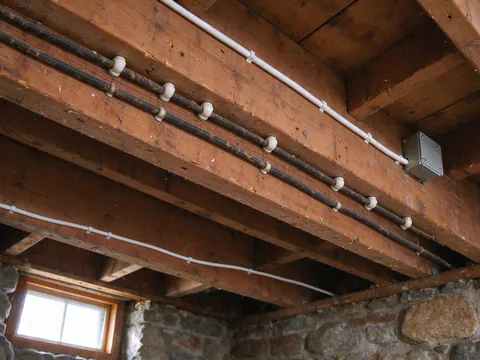
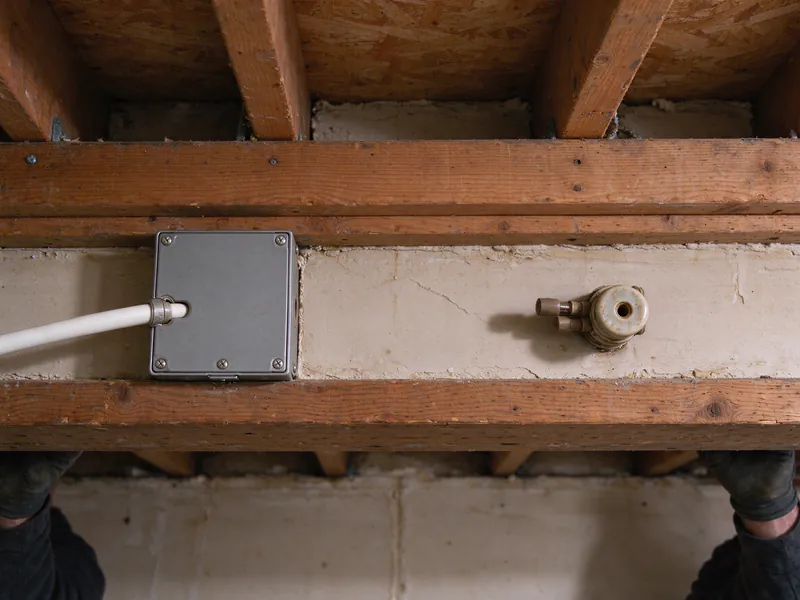
In a mixed system, knob and tube and modern nonmetallic cable, widely called Romex after one manufacturer’s brand, share the same circuits, the common result of renovations that added outlets or rooms without rewiring back to the panel. The new cable isn’t the danger; the junctions are, especially splices buried without a box, and the outlets that look modern while old wiring feeds them. Decker Boston Knob and Tube arranges tracing and partial knob and tube replacement for these systems in Boston-area homes, carried out by licensed and insured electricians.
This guide explains how mixed systems happen, why their joints fail, what the missing ground does to modern-looking outlets, and how the transitions get found and replaced. It gives no splicing instructions; this is work for a licensed electrician under permit.
How mixed systems come about
An old house doesn’t always go straight from knob and tube to a full rewire. It may change piece by piece, and each piece can tie into whatever wiring was nearest.
- Kitchen and bath remodels added outlets on new cable, often fed from an old circuit in the wall.
- Finished basements and attics gained new lights and outlets spliced onto runs that were already there.
- Selective rewiring replaced the easy runs and left the hard ones, sometimes splicing new cable to old at the boundary.
- Unit-by-unit updates in two- and three-family houses left each floor at a different stage. Somerville permit records include jobs such as replacing “knob and tube circuit in each of the 3 units,” a sign of how the work gets split up.
Homeowners report finding old circuits still spliced into newer wiring in houses they believed had been rewired. The visible cable told one story; the circuit told another, which is why proving what is still live comes before any scope.
Where old meets new
Transitions turn up in a handful of places, and each carries a different level of risk.
| Transition point | What it looks like | Risk | What the electrician does |
|---|---|---|---|
| Junction box with a cover | A metal or plastic box where old conductors and new cable join | The best case: contained, reachable and inspectable | Opens it with power off and checks the joint and the old conductors near it |
| Buried splice | Taped joint inside a wall or ceiling, with no box | The worst case: hidden, uncontained and impossible to inspect | Locates it by tracing, then plans an opening or a reroute |
| Device box | A modern outlet or switch on new cable, fed by an old run | Misleading: looks modern from the room | Traces the circuit back to find where the old wiring starts |
| Attic or basement run | New cable joined to old conductors along a joist | Visible, but often near insulation or stored items | Checks the joint, the insulation and the load on the circuit |
| At the panel | New cable landed on a circuit that still runs on knob and tube downstream | Easy to miss when the panel looks new | Maps what each breaker actually feeds |
Why improper splices arc
A splice is a mechanical joint carrying current. Several things work against a joint between new cable and old knob and tube conductors.
The old conductor gets disturbed
Making the joint means stripping and bending conductors whose rubber insulation may already be brittle. The covering can crack right where the new joint sits, exposing copper next to the connection.
The joint loosens over time
Heating and cooling, vibration and the slow aging of old tape loosen a twisted or wrapped joint. A loose joint resists current and heats. Heat oxidizes the copper, which resists more, and the cycle builds.
Nothing contains it
In a box, heat and sparks from a failing joint stay inside metal or rated plastic, and someone can open the cover and find it. Buried in a wall cavity against wood lath and framing, a joint that starts to arc has nothing around it but combustible material, and no one can see it.
The circuit may be carrying more
Extensions add outlets to circuits laid out for a few lights. More load means more current through the old run and the joint, and more heat at both. The danger guide covers how heat and arcing lead to fire.
The ground that isn’t there
Modern cable carries an equipment grounding conductor. Knob and tube has none. When new cable is spliced onto an old run, its ground wire has nothing to connect to upstream, so the outlets it feeds can’t be truly grounded.
This produces outlets that look safe and aren’t: three-prong receptacles on new cable with no ground path to the panel. In some cases, someone has jumpered the outlet’s ground screw to the neutral to make a plug-in tester show “correct,” which can put voltage on an appliance’s metal case if the neutral fails. The ungrounded outlet service and the AFCI and GFCI guide cover the ways to protect ungrounded circuits properly.
What Massachusetts code says about modifying old circuits
Rule 3 of 527 CMR 12.00 lets an existing installation stay as it is while additions follow the current code, but the new work can’t add a violation or enlarge one already there. A splice onto knob and tube is a modification, so it is judged on those terms by the inspector of wires.
The state left unchanged the national code’s arc-fault provision for branch circuits that are modified, replaced or extended, so that text governs extending an old circuit. Either way, the work needs a licensed electrician and a permit (legal status guide); in Boston the permit process runs through Inspectional Services.
How electricians find every transition
The process is the same circuit mapping used for any knob and tube assessment, with extra attention to the joints.
- Map each circuit from the panel, room by room, as in any knob and tube inspection.
- Note every circuit where modern devices and knob and tube both appear.
- Open accessible junction boxes with the power off and check the joint, the connectors and the old conductors entering the box.
- Follow new cable runs back toward their source to find where they join older wiring.
- Mark suspected buried splices where a circuit changes type with no box in between.
- Write down which transitions were seen and which were inferred.
Fixing a mixed system
There are two broad approaches, and the findings usually make the choice.
| Approach | When it fits | Limits |
|---|---|---|
| Replace the old section back to the panel | Most mixed circuits; any circuit with a buried splice or damaged old conductors | More work per circuit, but it removes the joint, the old run and the ground problem together |
| Correct the joint in a proper box | A reachable joint where the old run is short and in good condition, as a stopgap | Leaves knob and tube in service and the circuit ungrounded |
Mixed circuits can be the reason a “mostly rewired” house still needs a partial replacement, and the partial versus full guide helps decide how far to go.
Signs a house may have mixed wiring
None of these is proof, and none is a reason to open anything yourself.
- Three-prong outlets in a house that still has a fuse panel.
- A remodeled kitchen or bath in a house where other rooms have two-prong outlets.
- New cable in the basement or attic disappearing into the same cavity as old conductors.
- Lights or outlets in one room that go dead when an apparently unrelated old circuit is switched off.
To have the transitions in your house found and a scope written for them, call Decker Boston Knob and Tube on (617) 405-3599, or ask for an estimate and describe what you’ve seen.