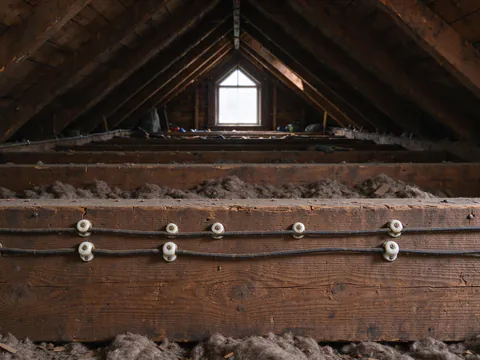
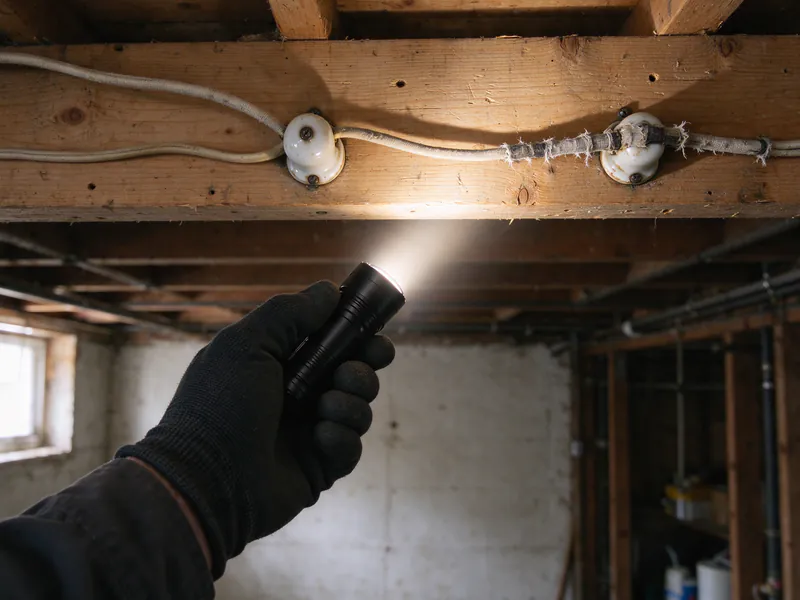
Knob and tube wiring isn’t automatically dangerous, but it has very little tolerance for the things that happen to houses over a century: heat, handling, insulation and amateur extensions. An intact, unmodified run on a correctly sized fuse can still carry power safely. Decker Boston Knob and Tube arranges knob and tube inspections and replacement in Boston and nearby cities through licensed and insured electricians, and this guide explains where the real risk comes from.
The honest answer for any one house is “it depends on condition,” and condition is mostly hidden. The rest of this page explains which conditions matter, how each one turns into a fire or shock hazard, and how they get found.
Condition matters more than age
Two houses built the same year can carry very different risk. One may have attic runs that were never touched, on fuses that still match the wire. The other may have had a kitchen remodel tie new cable into the old circuits, blown-in insulation over the attic runs and a 30 amp fuse where a 15 belonged.
The design itself was sound for its time. The knob and tube wiring guide covers how separation and open air did the insulating and cooling. Danger appears when one of those design conditions is lost.
How cracked insulation exposes live copper
Insulation breakdown is the slowest failure, and it can progress for years unnoticed. It follows a chain, and each step makes the next more likely.
- The rubber hardens. The rubber layer under the cloth loses its flexibility over decades, faster where the wire runs warm, such as near light fixtures or under attic insulation.
- Movement cracks it. Once brittle, the covering splits when the wire is bent, pulled or brushed by someone working in the attic or ceiling. Rodents chew what’s left.
- Bare copper appears. Pieces flake away and expose the conductor, often right at a knob, a tube or a splice where the wire turns.
- Something touches it. Exposed copper can now meet wood, metal lath, a nail, the other conductor where spacing has been lost, or a hand.
Each step is invisible from the room. This is also why handling the wiring to “check it” is risky: the act of moving brittle insulation can complete the chain.
Loose connections and the heat they make
A connection that loosens resists current, and resistance turns into heat at that one spot. The heat oxidizes the copper, oxidized copper resists more, and the joint gets hotter still. Original wrapped splices, the screw terminals at old outlets and switches, and fuse holders can all loosen after decades of heating and cooling.
What it can look like from the room
- Lights that flicker when nothing else changes
- A switch plate or outlet cover that feels warm
- Discoloration around an outlet, or a faint burning smell
- Buzzing or crackling at a device
None of these names a single cause; a loose fixture connection can produce a flicker on modern wiring too. Each one is still a reason to have an electrician look.
Fire risk and shock risk are different problems
People ask whether knob and tube is a “fire hazard,” but it carries two separate kinds of risk, with different causes and different fixes.
| Hazard | What causes it | What makes it worse | What reduces it |
|---|---|---|---|
| Overheating | Current beyond what the wire can safely carry | A fuse larger than the wire’s rating; space heaters and window units; insulation around the run | Correct fuse sizes, more circuits, new wiring (how much load a circuit can take) |
| Arcing | Current jumping a gap at a loose joint or damaged conductor | Buried splices to newer cable, rodent damage, disturbance during renovations | Finding and replacing the splices and damaged sections (mixed with newer cable) |
| Shock | No equipment ground, so a fault on a metal-cased appliance has no path back to trip the fuse | Three-prong outlets added without a ground, adapters, wet locations | Ground-fault protection or new grounded circuits (AFCI and GFCI on old wiring) |
Is inactive knob and tube dangerous?
Knob and tube that is truly disconnected at both ends carries no current, so the wire itself can’t overheat, arc or shock anyone. The risk sits in the word “inactive.”
Wiring gets called dead because it looks old, because a previous owner said so, or because one end was cut. A run that was cut at the panel can still be fed from the other end through a splice to a newer circuit. The live wiring guide explains how an electrician proves the difference, and why that proof should be written down.
What raises the risk in a Boston-area house
Some local patterns stack extra stress on the old circuits. None proves a problem in a particular house; each is a reason to look closer.
- Weatherization. Mass Save’s assessment standards treat any knob and tube as a barrier to insulation until a licensed electrician addresses it, because loose fill and batts take away the open air the conductors rely on. Older insulation jobs didn’t always stop for it.
- Winter loads. Boston averages 91.6 days a year with a low at or below freezing (NOAA), and a space heater on a bedroom circuit built for a lamp and a radio is a heavy, hours-long load.
- Stacked renovations. In two- and three-family houses, each unit may have been updated separately, leaving old circuits spliced into newer ones at every floor (triple-decker rewiring).
- Small services. Some Cambridge knob and tube permits record an existing service of just 60 amps, which leaves the whole house running close to its limit.
Call promptly, or plan calmly
Some findings call for an electrician soon; others are reasons to schedule an assessment without rushing.
| Call an electrician promptly | Plan an assessment |
|---|---|
| A warm or discolored outlet, switch or plate | Two-prong outlets throughout |
| A burning or hot-plastic smell with no obvious source | Porcelain knobs visible in the attic or basement |
| Scorch marks, buzzing or sparking at a device | A fuse panel with no record of rewiring |
| A fuse or breaker that keeps opening on the same circuit | An insurer or Mass Save assessor asking about the wiring |
| Bare copper visible on a run | Lights that dim briefly when an appliance starts |
How an inspection judges the risk
An electrician can’t see inside closed plaster, so an assessment combines what can be seen with what can be measured. It starts at the panel, comparing each fuse or breaker with the wire it protects, then traces every circuit to learn which rooms still run on knob and tube. The attic and basement routes are checked for cracked insulation, splices, rodent damage and insulation contact.
The written findings should separate what was verified from what was inferred. The knob and tube inspection service describes that report, and the signs your house needs rewiring guide covers which symptoms point toward replacement.
Lowering the risk while you decide
If the wiring stays in service for a while, a few habits help without anyone touching it.
- Never put a larger fuse in a socket; a fuse that keeps blowing is information, not an obstacle.
- Move heaters, window air conditioners and other heavy loads to newer circuits where the house has them.
- Keep stored boxes and new insulation off attic runs.
- Leave cut ends and loose wires alone, even ones that look abandoned.
When the findings point to replacement, the choice between partial replacement and a whole house rewire comes next. To find out which conditions your own wiring has, call Decker Boston Knob and Tube at (617) 405-3599 or ask for an estimate.