The signs that a house needs rewiring fall into three groups. Heat, burning smells, scorch marks, buzzing and repeated trips on one circuit need a prompt electrician visit. Dimming lights, two-prong outlets, too few outlets and a house still on its fuse box point to an aging or undersized system worth assessing. And an insurer’s question, a Mass Save finding or a renovation can make the decision with no symptom at all. Decker Boston Knob and Tube arranges knob and tube inspection and rewiring across Boston and nearby cities, carried out by licensed and insured electricians.
No single sign names a cause. A flickering light can be a loose bulb as easily as a failing splice, which is why the next step is tracing circuits, not guessing.
Signs not to wait on
These point to heat at a connection or damage in the wiring. They don’t prove which, but each one deserves an electrician’s visit soon rather than at the next renovation.
| What you notice | What it can mean | What to do now |
|---|---|---|
| Outlet, switch plate or cord plug that feels warm | Resistance at a loose terminal or splice, or a circuit carrying more than its wire should | Stop using it and keep the circuit off until it’s checked |
| Burning or hot-plastic smell with no obvious source | Overheating insulation or a failing device | Switch off the circuit if it’s safe; if there’s smoke, leave and call 911 |
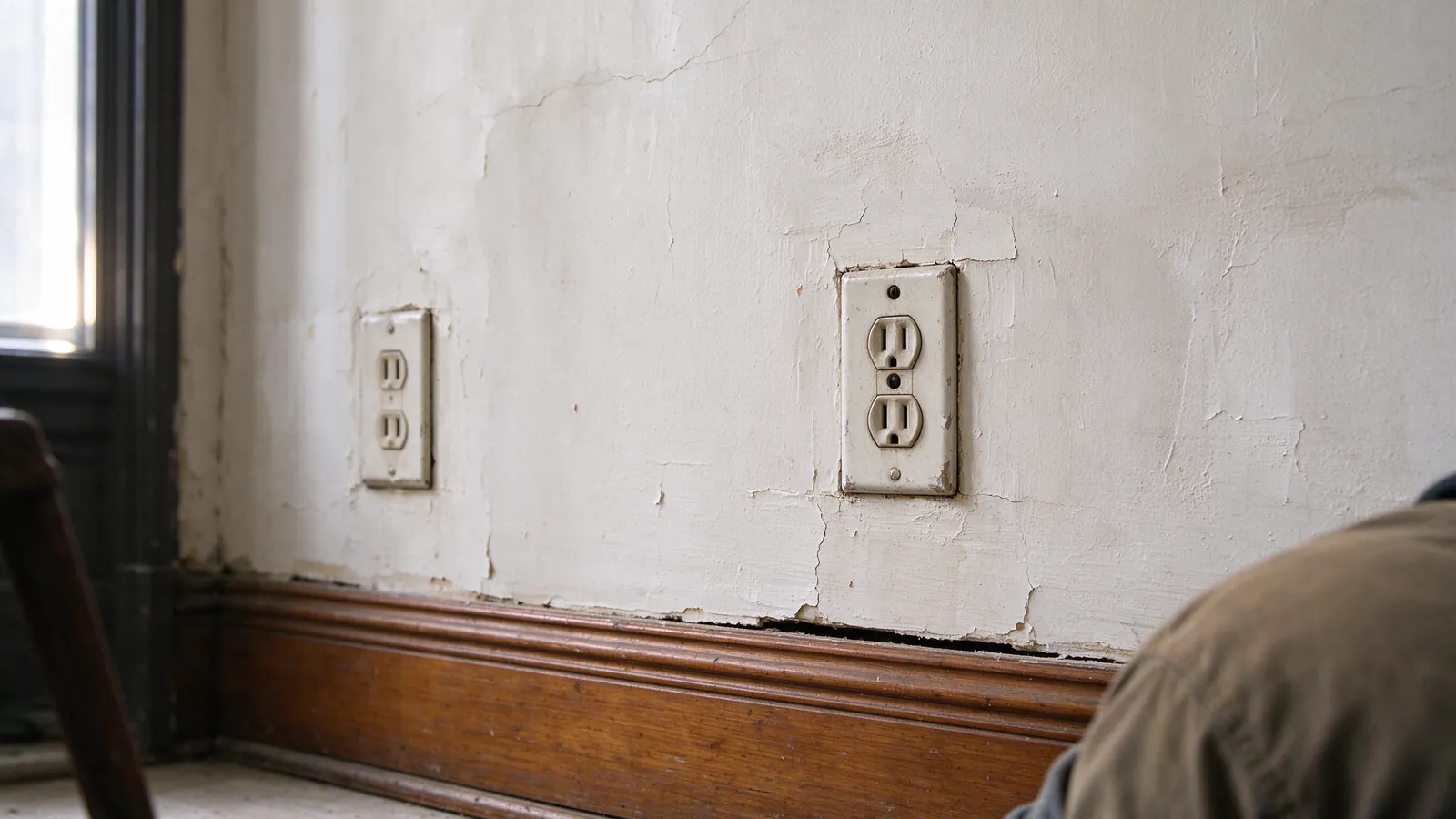
| Scorch marks or discoloration at an outlet or switch | Arcing or heat at the device or the wire behind it | Leave it off; don’t replace the device yourself |
| Buzzing or crackling from a device or wall | Arcing at a loose connection | Switch off the circuit and call |
| The same circuit’s fuse blowing or breaker tripping again and again | Overload, a fault in the wiring, or a device failing | Don’t fit a bigger fuse; have the circuit traced |
Signs of a system built for a different house
These are less urgent and more common. They describe wiring laid out for a few lights and outlets per room, now asked to run a modern household.
In the rooms
- Lights that dim when something starts, such as a vacuum, a microwave or a window air conditioner, especially on one circuit.
- Extension cords and power strips as permanent fixtures, because there aren’t enough outlets.
- Two-prong outlets, the everyday face of circuits with no ground; the ungrounded outlet upgrade page covers what that means.
- Push-button switches and fixtures on shallow boxes, hints of the original installation.
At the panel
- Screw-in fuses, which often date from the same era as knob and tube, though plenty of fuse boxes feed later cable.
- A fuse larger than the circuit’s others or its label, a possible sign of overfusing.
- No spare spaces, meaning new circuits have nowhere to go; the panel guide explains why a new panel alone doesn’t solve the wiring.
In the attic and basement
Single wires on porcelain knobs, insulation blown over or around old runs, taped splices with no box, and newer cable joined onto old wire are all worth photographing. Don’t handle them. The identification guide covers what to look for, and the cloth wiring comparison helps sort one old type from another.
Do old houses need rewiring?
Not because of their age. Wiring is judged on what it is, what has been done to it and what it’s being asked to carry. An undisturbed run in a dry basement can still be sound generations after it went in.
Age is still the reason to look
Boston has 46.7% of its housing built before 1940, and some neighborhoods more: 60.0% in Dorchester’s 02122 ZIP code, 57.7% in Jamaica Plain and 54.2% in Roslindale, according to the U.S. Census Bureau. Mass Save’s own standards tell its energy specialists to assume knob and tube may be present in any pre-1955 house. Many of those houses were partly or fully rewired long ago, so age tells you to check, not what you’ll find.
How many years before rewiring a house?
There’s no fixed lifespan. Searches for one turn up figures, but none fits a given house, because heat, disturbance, insulation and later modifications age wiring far more than the calendar does.
Things that aren’t proof either way
Some features look reassuring or alarming and prove neither.
| What you see | Why it doesn’t settle anything |
|---|---|
| Three-prong outlets throughout | An old circuit can be fitted with three-prong outlets that have no ground behind them |
| A modern breaker panel | Massachusetts code lets a service be replaced without replacing knob and tube circuits |
| A home inspection that didn’t mention knob and tube | Inspectors see what’s visible and can’t trace every circuit |
| Knob and tube visible in the basement | It may be disconnected and dead, or still live through a hidden splice |
| No problems in decades | Undisturbed wiring can hold up well; conditions change once someone insulates, extends or overloads it |
The live wiring guide explains how an electrician tells a dead run from a live one.
When the trigger isn’t a symptom
Plenty of rewires begin without any warning sign. In the Boston area, these are the usual ones.
- Insurance. Homeowners report carriers asking about knob and tube and fuse panels at purchase or renewal, sometimes with short deadlines. The insurance guide covers what to ask.
- Mass Save. A Home Energy Assessment that finds any evidence of knob and tube stops insulation until a licensed electrician deals with it; the insulation barrier service covers the certification.
- Buying or selling. A home inspection note becomes a negotiation point; see the buying guide.
- Renovation. Open walls are the cheapest moment to replace old circuits; see remodel rewiring.
What happens after you notice something
The next step is an inspection that maps the circuits: which are knob and tube or other old wiring, which are live, and what condition the accessible runs are in. That map decides whether the answer is a repair, a partial replacement or a whole house rewire. The online assessment tool helps sort your observations before the visit, though it can’t see inside your walls.
If you’re seeing any of the signs above, call Decker Boston Knob and Tube at (617) 405-3599 or ask for an estimate. For a warm outlet, a smell or scorching, keep that circuit off until it has been checked.