
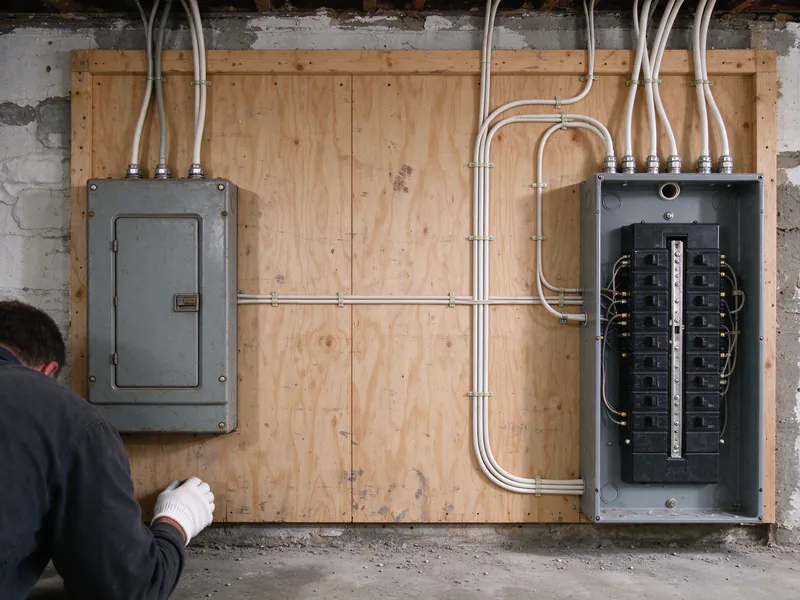
Knob and tube has no one amp rating. The load an old circuit can safely carry depends on the size of its copper, the condition of its rubber and cloth insulation, whether it still has open air around it, and above all on the fuse or breaker protecting it, which has to match the wire. Decker Boston Knob and Tube arranges knob and tube inspection and whole house rewiring across Boston and nearby cities, carried out by licensed and insured electricians, and sizing that protection correctly is one of the first things an assessment checks.
That’s why this guide gives no number for “knob and tube max amps.” Any figure that ignores the wire size, the surroundings and the fuse would be a guess, and guesses are how old circuits end up overloaded.
Why there’s no one number
Four things set the safe current on any circuit. On knob and tube, each one has to be found in the house, not assumed.
| Factor | Why it changes the answer | How it’s checked |
|---|---|---|
| Conductor size | Thicker copper carries more current for the same heat | Read at the panel or an accessible run |
| Insulation condition | Brittle or cracked covering tolerates less heat before it fails | Inspected where runs can be seen |
| Surroundings | Knob and tube was rated for open air; insulation around it traps heat | Attic and wall cavities checked for blown-in or batt insulation |
| Overcurrent protection | The fuse or breaker caps the current the wire will ever see | Each fuse or breaker size compared with its wire |
Even modern cable is treated more cautiously when it’s buried. The Massachusetts code says that where nonmetallic cable is installed in thermal insulation, its conductors are rated at the lower 60°C value. Knob and tube, which depends on air around each wire, has less margin still. The state code adopts the national code’s knob and tube article without change, and Mass Save won’t insulate over live runs.
The fuse is the real limit
On a correctly protected circuit, the fuse or breaker decides how much current the wire can ever carry. That’s the safety design of the whole system.
Matched protection
Each original circuit was fused to suit its wire. As long as that pairing holds, a circuit asked to carry too much simply opens, and the wire never sees a damaging current. The assessment checks every fuse or breaker against the wire behind it; the inspection service covers what that review includes.
Overfusing
When a fuse kept blowing, someone sometimes fitted a larger one. The circuit then stops protecting itself: it can carry more than the wire tolerates, and the warning sign, the blown fuse, goes away. Fuse adapters that accept only one size exist for exactly this reason, so the wrong fuse can’t be screwed in again. A panel upgrade replaces fuses with breakers sized to the wire.
How overload becomes overheating
Overload rarely fails all at once. It works through heat, and old wiring is vulnerable at every step of that chain.
Current makes heat
Every conductor warms as current passes through it, and the warming climbs steeply as current rises. In open air, a knob and tube conductor sheds that heat into the cavity around it. Packed in insulation, or run for hours near its limit, it stays warmer for longer.
Heat ages the insulation
Rubber hardens and cracks faster where it runs warm. Each long, hot evening of a space heater on an old circuit takes a little more life out of its covering, especially near light fixtures and where the wire bends into boxes.
Joints are the weak points
A loose joint resists current, and resistance at one spot concentrates heat there. Old twisted splices, worn device terminals and connections added in later renovations are where that heat tends to build. Warm switch plates, flickering lights or a faint burning smell can be the only outward signs, and the signs guide covers which ones need a prompt call.
Where modern demand outgrows the old layout
The original circuits were laid out for a few lights and a handful of outlets per room. What strains them now is usually not one appliance but steady loads stacked on a circuit that also feeds other rooms.
Steady loads
The arithmetic is simple: watts divided by volts gives amps. A 1,500 watt space heater, a common size, draws about 12.5 amps at 120 volts, and it runs for hours. Window air conditioners, dehumidifiers and portable heaters are all long-running loads of the same kind. On a circuit that also lights two bedrooms and a hall, that’s where the load builds.
Boston’s heating season
Boston averages 5,545 heating degree days a year, according to NOAA, so heaters in cold rooms are a real part of winter in older houses. The seasonal post on space heaters on old wiring in a Boston winter covers that in more detail.
Extension cords and power strips
Cords spread load from one outlet onto a run that was never planned for it, and add their own connections. They’re a sign the house has too few outlets, which a rewire is the cheapest moment to fix.
The service is a separate limit
The service is what feeds the whole house from the utility. It can be small too, but enlarging it doesn’t raise what any single old circuit can carry.
Some Cambridge knob and tube permits record an existing service of just 60 amps, and a Brighton permit described a knob and tube rewire that installed a 60 amp panel. Whether a house needs more is answered by a load calculation, which totals what the house actually runs. Heat pumps, induction cooking and EV charging tend to push the answer up. The panel guide explains why a larger service and a rewire are separate scopes.
Does knob and tube use more electricity?
Not in any way that shows on a bill. Electricity use is set by what’s plugged in and switched on. A loose or corroded joint does turn a little energy into heat at that spot, but that’s a safety problem, not a savings opportunity, and no rewire should be sold on lower bills.
What actually adds capacity
Capacity comes from giving loads their own paths. A rewire plans circuits around what each room runs now: kitchen appliances, bathrooms, a home office, a heat pump or an air conditioner on circuits of their own, each with the arc-fault protection Massachusetts now requires on every 10, 15 and 20 amp, 120 volt circuit in a home. The AFCI and GFCI guide explains that protection.
Until then
- Keep space heaters and window air conditioners off old circuits where you can, and never on cords.
- Spread steady loads across circuits rather than stacking them in one room.
- Treat a warm plate, dimming lights or a fuse that keeps blowing as a reason to call.
A partial replacement that gives the heaviest loads new circuits is sometimes the first step; a whole-house job falls in a typical Boston-area budgeting range of $8,000 to $25,000 or more, explained in the cost guide. To find out what your own circuits can carry, call Decker Boston Knob and Tube at (617) 405-3599 or ask for an estimate.