Yes. Most households live at home through a knob and tube rewire, because the work moves area by area: one part of the house is without power while the rest keeps it, and each area goes back on as its new circuits are finished. Decker Boston Knob and Tube arranges whole house rewiring and partial replacement across Boston and nearby cities, carried out by licensed and insured electricians, with power-off windows planned around the household.
What makes an occupied rewire work is settling a few things before it starts: what must never lose power, how dust and openings are handled, and in a multi-family building, how each household is told.
How a staged rewire keeps the house running
The house stays livable because only the circuits being worked on are switched off. The rest stays on the existing wiring until its turn.
Area by area
New cable for an area is run first, with the old circuits still live. Then the old circuit is shut off, the new one is connected and tested, and power returns through the new wiring. The replacement process guide covers each stage in order.
What a typical day looks like
Expect the rooms in that day’s area to be without power for part of the day, not all of it. Lights in a hallway or a bathroom may be off while their circuit is switched over, so a battery lamp or two helps. Extension cords from live rooms are a short-term workaround the electrician can advise on; they aren’t a way to run a space heater, and the amps guide explains why.
What has to stay on
Decide this before the schedule is written. A short list given on day one shapes the order of the whole job.
| Load | Why it matters | What to tell the electrician |
|---|---|---|
| Boiler or furnace controls | No controls, no heat, even with gas or oil in the tank | Which circuit feeds the burner, thermostat and circulator, if you know |
| Refrigerator and freezer | Food safety over a long day | Where they plug in |
| Medical equipment | Oxygen concentrators, CPAP, powered beds | Exact rooms and hours they’re used |
| Home office | Calls and connectivity | Where the router and modem sit |
| Sump pump, where there is one | Basement water | Which outlet it uses |
Winter in particular
Boston’s Logan Airport station averages 91.6 days a year with a low at or below freezing, and January’s mean low is 23.1°F, according to NOAA. Attic work is cold in those months, and a shutdown that takes out heating controls on a January afternoon quickly becomes a problem. Power-off windows are planned so the heating system keeps power or gets it back quickly.
Dust, openings and furniture
A rewire through plaster is not a gut renovation, but it isn’t dust-free. Most of the mess comes from three places.
Where the dust comes from
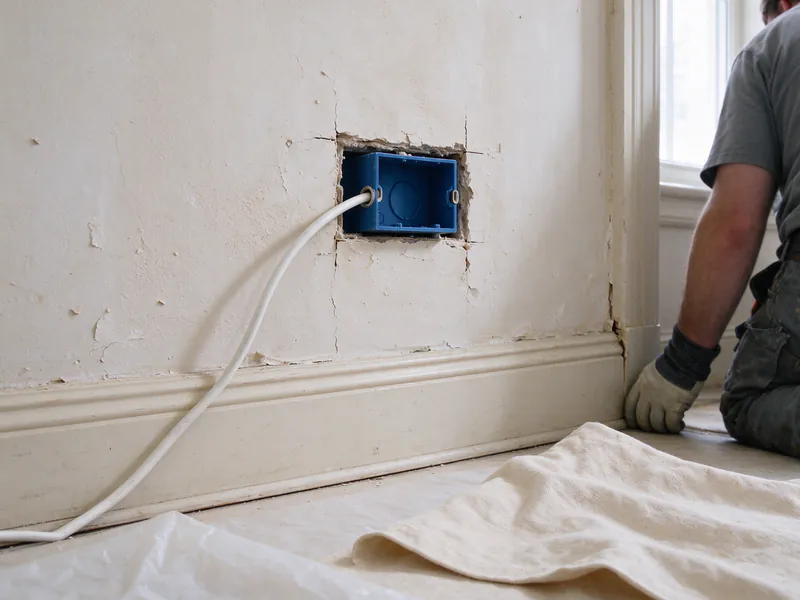
- Small access openings at box locations, top plates and blocked framing, cut through plaster and lath.
- Attic work, where drilling through top plates can shake debris and old insulation down into wall cavities.
- Basement work, which is usually the least disruptive to living space.
What you can do
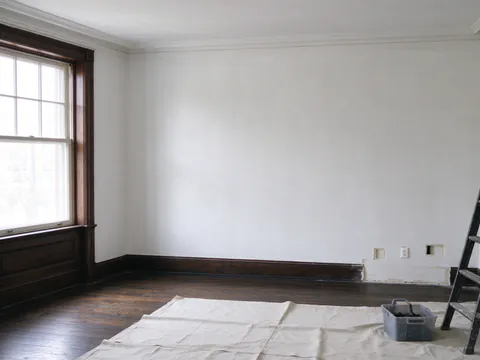
Move furniture and wall hangings away from exterior and interior walls in the area being worked on, clear a path to the attic hatch and the panel, and empty closets that stack between floors, since they’re often the easiest routes. Ask how floors will be covered and how each area will be cleaned before you move back into it.
Lead paint, old fill and children
In an older house, the dust question has a regulatory side. Any home built before 1978 counts as target housing under the state’s lead-safe renovation rules.
The six-square-foot line
Under the state’s Department of Labor Standards rules (454 CMR 22.00), work for a fee that disturbs six or fewer square feet of painted surface per room inside counts as minor repair and maintenance. Unless testing shows no lead, going past that in a room makes it renovation work, carried out by a licensed lead-safe renovation contractor with containment. Fishing cable through small openings can stay under the line; opening long runs of wall usually won’t.
Attic fill
Loose fill in the attic is worth a question before anyone disturbs it. Mass Save treats vermiculite, like knob and tube, as a barrier to insulation. The asbestos and lead paint guide covers testing and what it changes.
Two- and three-family houses
In a multi-family building, staying at home means several households at once. A three-decker is usually rewired floor by floor, each unit as its own stage, with each household told when its power-off windows fall.
Common areas
Hallway and stair lighting is shared. Massachusetts code lets common-area lighting on the same floor in an existing three-family building be fed from equipment that supplies a dwelling unit, which affects how those lights are staged. Plan stair lighting so no one climbs a dark stairwell at night during the work. The triple-decker rewiring page covers unit-by-unit staging.
Access between units
Routes for one unit often pass through another’s closets or ceilings. Settle access dates with each household in writing before the schedule is fixed.
When moving out makes sense
Staying is the norm, but not always the best choice. Consider a short stay elsewhere when:
- the job is combined with a renovation that opens many walls at once;
- lead-safe renovation work and containment cover most of the living space;
- someone in the house depends on powered medical equipment and the layout makes keeping that circuit live hard;
- the work falls in the coldest weeks and the heating controls share a circuit with areas being rewired.
The remodel rewiring page covers the case where walls are open anyway.
Questions to settle before work starts
A short written plan answers most of the worry. Ask for these points in the scope or schedule, and see the quote comparison guide for how they show up in a price.
- The order of areas and roughly how long each stays without power.
- Which circuits stay live throughout, starting with heating controls.
- How openings are protected, cleaned and, in a pre-1978 house, contained.
- When the rough-in inspections fall, since openings stay open until then.
- In a multi-family house, how and when each household gets notice.
Occupied-home protection is one of the things that moves a price within the typical Boston-area budgeting range of $8,000 to $25,000 or more for a whole house; the cost guide explains the rest. To plan a rewire around your own household, call Decker Boston Knob and Tube at (617) 405-3599 or ask for an estimate.