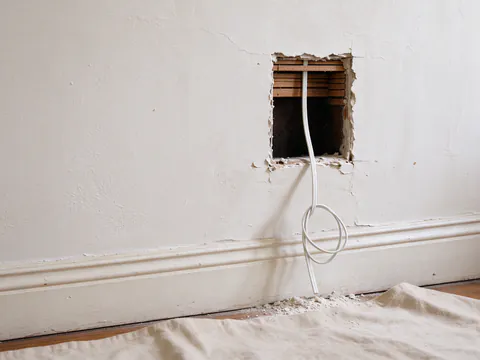
Knob and tube conductors are insulated with rubber and woven cloth, and nothing in a visual inspection can prove whether a particular old material in a house contains asbestos. Only laboratory testing of a sample settles that. Decker Boston Knob and Tube arranges knob and tube replacement across Boston and nearby cities, carried out by licensed and insured electricians, and in an older house the plan has to account for three materials that sit where the work goes.
Two of them have clear Massachusetts rules. Lead paint is governed by the state’s lead-safe renovation regulations, and vermiculite attic fill is named by Mass Save as a barrier to insulation. Asbestos is the one that has to be tested before anyone can say anything certain.
What the wire itself is made of
Original knob and tube conductors are solid copper with a layer of rubber, then a woven cloth covering. Where they enter a box or fixture, they run through loom, a flexible woven sleeve. That’s the standard construction.
Why the asbestos question comes up anyway
Houses of this age were built and altered with materials whose makeup can’t be read from the outside, and wiring, fixtures and insulation were often added at different times by different hands. Looking at a wire or sleeve can’t tell you its contents, and neither can its age.
What to do with the question
- Don’t disturb it to find out. Cutting, stripping or crumbling old insulation releases whatever is in it, and a run that seems dead may be live.
- Raise it before the scope is set. If something near the work looks suspect, say so at the first visit so testing, if needed, can happen before routes are planned.
- Let the result decide. If a material tests positive, it is dealt with by people qualified for that work before the electrical job disturbs it. If it tests negative, the rewire proceeds as planned.
Lead paint and the openings a rewire needs
Lead paint is the material most likely to shape the plan, because a rewire has to reach behind painted plaster. Massachusetts sets a clear threshold.
The rule
Under 454 CMR 22.00, from the state’s Department of Labor Standards, target housing is any housing built before 1978, with exceptions for elderly or disabled housing where no child under six lives and for zero-bedroom dwellings. Renovation includes removing portions of a structure, such as walls and ceilings.
| Work in a pre-1978 home | How the rule treats it |
|---|---|
| Six or fewer square feet of painted surface disturbed per room, inside | Minor repair and maintenance |
| Twenty or fewer square feet disturbed outside, in total | Minor repair and maintenance |
| More than six square feet per room inside, or partial demolition of painted surfaces, without lead testing | Renovation work, carried out by a licensed lead-safe renovation contractor under 454 CMR 22.11 |
What it means for a rewire
A rewire fished through the house’s own cavities, with small openings at boxes, top plates and blocked framing, can often stay at or under six square feet in each room. A rewire that opens long runs of wall or ceiling, or one combined with a renovation, usually can’t. Once a room crosses the line, the work needs a licensed lead-safe renovation contractor and containment, which changes the setup, the cleanup and the cost.
Exterior work
The exterior threshold is 20 square feet in total. A service upgrade that disturbs painted trim or siding around a new mast or meter can count toward it, which is worth knowing in a historic house where exterior work may already need review. The historic district guide covers that.
Vermiculite in the attic
Loose, granular fill between attic joists, often gray-brown with a shiny, pebbly look, may be vermiculite. It matters to a rewire for two reasons.
Why it’s treated with care
The asbestos question owners ask about wiring applies to attic fill too, and so does the answer: only testing tells you what the fill in your attic contains. Until then, don’t dig through it, sweep it or store things on it, and tell the electrician before anyone works across the attic floor.
Why Mass Save cares
Mass Save treats vermiculite as a barrier to recommended insulation, alongside live knob and tube. When both turn up in the same attic, they are planned together: deciding how the fill is handled comes before routing new cable across the joists or removing old runs there. The insulation barrier service covers the knob and tube side of that certification.
How the three change the sequence
Each material adds a decision near the start of the job, not a surprise in the middle. The usual order looks like this.
- First visit: trace the circuits and note any suspect materials, painted surfaces that routes will cross and attic fill.
- Testing, where needed: before routes are fixed, so the plan reflects the results.
- Route plan: openings per room sized with the lead-safe threshold in mind.
- Fill and hazard work, where needed: done by the right specialist before electrical work disturbs the area.
- Rewire, inspection, disconnect, test: the normal sequence in the replacement process guide.
- Closing and cleanup: to lead-safe standards where the rule applies.
For a household staying at home, the living at home guide covers keeping children and pets out of work areas.
Programs that help with these costs
Several programs that cover knob and tube also cover vermiculite or asbestos. Eligibility depends on income and, for Mass Save, on a Home Energy Assessment first.
| Program | What it covers here | Who qualifies |
|---|---|---|
| Mass Save enhanced barrier incentive | Up to $7,000 of eligible removal costs for knob and tube or vermiculite | Moderate-income households in one- to four-unit homes whose assessment recommended insulation the barrier blocks |
| Mass Save HEAT Loan | 0% financing for pre-weatherization barriers, including knob and tube and vermiculite | Homeowners with a Mass Save sponsor account, after a Home Energy Assessment |
| Boston Home Center Home Repair and Improvement Loan | Its covered list names removal of asbestos, vermiculite or knob and tube wiring | Income-eligible Boston owner-occupants of one- to four-family homes |
Work done before approval isn’t reimbursed under the Boston Home Center program, and HEAT Loan financing doesn’t cover work finished before authorization, so apply before you sign. The grants guide explains each program, and the cost guide shows where hazard testing sits in a budget.
If you suspect lead, asbestos or vermiculite near wiring that needs replacing, mention it when you call Decker Boston Knob and Tube at (617) 405-3599 or ask for an estimate, so the plan accounts for it from the first visit.