
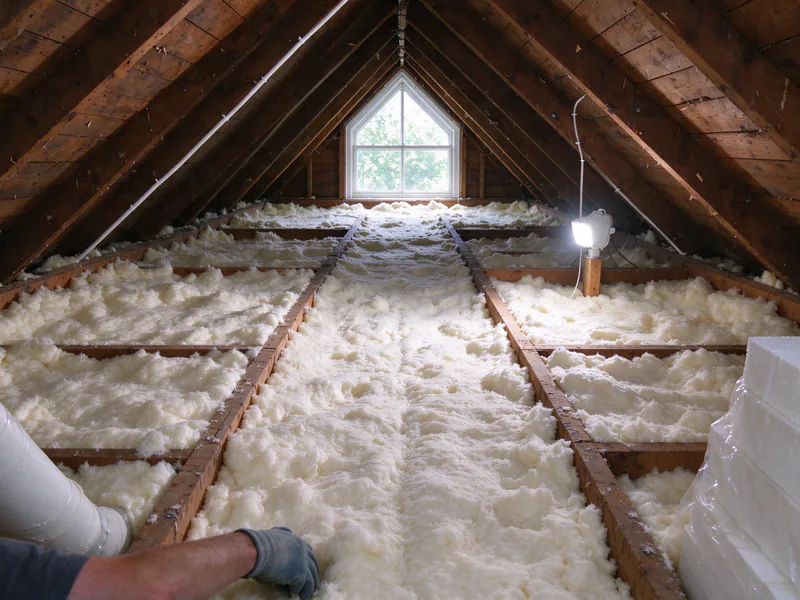
A Mass Save Home Energy Assessment that finds knob and tube puts wall and attic insulation on hold until a licensed electrician addresses the wiring. That is the program’s own standard, not one assessor’s caution. The way through is a set sequence: keep the report, check the incentives, have the wiring traced and certified or replaced, then let the insulation go in.
Decker Boston Knob and Tube handles the electrical side of that sequence for homes in Boston, Cambridge, Somerville and the surrounding towns: tracing, certification and insulation barrier work, with licensed and insured electricians doing the wiring. This post follows the assessment-to-insulation cycle as it repeats in older houses every heating season.
A cycle, not a deadline
Mass Save publishes no single application window for these offers, so there is no date to catch. The terms move on a pattern instead: the offers are set in three-year plans, and the income limits for the enhanced offers are updated for each heating season. Check the current figures when you book, not when you first read about them.
Why the stop often lands in winter
If the assessment happens as the weather turns, the electrical step falls in the coldest months. Attic work is colder then, and every power-off window has to keep the boiler or furnace controls running. Homeowners report that lining up an electrician to quote knob and tube work can take many calls, so that step is worth starting early.
What the assessor is checking for
The assessor works from Mass Save’s energy assessment standards, which treat knob and tube as something to suspect in any house built before 1955.
- If any evidence of knob and tube is found, no insulation may be installed until a licensed electrician addresses the wiring.
- The finding is a barrier to all insulation in the home, except where fully visible, uninsulated open cavities let the assessor confirm no knob and tube is present.
- Air sealing, duct sealing and pipe and duct insulation may proceed if the wiring isn’t disturbed.
- Before insulation, or air sealing that may contact the wiring, a licensed electrician has to certify that the areas where work is recommended are free of active knob and tube.
Inactive or removed?
The standard’s word is “active”. The City of Boston says insulation can proceed as long as the knob and tube system is inactive, which means runs disconnected at both ends can usually stay in place. Homeowners report getting different answers on this from different parties, so ask the program to confirm in writing what your areas need. The live wiring guide explains how an electrician tells the difference.
The path from stop to insulation
Done in this order, the paperwork lines up with what each program asks for. Done out of order, a payment can be lost.
Before any work
- Keep the assessment report, which lists the recommended insulation and air sealing and notes the knob and tube.
- Check incentive eligibility first. The enhanced incentive needs income verification, and the Boston Home Center’s repair loan doesn’t reimburse work done before approval.
- Book the electrical visit. It starts at the panel, traces every circuit, and checks the attic and basement routes, so the written scope covers exactly the areas on the assessment.
The wiring and the records
- Get the signed proposal from the licensed electrician. The HEAT Loan asks for it on contractor letterhead.
- A licensed electrician pulls the permit, and the live runs in the work areas are replaced, or disconnected where they serve nothing.
- Collect the completion documents: the signed completion form, the paid invoice, and a written summary that no knob and tube remains in service in those areas. The HEAT Loan also requires a verification inspection after completion.
- The Mass Save insulation contractor installs the insulation, and the rest of the recommended weatherization is finished.
Assessment flagged knob and tube?
Send the report with your request; the electrical scope can be matched to the areas the assessor listed.
What the programs pay toward
Two Mass Save offers touch the wiring step directly. Both depend on the assessment.
| Offer | What it covers | Who it’s for |
|---|---|---|
| Enhanced barrier mitigation incentive | Pays up to $7,000 toward eligible costs of taking out the knob and tube | Households in the moderate income band, in buildings of one to four units, after income verification and an assessment recommending work the wiring blocks |
| HEAT Loan | Interest-free (0%) financing that can include knob and tube as a pre-weatherization barrier, within a lifetime cap of $25,000 per customer | The homeowner, holding a residential electric or gas account with a sponsor utility, who then finishes the recommended weatherization |
The state’s energy department, DOER, describes Mass Save’s wiring incentives as meant for lower- and moderate-income customers who are insulating. A household above those bands gets no incentive for the wiring but can still finance it through the HEAT Loan. The grants guide covers the city and state programs that can sit alongside these, and the cost guide covers the electrical budget itself.
Belmont and other municipal-light towns
Belmont is served by Belmont Light, the town’s own municipal electric department, which is not one of the Mass Save electric sponsors. Belmont Light offers its own residential energy assessments through Energy New England, and a house that heats with sponsor-supplied gas can also book through Mass Save. That gas-heat case is also the only way a municipal-electric customer reaches the HEAT Loan. Elsewhere, Boston, Cambridge and Somerville are Eversource territory, and Medford and Malden are National Grid.
Before the attic is disturbed
Old attics hold more than wiring. Vermiculite loose fill counts as a Mass Save barrier in its own right, and in pre-1978 housing, openings that disturb over six square feet of painted plaster per room turn the job into lead-safe renovation work under state rules. The guide to asbestos, vermiculite and lead paint covers both, and the space heater post covers getting through the winter in the meantime.
To match the electrical scope to your assessment, phone (617) 405-3599 or send the report with an estimate request.