

Medford and Malden buy their electricity from National Grid, and that one fact changes how a knob and tube job runs whenever the house also needs a bigger service. Next door in Somerville, Arlington and Everett, the same upgrade is an Eversource work request.
Decker Boston Knob and Tube arranges knob and tube replacement in both cities, from West Medford, Medford Hillside and Wellington to Malden Center, Edgeworth and Linden, carried out by licensed and insured electricians. The starting point is a knob and tube inspection that sorts live circuits from abandoned ones.
Where National Grid enters the schedule
National Grid is involved only when the service or meter changes. A rewire that stays on the existing service is a matter between the licensed electrician and the city’s inspector of wires. A rewire that needs a larger service adds National Grid’s process.
When the existing service is enough
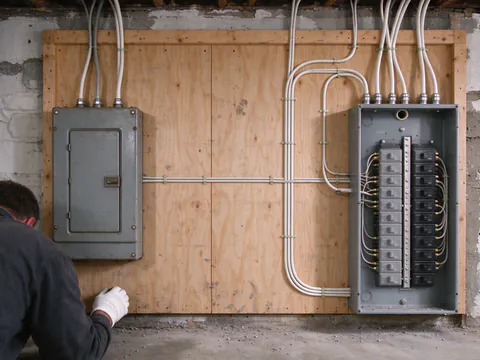
Where the panel has room and the calculated load allows, a rewire stays within the existing service: the new circuits are spread across a new or existing panel, and nothing changes at the meter. The Massachusetts electrical code also works the other way round. Replacing a service doesn’t oblige anyone to replace the knob and tube it feeds, so a new panel alone leaves the old branch circuits in place. The panel upgrade guide explains the difference.
When the service has to grow
The Massachusetts Department of Public Utilities lists Medford and Malden in the Massachusetts Electric Company franchise, which is National Grid. Its upgrade process starts with a licensed electrician confirming the scope, then the customer submits National Grid’s Electric Service Request Form, and the installation follows ESB 750, the utility’s specification for electrical installations. The panel and service upgrade page and the panel upgrade cost guide cover when that step is needed and what it adds.
Medford’s wire office
Medford runs a separate electrical department under a superintendent of wires at City Hall, and its rules shape the calendar more than the paperwork.
- Online only. The city’s electrical page says applications aren’t accepted by mail; every permit is submitted online.
- License registration first. Contractors filing for building, electrical, plumbing or gas permits must register their licenses with the city, so a licensed electrician new to Medford does that before the permit.
- Set call-in hours. Inspections are arranged directly with the inspectors during office hours, currently early weekday mornings and early afternoons Monday to Thursday. Check the city’s electrical page for the current times.
Those hours meet the state’s inspection rule. New wiring can’t be covered until the inspector of wires has seen it, within 72 hours of notice with weekends and holidays excluded, so the rough-in request is planned around the call-in window and plaster patching waits for the visit.
Malden has its own inspector of wires. Its filing method and inspection scheduling are confirmed for each address before a Malden job is booked.
Two-family houses, one unit at a time
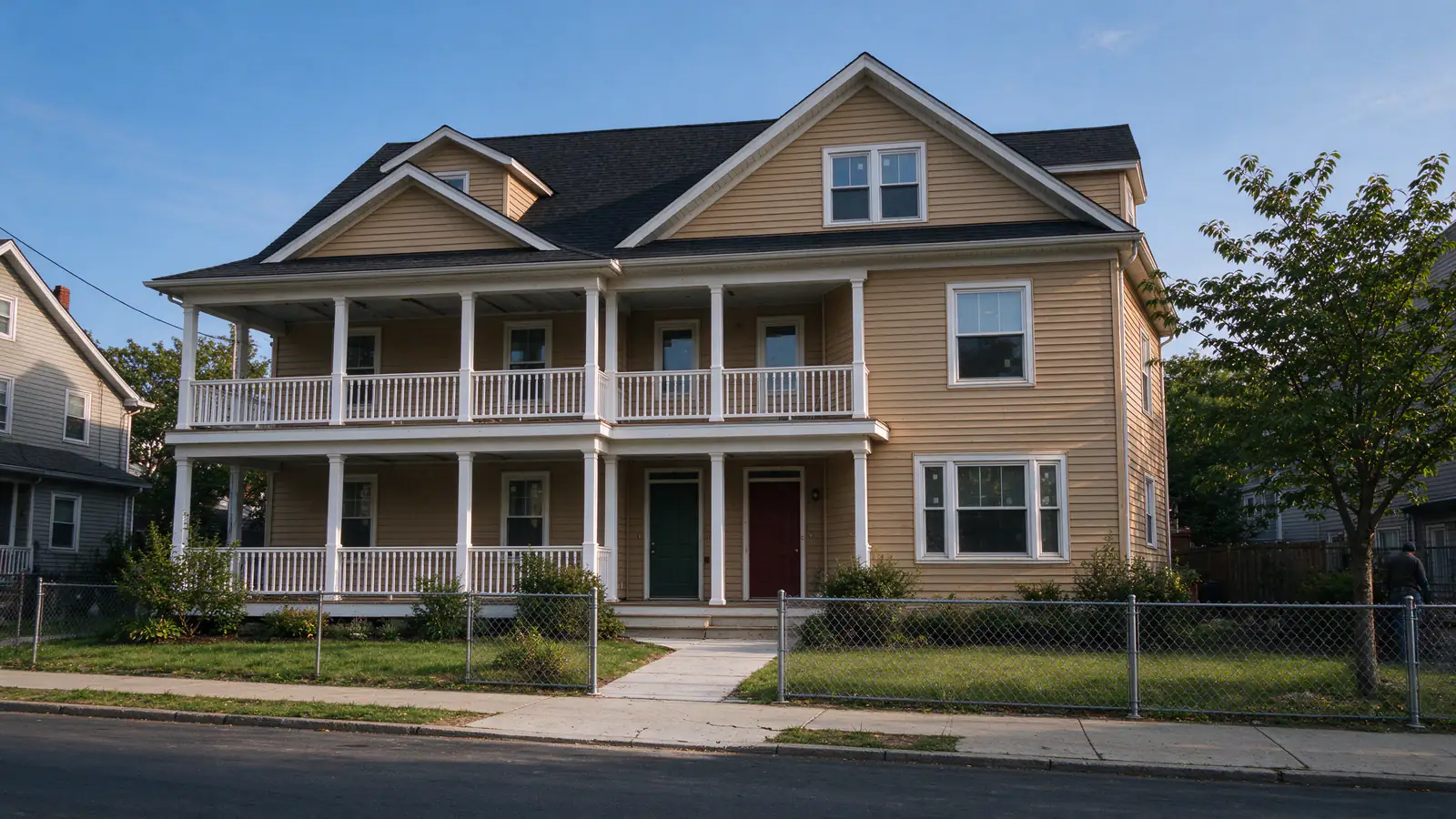
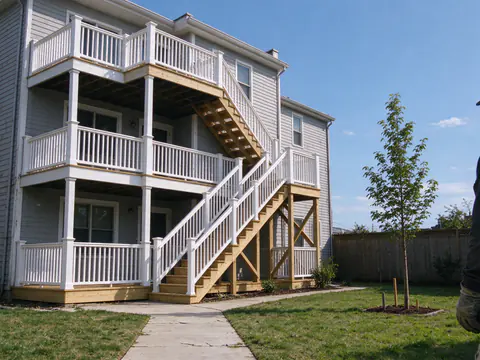
Two-families make up a large part of Medford’s housing. Census figures put 27.1% of Medford’s housing units in two-unit buildings and 33.8% in detached houses, with 48.8% built before 1940. Malden’s mix leans larger: 21.5% two-unit, 12.1% in three- and four-unit buildings and 34.6% in buildings of five or more, with 45.1% pre-1940.
Working around the other household
In a two-family the work goes area by area, which normally means one unit at a time while the other household stays on its own circuits. The basement is where both units’ circuits pass on the way to the meters, so it is traced first. Massachusetts lets common-area lighting on a unit’s floor in a two-family be supplied from that unit’s equipment, which can spare the shared stair a panel of its own. A three- or four-unit Malden building follows the triple-decker rewiring approach, floor by floor.
How a Medford or Malden job runs
- The call covers the address, which city, how many units, who lives in each, and what started it: a sale, an insurer or a Mass Save assessment.
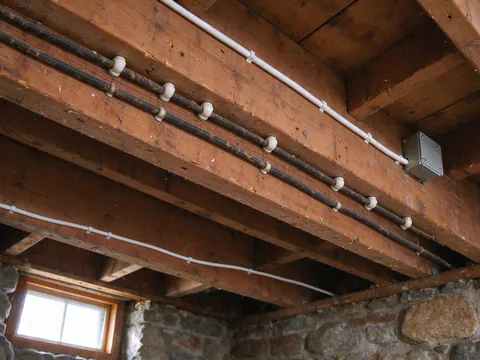
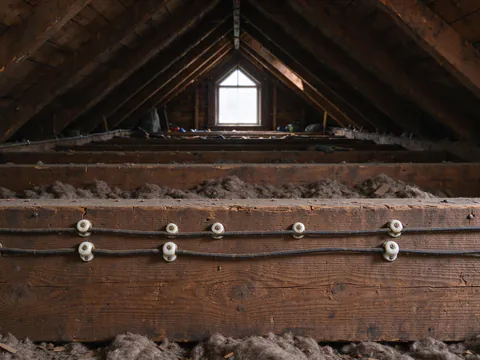
- The first visit opens at each panel, follows every circuit to its rooms, and looks at the attic and basement as cable routes.
- The written scope lists new circuits, old runs left disconnected, planned openings, any panel or service work, and a separate patching line.
- The licensed electrician files with the right city, after license registration in Medford. If the service changes, the homeowner sends National Grid’s service request using the electrician’s confirmed scope.
- The work proceeds area by area with planned power-off windows that keep boiler or furnace controls running.
- Rough-in inspection, then close. Once the inspector signs off, the knob and tube is cut out of service, the new circuits are tested, whatever old wire can be reached in the attic and basement comes out, and the openings are patched.
- The handover is a panel directory naming every breaker and a written statement that the house has no knob and tube left in service.
The living at home guide covers what each household can expect on work days.
Rewiring a Medford or Malden two-family?
Tell us which unit still runs on the old wiring and whether the service is changing. The National Grid step depends on it.
Along the Mystic and the Orange Line
Medford
Medford’s coverage runs from West Medford and the streets along Route 16 and the Mystic Valley Parkway, up Medford Hillside around Tufts University, to Wellington by the Orange Line and South Medford near I-93. The Middlesex Fells Reservation lies to the north. One wire office serves all of Medford and one utility serves both cities, so it is the buildings that make each job different.
Malden
Malden’s coverage centers on Malden Center and its Orange Line station, with Edgeworth, Linden and the streets along Route 60. With more than a third of its housing units in buildings of five or more, a Malden job may be one unit inside a larger building rather than a whole house. A unit rewire stops at that unit’s panel, and anything on the building’s side, such as common areas or the meter room, is a scope agreed with the owner of the building.
Mass Save on a National Grid account
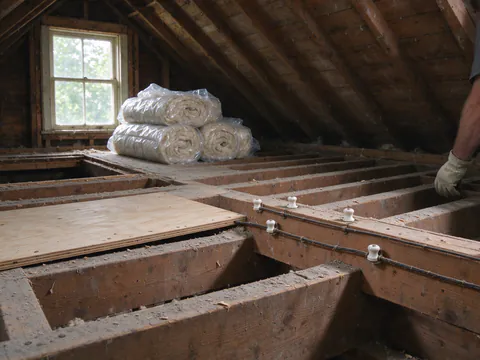
National Grid is also a Mass Save sponsor, so the Mass Save rule holds here: an assessment that finds knob and tube stops insulation in the affected areas until a licensed electrician certifies there is no active knob and tube there. Homeowners with a National Grid account can finance the barrier work through the HEAT Loan at 0%, and Mass Save’s barrier incentive, worth up to $7,000, is open to moderate-income households in homes of one to four units, subject to income verification.
The insulation barrier service and the grants guide explain the steps, and the buyer’s guide covers the purchase-time questions.