
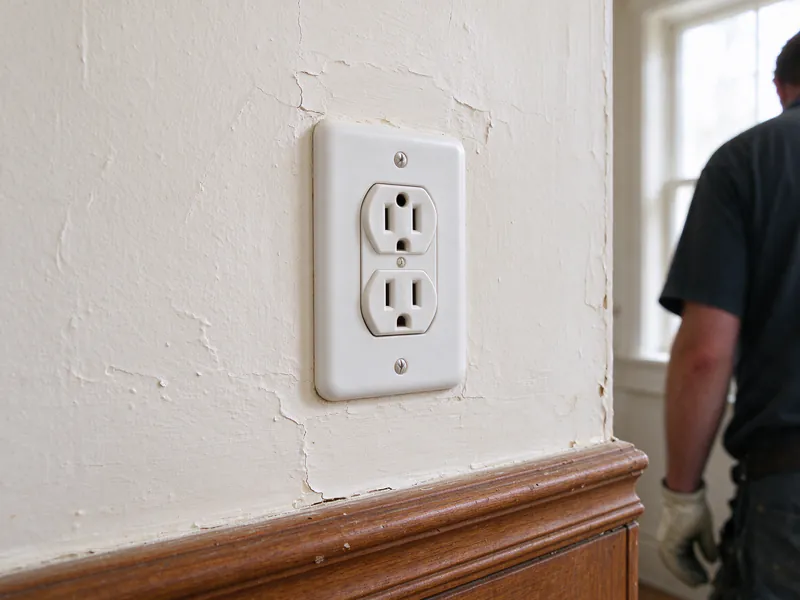
Space heaters on knob and tube circuits are the most common way old wiring gets pushed past what it was built for, and a Boston winter gives them plenty of hours. A typical 1,500-watt heater draws about 12.5 amps at 120 volts. On an original circuit protected at 15 amps, that leaves little room for the lights, a phone charger or anything else sharing the run.
Decker Boston Knob and Tube arranges knob and tube inspection and replacement for older homes in Boston, Cambridge, Somerville and nearby cities, carried out by licensed and insured electricians. This post covers how to get through the heating season with less strain on old circuits, and which signs mean a heater should be unplugged for good.
Why a Boston winter is hard on old circuits
The cold here lasts. NOAA’s 1991-2020 normals for Logan Airport show a January mean of 29.9°F, about 92 days a year with a low at or below freezing, 49.2 inches of snow and 5,545 heating degree days. That is a long season of evenings when a cold room gets a heater.
Old houses, cold rooms
Nearly half of Boston’s housing units, 46.7%, were built before 1940, according to the U.S. Census Bureau. That is a reason to look, not proof of what a given house contains. Where a house still runs on original circuits, it is often also the house that can’t easily be insulated: Mass Save’s assessment standards stop wall and attic insulation wherever knob and tube is found until a licensed electrician deals with it (insulation barrier work). The wiring that keeps the house drafty is the same wiring the heater leans on.
Duration matters more than the peak
Copper handles a short burst well. The problem is a load near the circuit’s limit for four or five hours, night after night. Heat builds at every connection along the run: the outlet the heater plugs into, the twisted and taped splices knob and tube relies on, and any later cable spliced into the old run. Over seasons, heat and age harden the rubber insulation on the conductors. The danger guide explains why those connections are the weak points.
The arithmetic on one old circuit
The table uses watts divided by volts, so it shows rough current, not a measurement of your house. The appliance wattages are examples; check the label on your own.
| Example load on one 120 volt circuit | Approximate current |
|---|---|
| 1,500-watt heater on high | about 12.5 amps |
| Same heater on a 750-watt setting | about 6.3 amps |
| 1,200-watt hair dryer | about 10 amps |
| Three or four 60-watt incandescent bulbs | about 1.5 to 2 amps |
| Laptop and phone chargers | under 1 amp |
A heater plus a hair dryer, or two heaters in rooms that happen to share a circuit, takes an old run well past 15 amps. The guide to how many amps knob and tube can carry explains the ratings behind those numbers.
When the fuse no longer protects the wire
Fuses blow for a reason. If someone in the house’s past swapped a blown 15-amp fuse for a 20 or a 30, the fuse will now let the wire carry more current than it was meant to, and it will stay quiet while the run overheats. Don’t change fuse sizes yourself in either direction; an electrician matches protection to the wire when the circuits are traced.
Running a heater with less strain
None of this needs tools or opening anything. It is about where and how the heater is used.
- Plug it directly into a wall outlet. Skip extension cords and power strips, which add more warm connections.
- Use the lowest setting that keeps the room comfortable.
- Run one heater per circuit at most. If you don’t know which outlets share a circuit, assume rooms on the same floor might.
- Keep hair dryers, kettles and other high-draw appliances off the heater’s circuit while it runs.
- Choose a heater with tip-over and overheat shutoff, and keep it a clear distance from bedding, curtains and furniture.
- Turn it off when you leave the room or go to sleep, where you can.
What to leave alone: don’t open outlets or switch plates, don’t pull at wiring in the attic or basement, and don’t try to work out which circuits are original by testing them. Tracing circuits is a job for an electrician starting at the panel.
Signs to stop using that circuit
Some signs mean unplug the heater and stop using the circuit until an electrician has looked. They point to heat building somewhere in the run.
- An outlet, plug or switch plate that feels warm, or shows brown or darkened marks.
- A burning or hot-plastic smell when the heater runs.
- Lights that dim or flicker each time the heater cycles on.
- A fuse that blows or a breaker that trips repeatedly with the heater in use.
- Buzzing or crackling from an outlet or switch.
If you see smoke or flame, leave the house and call 911. For the rest, stop using the circuit and book an inspection. The signs your house needs rewiring guide covers the slower warnings.
Find out what the heater is plugged into
Tracing the circuits shows which rooms still run on original wiring and how much each one can carry.
The longer-term fix
A space heater in a cold room is usually two problems at once: too few circuits and too little insulation. Fixing the wiring helps with both.
More circuits, protected properly
A rewire is the time to plan circuits around the loads a house actually runs. In Massachusetts, every new 120 volt, 15 and 20 amp branch circuit supplying outlets or devices in a dwelling unit needs arc-fault protection under 527 CMR 12.00, which can decide whether the existing panel has room. The whole house rewiring and partial replacement pages explain the two scopes, and the panel upgrade page covers the service side.
Then the insulation can go in
Once a licensed electrician certifies that the areas to be insulated are free of active knob and tube, the Mass Save insulation can proceed. Moderate-income households in one- to four-unit homes may qualify for Mass Save’s barrier incentive of up to $7,000, and the HEAT Loan offers 0% financing for barrier work after a Home Energy Assessment. The Mass Save post walks through that sequence, and the grants guide covers who qualifies.
What it costs to plan for
A typical Boston-area budgeting range for whole-house knob and tube replacement is $8,000 to $25,000 or more. The cost guide shows what moves a house within it, and the assessment quiz helps sort out how urgent your situation is. To have the circuits traced before the coldest months, call Decker Boston Knob and Tube at (617) 405-3599 or ask for an estimate.