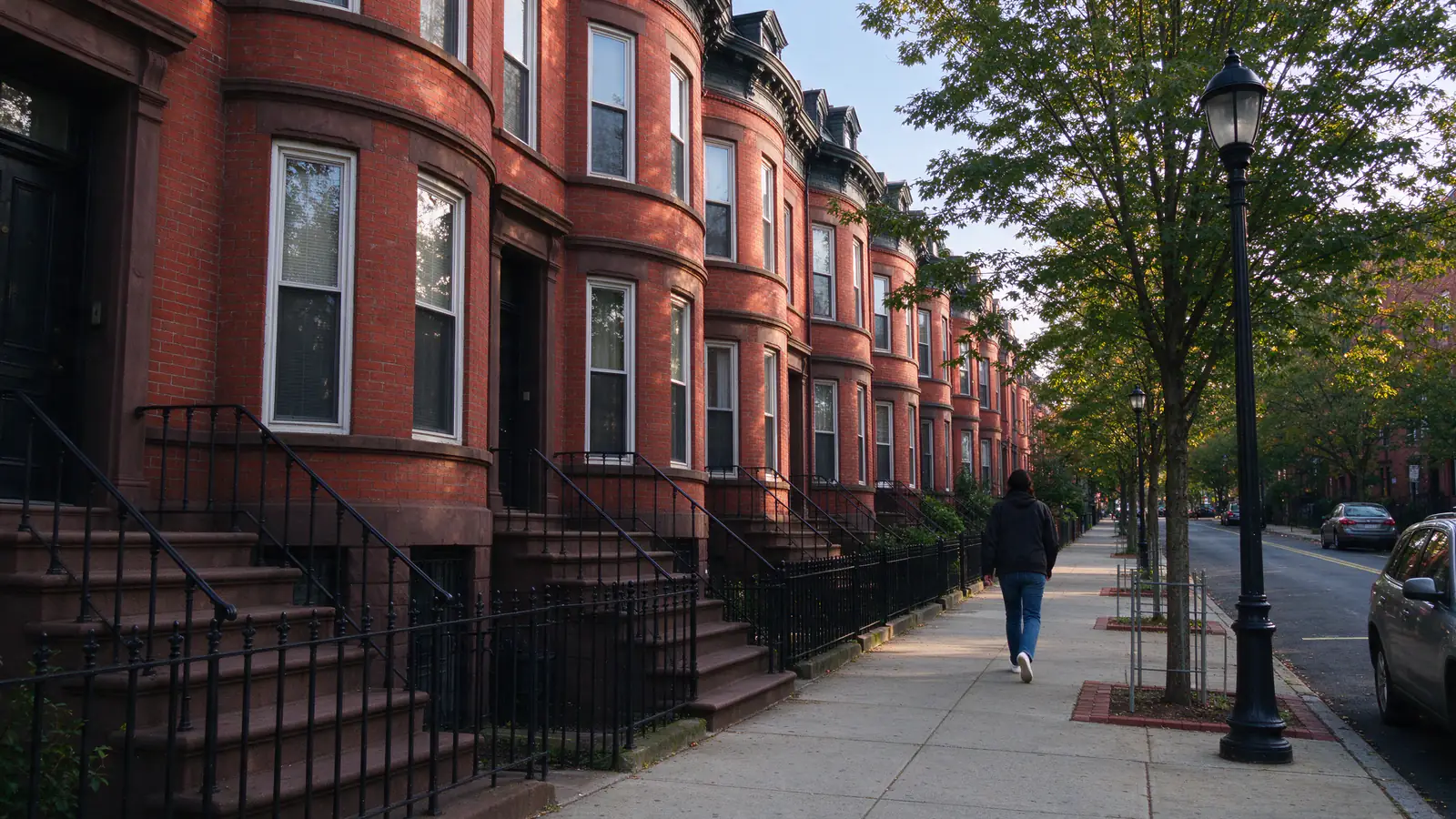
Rewiring a historic home in Boston works like any other knob and tube replacement inside the walls; what changes is the exterior equipment and how carefully the interior finishes are treated. Boston’s local historic districts review exterior work, particularly what can be seen from a public way, so a new meter, service mast or exposed conduit may need a commission decision before the building permit, while new cable fished through the walls doesn’t. Decker Boston Knob and Tube arranges plaster wall rewiring and knob and tube replacement in historic houses across Boston and nearby cities, carried out by licensed and insured electricians.
Many of these houses are also among the oldest housing in the area. In Beacon Hill’s 02108 ZIP code, 75.0% of housing units were built before 1940, the highest share of any Boston ZIP code, according to the U.S. Census Bureau.
What Boston’s districts review
The Boston Landmarks Commission oversees a set of local districts, each with an architectural or landmark commission and its own review scope. The common thread is the exterior.
| District | Designated | What is reviewed |
|---|---|---|
| Back Bay Architectural District | 1966, later expanded | All proposed exterior work |
| Historic Beacon Hill District | 1955, expanded several times, most recently 2024 | All exterior work visible from a public way, including views from the Common, Public Garden, Storrow Drive, the Esplanade and the Longfellow Bridge |
| South End Landmark District | 1983 | Front facades, plus rooftops and side or rear elevations visible from or directly facing a public way |
| Bay Village Historic District | 1983 | Exterior work |
| St. Botolph Area Architectural Conservation District | 1981 | Exterior work |
| Aberdeen Architectural Conservation District, Brighton | 2002 | All exterior work visible from a public way |
| Mission Hill Triangle Architectural Conservation District | 1985 | Front, side and visible rooftop work; rear elevations excepted |
| Highland Park Architectural Conservation District, Roxbury | 2022 | See the district’s own page for its review scope |
The commission also lists the Bay State Road/Back Bay West and Fort Point Channel districts, and a Monument Square district in Charlestown under study. Each district page says the commission’s decision letter is needed to obtain your building permit.
What that means for a rewire
Cable fished between floors, new boxes and a new panel in the basement are interior work. A new service entrance, a relocated meter, a mast on a roofline or conduit run up a visible wall is exterior work, and in these districts it goes to the commission first. Build that step into the schedule, and settle the service location with the commission before the utility request goes in.
Back Bay’s rules for service equipment
Back Bay goes furthest. Its residential guidelines treat all communications and service equipment as subject to commission review and spell out where it may go.
The guidelines in plain terms
- No electrical, telephone, cable or other utility equipment on the primary elevations of any building.
- All wiring and equipment should be black.
- Building attachments go between the first and second story on the rear elevation.
- All connections to individual units are made inside the building.
- Exposed conduit is inappropriate for entry lighting, conduit for rear-yard lighting is concealed, and exterior conduit on rooftops is inappropriate.
What it changes
For a service upgrade, the rear elevation is the starting assumption, and a design that feeds each unit from inside rather than with exterior runs fits the guidelines. The panel upgrade guide covers when a service change is part of a rewire at all.
Cambridge, Somerville, Brookline and Newton
Nearby cities have their own commissions. Their scopes are similar in spirit and different in detail.
Cambridge
The Cambridge Historical Commission oversees two historic districts, Old Cambridge and Fort Washington, and four neighborhood conservation districts: Avon Hill, Half Crown-Marsh, Harvard Square and Mid Cambridge. The conservation district commissions review alterations visible from a public way; interior alterations and work not visible from any public way are exempt. Exempt and in-kind work gets a Certificate of Non-Applicability, which staff usually issue on the spot, and the commission says one of its certificates is always needed to obtain a building permit in a district or on a landmark. See the Cambridge page.
Somerville
Somerville’s Historic Preservation Commission reviews alterations or repairs in a Local Historic District that are visible from a public way and would make an irreversible change to the design, materials or outward appearance. Routine maintenance in kind isn’t reviewed. The city publishes a list of district properties by address, and applications go through CitizenServe, the same portal as electrical permits. See the Somerville page.
Brookline and Newton
Historic review rules in both are confirmed per address and project before any exterior electrical work is planned. See the Brookline and Newton pages.
Inside: protecting historic plaster and trim
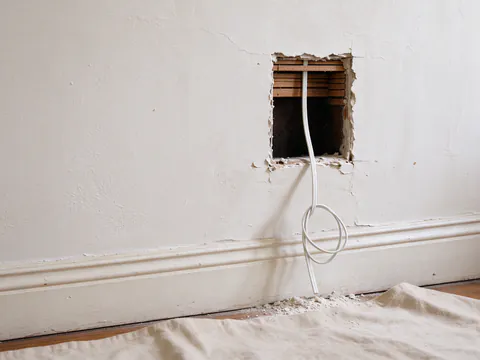
Indoors there’s no commission, but there is the house. Original plaster, cornices, picture rails, ceiling medallions and painted woodwork are what a careless rewire damages and a careful one avoids.
Route planning first
The Massachusetts code allows cable to be fished between access points for concealed work in finished buildings, which is what makes a plaster-preserving rewire possible. Routes come down from the attic, up from the basement, and through closets and chases that stack between floors. Openings go where they’ll be hidden or easiest to restore: behind future box locations, at top plates, inside closets. The replacement process guide shows where those openings fall in the sequence.
Decorative ceilings
Ceilings plastered over wood strapping can sometimes be crossed without opening them, since the state code treats cable run diagonally behind strapping of about three-quarters of an inch as supported if it isn’t pulled taut. A fixture box under a medallion can sometimes be reached from the attic or the floor above, leaving the decorative plaster untouched.
Lead paint on old finishes
Painted plaster and trim in a house built before 1978 fall under the state’s lead-safe renovation rules. Disturbing more than six square feet of painted surface in a room, without testing, makes the job renovation work for a licensed lead-safe renovation contractor. Small, planned openings help on both counts. The asbestos and lead paint guide covers the rule in full.
Taller rowhouses and apartment buildings
Many houses in the historic core are taller masonry buildings with several units. In 02108 and 02116, about 74% of housing units are in buildings of five or more units, according to the U.S. Census Bureau.
That matters because, in buildings over three stories, the Massachusetts code limits cable circuits to the floor or dwelling unit where they start. The wiring method in a five-story rowhouse may differ from the one in a two-story house, and the scope should say which is used where. The Back Bay, Beacon Hill and South End page covers those buildings.
What it does to the budget
Historic finishes are one of the drivers that move a house within the typical Boston-area budgeting range of $8,000 to $25,000 or more for a whole-house replacement: slower, smaller openings and more careful restoration take more time. Commission review adds a step to the schedule. The cost guide covers the other drivers, and the quote comparison guide shows how to check that restoration is written into the scope.
To plan a rewire around a historic house’s finishes and its district’s rules, call Decker Boston Knob and Tube at (617) 405-3599 or ask for an estimate.