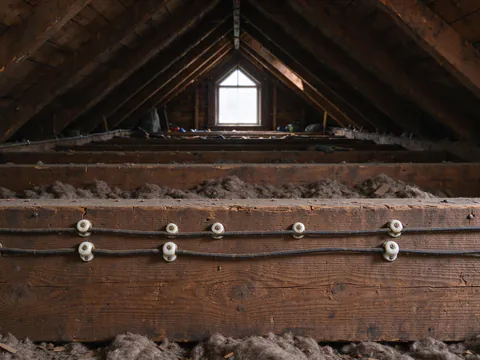
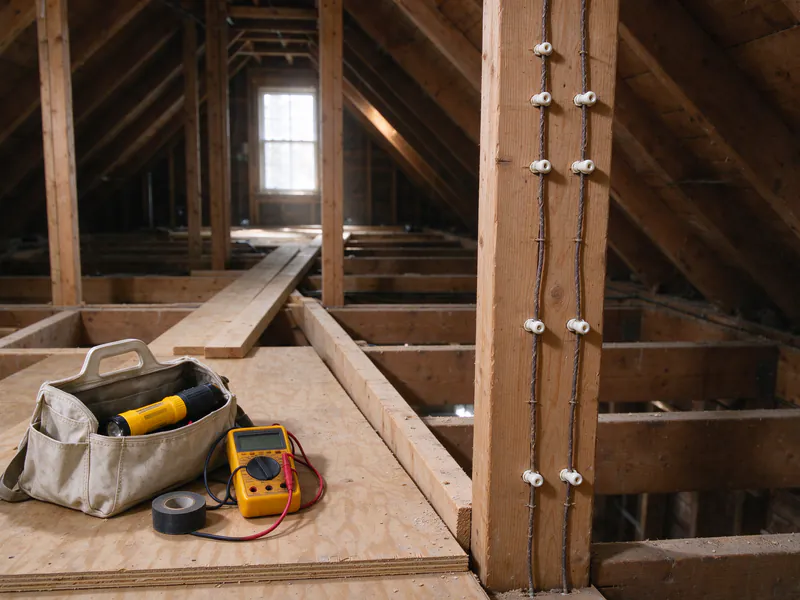
Knob and tube is easiest to identify where the framing is exposed. Look for two separate wires, each in a rubber and cloth covering, running several inches apart on porcelain knobs nailed to joists or rafters, and passing through porcelain tubes where they cross framing. Hints in finished rooms prove much less. Decker Boston Knob and Tube arranges knob and tube inspections and replacement in Boston and nearby cities through licensed and insured electricians, and this guide shows what to look for without touching anything.
Identifying it is the first step, not the last. What you can see tells you the system is or was in the house; it doesn’t tell you how much is still live or where it continues behind plaster.
What each part of the system looks like
Each component has a job, and knowing the job makes it easier to recognize.
Knobs
Small porcelain spools, usually nailed through the center into a joist or rafter. The conductor is wrapped around the knob or tied to it, which holds it clear of the wood. Where a run changes direction, you’ll often find a knob at the turn.
Tubes
Short porcelain sleeves pushed through holes bored in studs, joists and beams. Wherever a wire passes through framing rather than along it, a tube keeps it from touching the wood. A line of tubes through a basement beam is a strong sign.
Loom
A flexible woven sleeve slipped over the conductors where they enter a box, a fixture or a tight spot. It often looks like a dark, frayed fabric tube where the wire disappears into a ceiling or wall.
The conductors
Solid copper wire in a rubber layer under a cloth wrap, often darkened with age and dust. The two wires of a circuit travel apart, typically several inches, and only come near each other at a splice or a device.
Splices
Original branch connections were wrapped joints along the run, covered in old tape. A splice where a branch heads off toward a room is part of the original design. A splice to newer, flat cable is a later change (mixed with newer cable).
Where to look in a Boston-area house
| Where | What to look for | What to keep in mind |
|---|---|---|
| Basement ceiling | Pairs of single wires along joists on knobs, tubes through beams, runs heading up into walls | The best place to see the system; a finished basement ceiling hides it |
| Attic floor and rafters | Wires across joists or up rafters to ceiling fixtures below | Insulation may cover the runs; don’t dig through it |
| Top-floor knee walls and eaves | Short runs feeding outlets and lights in sloped rooms | Often reached through small access panels; look only |
| Around the fuse panel | Single wires entering the panel, often through loom | A breaker panel can still feed old circuits |
| Triple-decker stairwells and common halls | Old fixtures and switches for shared lighting | Each floor may have been updated differently (triple-decker rewiring) |
| Flat-roofed buildings | Little or no attic to inspect | The Boston Preservation Alliance describes South Boston’s triple-deckers as mostly flat-roofed, which leaves fewer places to see the wiring |
Clues in finished rooms
Inside the living space, the wiring is hidden, so the clues are indirect. None of them proves knob and tube on its own.
- Two-prong outlets. Found on ungrounded circuits, including knob and tube, but also on early cable.
- Push-button switches and old ceiling fixtures. Original devices suggest original wiring behind them.
- Outlets low in the baseboard or few per room. Typical of circuits laid out before modern loads.
- Three-prong outlets in an old house. These prove nothing about grounding; they can sit on a knob and tube circuit (ungrounded outlets).
You don’t need to remove a cover plate or pull out a device to learn more. An electrician looks inside boxes with the circuit off, which is part of an inspection.
What it can be confused with
Two later wiring methods turn up in the same houses and get mistaken for knob and tube.
| Lookalike | How it differs | Why it matters |
|---|---|---|
| Cloth-sheathed cable | Both wires bundled in one fabric jacket and fastened flat to the framing, not held apart on porcelain | Different age and failure pattern, though often replaced in the same job (knob and tube versus cloth wiring) |
| Early armored cable | Wires inside a spiral metal sheath | A different system with its own questions, including whether the jacket can serve as a ground, which only an electrician can judge |
| Empty knobs | Porcelain left on joists after the wire was removed | Shows where wiring once ran, not where it runs now |
Clues from the house itself
Building age is a reason to look. Mass Save trains its assessors to assume knob and tube may be present in any house from before 1955. In Boston, 46.7% of housing units were built before 1940 (U.S. Census Bureau), so a very large share of the city’s homes fall in that window.
Age doesn’t settle it, though. Some of those houses were rewired in part or in full long ago. A permit history, earlier inspection reports and a seller’s records can narrow the question before anyone opens a panel.
Taking useful notes for an electrician
If you find what looks like knob and tube, a few photos and notes make the first visit more productive.
- Photograph the runs from a distance, without moving them or the insulation.
- Photograph the panel with its cover on, and note whether it uses fuses or breakers.
- Note which rooms have two-prong outlets or original switches.
- Write down anything you know about past renovations or rewiring.
Where identification ends
Spotting knob and tube answers “is it here?” The next questions, which runs are live and how far they reach, take circuit tracing by an electrician. The live wiring guide explains that process, and the knob and tube wiring guide covers how the whole system works.
If you’ve found knob and tube and want to know what it means for your house, call Decker Boston Knob and Tube at (617) 405-3599 to arrange an inspection, or request an estimate.