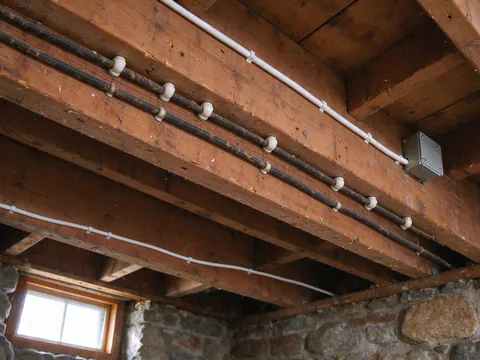
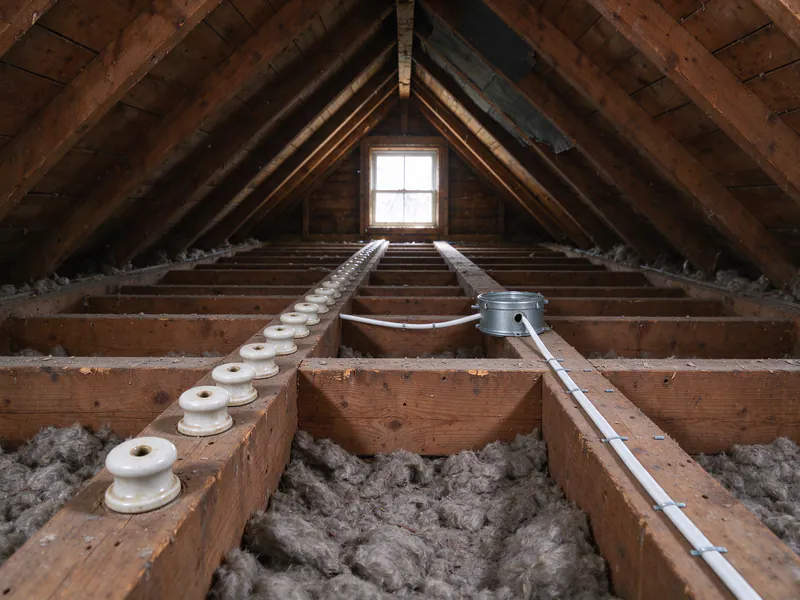
Replace part of the knob and tube when only a few circuits remain, the rest of the wiring is sound, and nothing requires you to prove the house is free of it. Replace all of it when most circuits are still original, old and new wiring are spliced together throughout, an insurer wants every run gone, or the walls are opening anyway. Decker Boston Knob and Tube arranges both partial replacement and whole house rewiring in Boston-area homes, carried out by licensed and insured electricians.
Neither answer is right by default. The state code lets working knob and tube remain, so the choice rests on the circuit map, the reason you’re acting now and what you plan to do with the walls.
Three different jobs
People use “fixing the knob and tube” for three scopes that solve different problems.
| Scope | What it does | When it fits | What it leaves |
|---|---|---|---|
| Repair | Corrects a specific fault on an existing knob and tube run | A failed device or a damaged short section, with sound wiring around it | The circuit stays knob and tube: ungrounded, few outlets, old insulation |
| Partial replacement | Replaces selected circuits, rooms or floors with new wiring | A few circuits left after earlier rewiring, or a staged plan | Knob and tube on the circuits not yet replaced |
| Full replacement | Replaces every active knob and tube circuit in the house or unit | Most circuits original, or a requirement to remove all of it | Only disconnected runs, documented as dead |
Disconnecting runs that already have replacements elsewhere is a fourth, smaller task that can come with any of these (removal service).
When repair is enough, and when it isn’t
Repair keeps the existing system and corrects one problem. It can make sense for a single failed switch or outlet, a short damaged section in an open basement, or an original joint that has loosened where it can be reached.
Repair has limits that replacement doesn’t. It adds no ground, no new circuits and no arc-fault protection, and it means handling brittle conductors whose insulation can crack beside the fix. If faults show up in several places, that pattern is the finding: the circuit, not the fault, is the problem.
What points toward a partial job
- The circuit map shows only a handful of knob and tube circuits left, such as attic-fed ceiling lights or one bedroom.
- The rest of the house is on modern cable in good condition.
- The goal is a Mass Save insulation job, and the knob and tube to clear sits in the areas being insulated.
- The budget calls for staging, one floor or unit at a time.
- A renovation will open some rooms soon, and those circuits can wait until then.
The Mass Save angle
Mass Save’s standards ask a licensed electrician to certify that the home is free of active knob and tube in the areas where insulation or air sealing is recommended. That is an area-by-area test, so a partial job focused on the attic and the walls being insulated can meet it. The insulation barrier service covers that work.
What points toward full replacement
- Most circuits are still original knob and tube.
- Old and new wiring are spliced together on many circuits, so the boundary is hard to define (mixed with newer cable).
- An insurer wants all knob and tube removed, or proof that none remains in service.
- The panel or service is being replaced anyway, so every circuit will be touched.
- A major remodel will open walls throughout the house.
- The house is empty between owners, the easiest time to reach every room.
The questions that settle it
How many circuits remain?
Everything starts with tracing. A first visit begins at the panel, traces every circuit and checks the attic and basement routes, so the count of live knob and tube circuits and where they run is known before anyone prices a scope (how live wiring is verified).
Who is asking, and what do they need?
An insurer usually asks about the whole house; Mass Save asks about the work areas. A buyer wants a clear record. Homeowners report carriers putting that whole-house question directly, and a staged job can only answer it once the final phase is finished (insurance guide).
What are your plans for the walls?
If a kitchen or bath remodel is coming, rewiring those rooms during the remodel avoids opening finished walls twice (remodel rewiring). If the plaster is staying, the access plan for each circuit affects cost and disruption, whether the scope is partial or full.
Does the panel have room?
New circuits in a Massachusetts home need arc-fault protection on every 120 volt, 10, 15 and 20 amp branch circuit supplying outlets or devices. A full rewire is a natural time to replace the panel; a partial job may fit in an existing breaker panel if it has space and capacity.
How the costs compare
A whole-house replacement falls in a typical Boston-area budgeting range of $8,000 to $25,000 or more. Partial replacement has no published range because the leftover circuits vary so much; it is priced from the circuit map, and the remaining runs can be the hardest to reach. The cost guide explains what moves both.
Staging a full replacement as a series of partial jobs spreads the cost but adds to it. Each phase has its own permit, its own setup and its own round of patching.
Staging a full replacement over time
When the goal is full replacement but the budget or the household calls for stages, plan the whole job first and then cut it into phases.
- Map every circuit and agree on the end state.
- Order the phases by risk and access, often the attic and top floor first.
- In a triple-decker, work floor by floor, with notice to each household before its power-off windows.
- Keep power-off windows planned so boiler or furnace controls stay powered.
- After each phase, update the written record of what remains.
Describing a partial job honestly
At the end of a partial job, the owner receives a labeled panel and a written list of which circuits were replaced and which still run on knob and tube. “Knob and tube removed” is only true when no knob and tube remains in service. Anything else invites a mismatch between what an insurer or buyer was told and what is in the walls.
To get the circuits mapped and both options priced side by side, call Decker Boston Knob and Tube at (617) 405-3599 or ask for an estimate. The replacement process guide shows what each stage involves.