
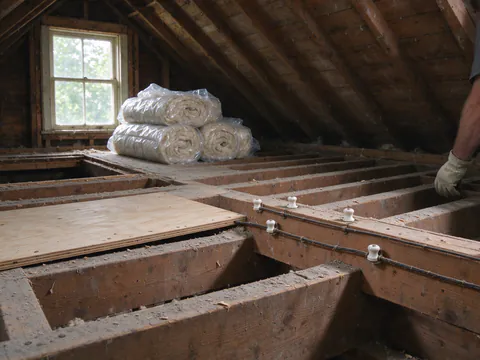
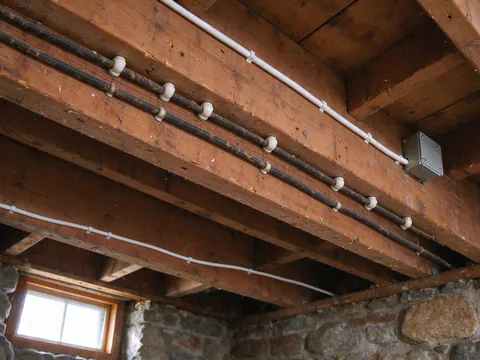
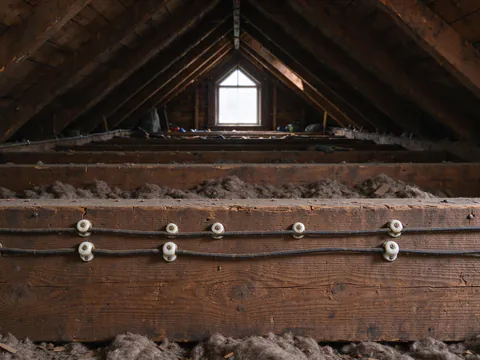
“Remove knob and tube so customer can insulate.” That is the whole description on one City of Cambridge electrical permit, and it sums up how much of the city’s knob and tube work begins: with an insulation project that can’t go ahead until the old wiring is out of service. Decker Boston Knob and Tube arranges knob and tube replacement across Cambridge, from Agassiz-Baldwin and Neighborhood Nine to Mid-Cambridge, North Cambridge and Cambridgeport, carried out by licensed and insured electrical contractors.
Cambridge has its own permit office, its own fee schedule and its own historic review, separate from Boston’s. The job usually starts with a knob and tube inspection that finds which circuits are live and which unit or common area each one serves.
Where Cambridge’s knob and tube permits cluster
Cambridge publishes its electrical permits as open data, which shows clearly where the old wiring is being replaced: the residential neighborhoods west and north of Harvard Square.
Between November 2021 and October 2026, 94 of 13,591 electrical permits named knob and tube. The neighborhood breakdown shows the concentration.
| Neighborhood | Permits naming knob and tube | All electrical permits | Per 1,000 |
|---|---|---|---|
| Baldwin | 29 | 913 | 31.8 |
| Strawberry Hill | 4 | 216 | 18.5 |
| Mid-Cambridge | 13 | 1,169 | 11.1 |
| Neighborhood Nine | 12 | 1,135 | 10.6 |
| North Cambridge | 15 | 1,559 | 9.6 |
| West Cambridge | 14 | 1,747 | 8.0 |
| Cambridgeport | 5 | 1,236 | 4.0 |
| Riverside | 2 | 866 | 2.3 |
East Cambridge and Area 4 recorded none in that window. Descriptions are free text, so a permit that says only “rewire” isn’t counted, and the figures show where old wiring is being written up, not which houses still have it.
Clearing the way for insulation
When knob and tube is found during an energy assessment, insulation stops until a licensed electrician certifies the work areas. In Cambridge, that rule shows up directly in the permit text.
The Mass Save rule
Mass Save’s assessment standards say that if any evidence of knob and tube is found, no insulation may be installed until a licensed electrician addresses the wiring. The customer needs certification that the home is free of active knob and tube in every area where work is recommended. Air sealing and duct work can sometimes go ahead if the wiring isn’t disturbed.
What the electrician delivers
The certification is area by area, so the scope can match the insulation plan. One Cambridge permit reads “Remove knob & tube wiring in Basement and Attic in preperation of insulation.” Where only those areas are being insulated, the job may be a targeted insulation barrier clearance rather than a full rewire, with the boundary written down. The guide to telling whether knob and tube is live explains why inactive runs are treated differently.
One unit, the common stairs, or the whole house
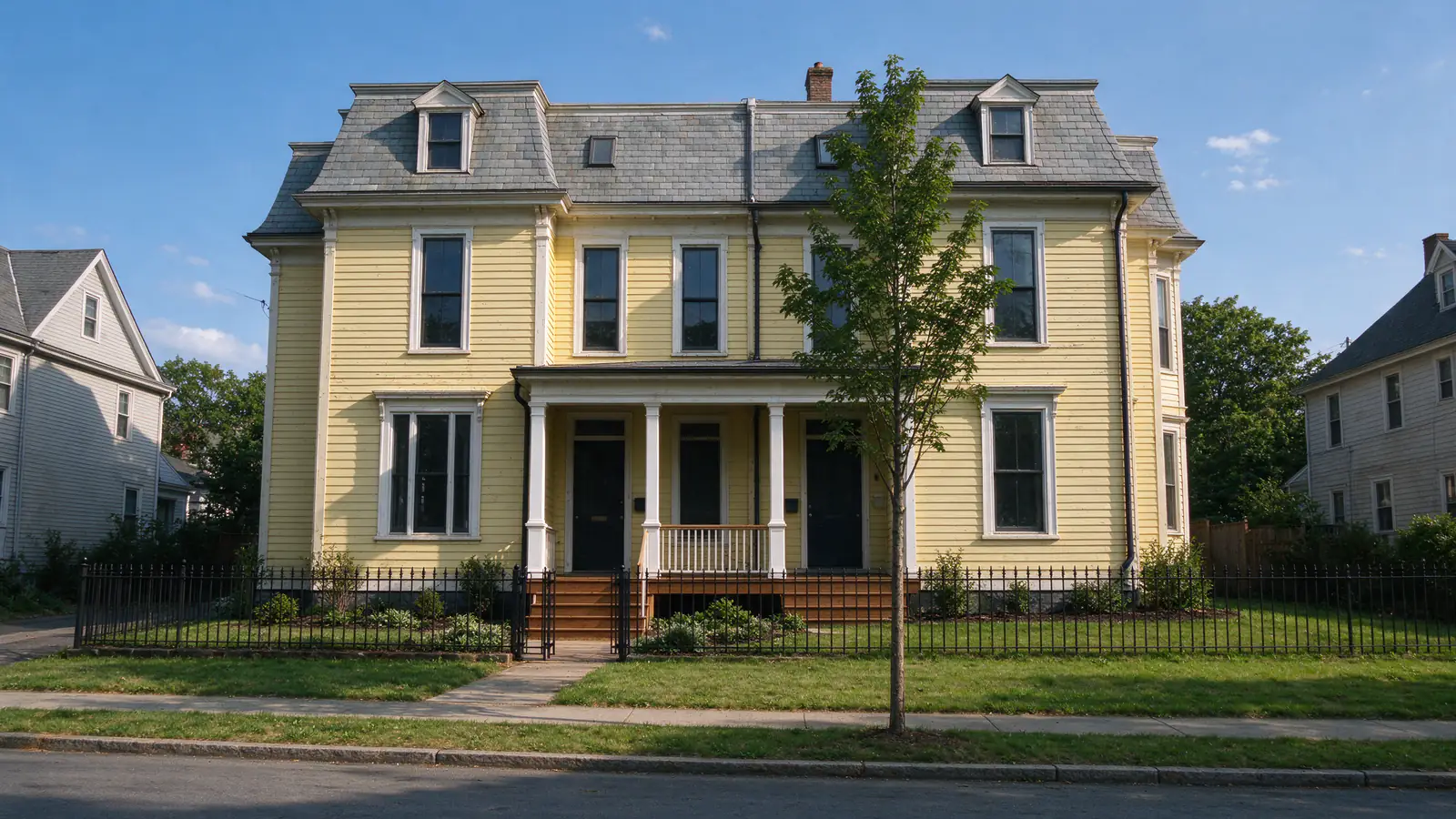
Only 9.9% of Cambridge’s housing units are detached houses, and 54.5% are in buildings of five or more. Most knob and tube permits here are in multi-family buildings, 56 against 35 in one- or two-family dwellings over the last five years.
Unit by unit
A common scope is a partial replacement covering one apartment or condo. A 2019 permit reads “unit #3 rewire knob and tube … install 60 amp sub panel,” and 15 of the city’s 155 permits naming knob and tube mention a sub-panel. Where each unit gets its own panel, the work becomes a staged triple-decker or multi-unit rewire.
Hallways and stairs
Thirty-one of those 155 descriptions name hallways, common areas or stairs. Massachusetts lets common-area lighting on the same floor as a unit, in a two-family or an existing three-family building, be fed from that unit’s equipment, which can keep the stair lights off a separate house panel.
Panel and service
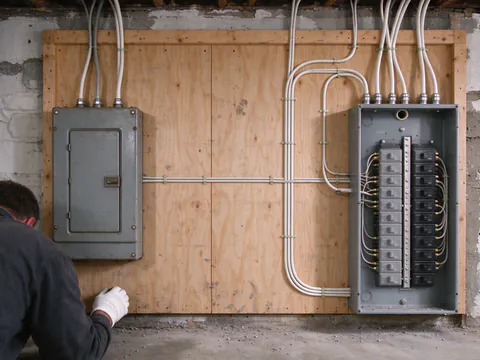
Forty-one of the 155 mention a service or panel, and in a one- or two-family house a panel change may come with a whole house rewire. The panel and service upgrade page explains when the new circuits outgrow what’s there.
Cambridge ISD permits and what they cost
The Electrical/Wiring Division of the Cambridge Inspectional Services Department, at 831 Massachusetts Avenue, issues electrical permits through the city’s online system, with its own inspectors. Its posted fees are set per item.
| Item | Fee |
|---|---|
| 15 amp receptacle | $1 each |
| 20 amp receptacle | $4 each |
| 30 amp dryer circuit | $5 |
| 50 amp range or water heater | $8 |
| Service, per 100 amps | $10 |
| Meter | $5 each |
| Reinspection for a code violation | $50 |
The posted schedule lists no base application fee or lighting-outlet line, so the electrician confirms the full fee with ISD at 617-349-6100. Work started before a permit triples the fee.
Historical Commission certificates
The Cambridge Historical Commission oversees two historic districts, Old Cambridge and Fort Washington, and four neighborhood conservation districts: Avon Hill, Half Crown-Marsh, Harvard Square and Mid Cambridge.
Interior alterations and work not visible from any public way are exempt from review, and staff usually issue a Certificate of Non-Applicability for them on the spot. A new meter, mast or exterior conduit visible from the street is the kind of change that goes to review. The Commission says a certificate is always needed for a building permit in a district or on a landmark, so check the address first. The historic district guide covers the design side.
From certificate to final inspection
Most Cambridge jobs move through the same steps, and where insulation is planned, its date is the deadline they work back from.
- The first visit starts at the panel, traces every circuit, and checks the attic and basement routes.
- The written scope names each new circuit, each old run left disconnected, the openings, the panel, and patching as its own line.
- Any Historical Commission certificate the address needs comes first; then the licensed electrician files with Cambridge ISD.
- Work goes area by area, with planned power-off windows that keep the boiler or furnace controls powered, and notice to other households in a multi-family.
- Rough-in inspection, then disconnect and test: old circuits are taken out of service, and reachable attic and basement runs are removed before walls close.
- The finish is a labeled panel schedule and a written summary that no knob and tube remains in service, plus the licensed-electrician paperwork Mass Save asks for.
Insulation waiting on old wiring?
Start with which areas the insulation plan covers and which circuits run through them.
Between Fresh Pond and the river
The city is small, but the houses that carry most of this work sit in a fairly clear band.
North of Harvard Yard, Baldwin and Neighborhood Nine run up Massachusetts Avenue toward Porter Square on the Red Line. Baldwin has the city’s highest rate of knob and tube permits, nearly 32 per 1,000 electrical permits. West Cambridge, around Brattle Street, Longfellow House and out toward Fresh Pond, has the second-highest count across all years, 33 permits since 2018, behind Baldwin’s 44.
North Cambridge, out toward Route 2 and the Alewife Brook Parkway, logged 15 in the last five years and Mid-Cambridge 13. Cambridgeport, near Memorial Drive, shows far fewer for its size, about 4 per 1,000, and East Cambridge none.
The calendar matters too. Boston-area winters average 91.6 days at or below freezing (NOAA), and insulation planned for fall or winter puts the electrical certification on a deadline. Cambridge is Eversource territory, so Mass Save’s barrier incentive and HEAT Loan apply. The Boston-area cost guide shows what moves the price.