
Somerville keeps more of its pre-war housing than any other city in Boston’s inner core. Census figures date 59.0% of its homes to before 1940, ahead of Belmont, Brookline and Cambridge, and put 55.2% of all units in buildings of two to four units. Decker Boston Knob and Tube arranges knob and tube replacement across Somerville, from Davis, Teele and Ball Squares to Spring Hill, Winter Hill and East Somerville, carried out by licensed and insured electrical contractors.
The typical job is one floor of a wood-frame two-family or triple-decker, with someone living on the other floors. It starts with a knob and tube inspection that sorts out which unit each live circuit belongs to.
West Somerville carries most of the named work
Somerville’s open permit data shows knob and tube work concentrated on the city’s west side, between Davis Square and Tufts.
Between November 2021 and October 2026, 60 of 9,332 electrical permit applications named knob and tube. The rate is what stands out.
- Hillside: 17 of 390 electrical applications, 43.6 per 1,000, the highest in the city.
- Davis Square: 16 of 1,037, 15.4 per 1,000.
- Spring Hill and Winter Hill: 7 and 5, around 5 per 1,000.
- Magoun Square, East Somerville, Teele Square and Ball Square: two or three each.
- Union Square: 1 of 1,354.
Across all years since 2014, 181 applications named knob and tube, 180 of them residential. Descriptions are free text, so the counts show where old wiring gets written up, not which houses still have it.
A two-family is two jobs that share a basement
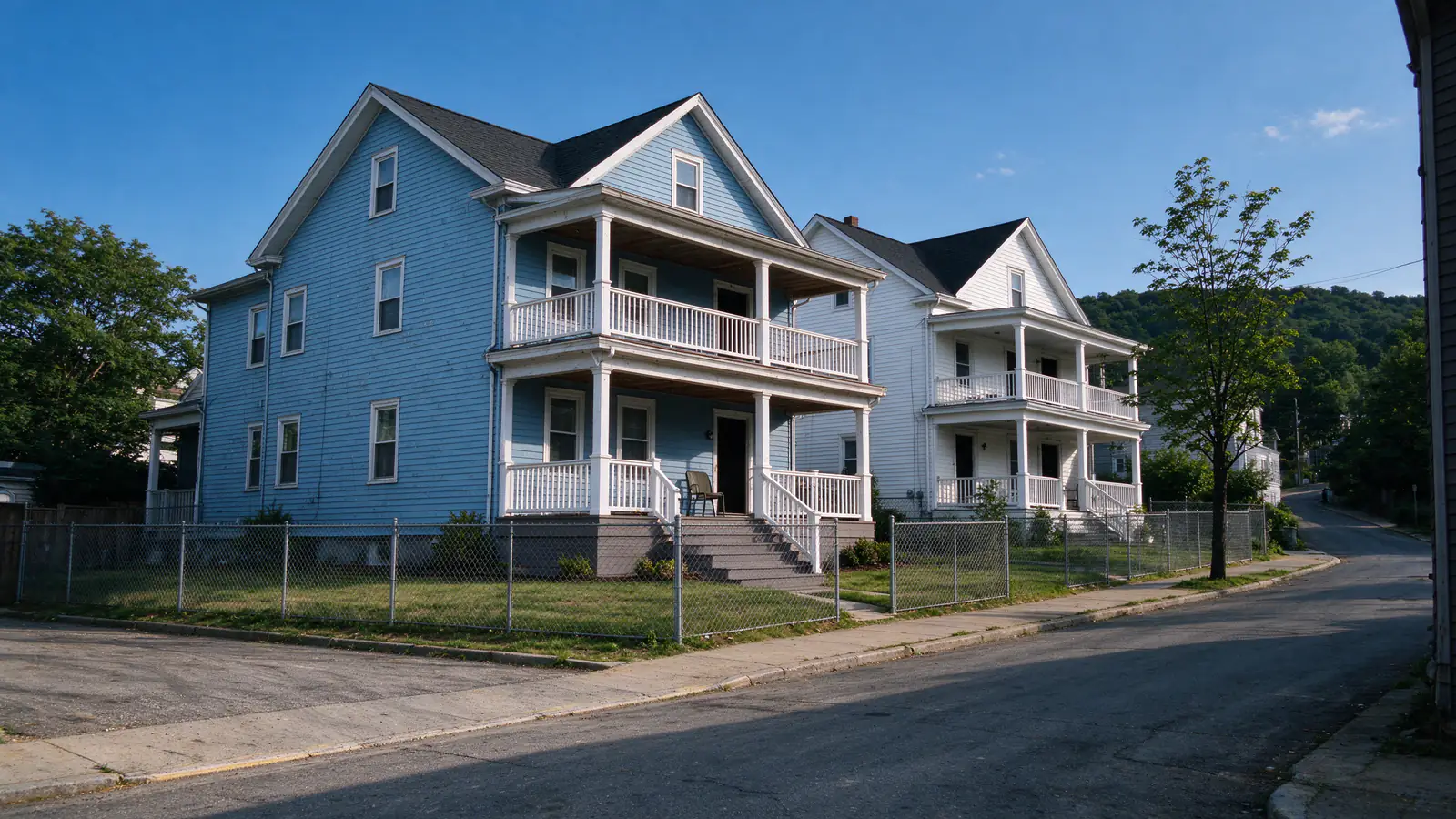
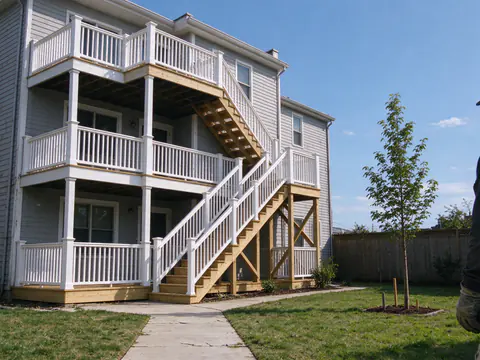
Most Somerville housing is stacked: 28.2% of units are in two-unit buildings and 27.0% in three- and four-unit buildings. The permits read accordingly.
Floor by floor
“Rewire knob and tube 1st 2nd and 3rd floor” (Teele Square, 2022) and “replace knob and tube circuit in each of the 3 units” (Porter Square, 2021) are typical. Each floor is normally its own dwelling unit and its own stage, so the household upstairs keeps power on its circuits while the floor below is worked on. Where one floor was already updated, the work there is a partial replacement of whatever remains. A full three-unit job follows the triple-decker rewiring approach.
The shared spaces
The basement carries every unit’s circuits back to the meters, and the front and back stairs are their own scope. Sixteen of the 181 descriptions mention hallways, common areas or stairs. In a two-family, new or existing, the Massachusetts code lets common-area lighting on a unit’s floor be fed from that unit’s equipment.
Panels per unit
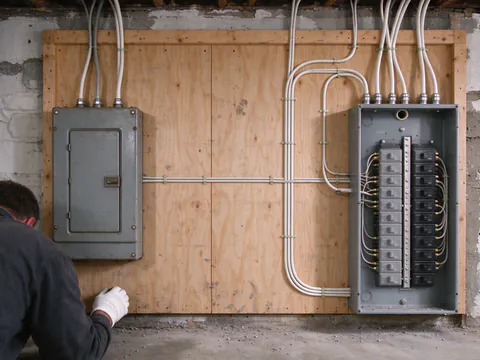
Thirty-five of the 181 mention a service or panel, and nine mention a sub-panel. The panel upgrade page covers when each unit’s capacity has to grow.
Crawl spaces, basements and the top floor
The access in a Somerville house usually depends on what’s above the top unit and below the first.
The attic
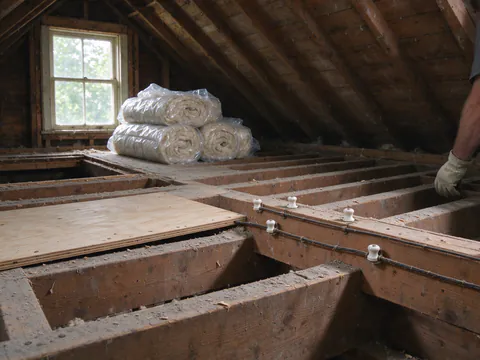
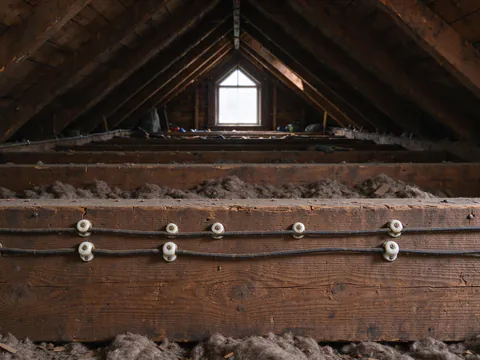
A 2021 Winter Hill permit reads “Remove old knob tub wires in attic crawl space.” Where the attic is a low crawl space rather than a walk-in room, cable can still cross the joists, but working room is tight and any insulation over the old runs has to be checked for live wiring first. Seven of the 181 descriptions mention the attic.
The basement
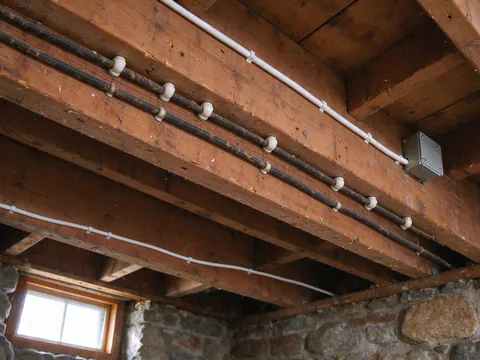
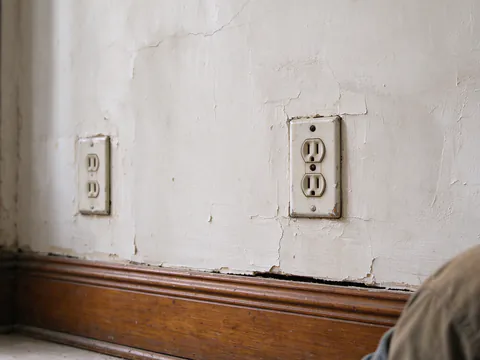
Thirteen mention the basement, where every floor’s runs meet. An open basement ceiling makes the first floor the easiest to reach, and stacked closets or chases carry cable to the floors above. Where no path exists, small openings in plaster are fished between, which the state code allows in finished buildings. The plaster wall rewiring page covers that work.
Insulation as the trigger
A 2014 permit reads “ELIMINATE KNOB & TUBING 2ND FLOOR FOR INSULATION.” Mass Save’s standards stop insulation in a home where knob and tube is found until a licensed electrician certifies that the work areas are free of active knob and tube, which is what insulation barrier work delivers.
Somerville ISD, CitizenServe and the Historic Preservation Commission
Somerville runs its own permit office, separate from Boston’s and Cambridge’s.
Somerville Inspectional Services issues electrical permits through the CitizenServe portal, and a licensed electrician must apply. The contractor confirms the current fee with ISD. The Historic Preservation Commission reviews changes visible from a public way to properties in Local Historic Districts that would irreversibly alter their design, materials or appearance. Interior rewiring isn’t reviewed; a new mast or meter on a listed property can be. The city’s address list shows whether a house is in a district.
Rewiring around the people who live there
The order is the same in most Somerville houses; the notice to each household is what changes.
- The first visit starts at the panels, traces every circuit, and checks the attic and basement routes.
- The written scope splits the work by unit and common area, with patching as a separate line.
- Each household gets notice of its floor’s dates and any shutdown of the shared service.
- The licensed electrician files the permit through CitizenServe, and work goes floor by floor with power-off windows that keep the boiler or furnace controls powered.
- The rough-in inspection comes before walls close, within 72 hours of notice, weekends and holidays excluded.
- The finish is a labeled panel schedule for each unit and a written summary that no knob and tube remains in service.
Rewiring one floor of a Somerville two-family?
Start with which floor still runs on the old circuits and how the basement reaches it.
From Davis Square to East Somerville
The city is dense and fairly uniform in age, but the patterns shift from west to east.
Around Davis Square on the Red Line and up the Hillside toward Tufts, the rate of permits naming knob and tube is far above the citywide 6.4 per 1,000: nearly seven times it on the Hillside and more than twice it in Davis Square. Where a street is lined with two-families and triple-deckers, the work is usually one household’s floor at a time.
Spring Hill, and Winter Hill along Broadway, show about 5 per 1,000, closer to the city’s average; Prospect Hill and its monument sit just south. Union Square and East Somerville, near Route 28, I-93 and the Green Line Extension toward Assembly Row, show the fewest, so a house there gets the same tracing without any assumption from its neighbors.
Winter work happens in occupied houses with heating systems running. Boston-area winters average 91.6 days at or below freezing (NOAA), so a shutdown of a shared service in a two-family is planned around both households’ heat.
Paying for it in Somerville
Somerville is Eversource territory, so Mass Save programs apply. The barrier incentive of up to $7,000 for moderate-income households covers 1 to 4 unit homes, and the HEAT Loan offers 0% financing after an assessment. The grants guide explains both, and the living at home guide covers the working days. The cost guide shows what moves the price.