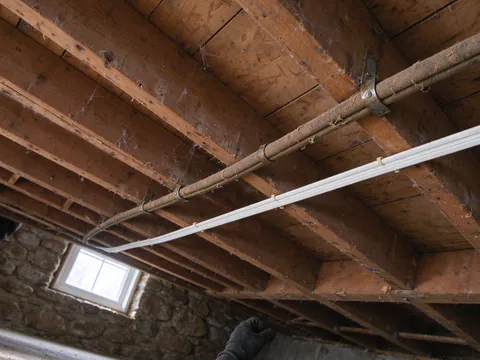
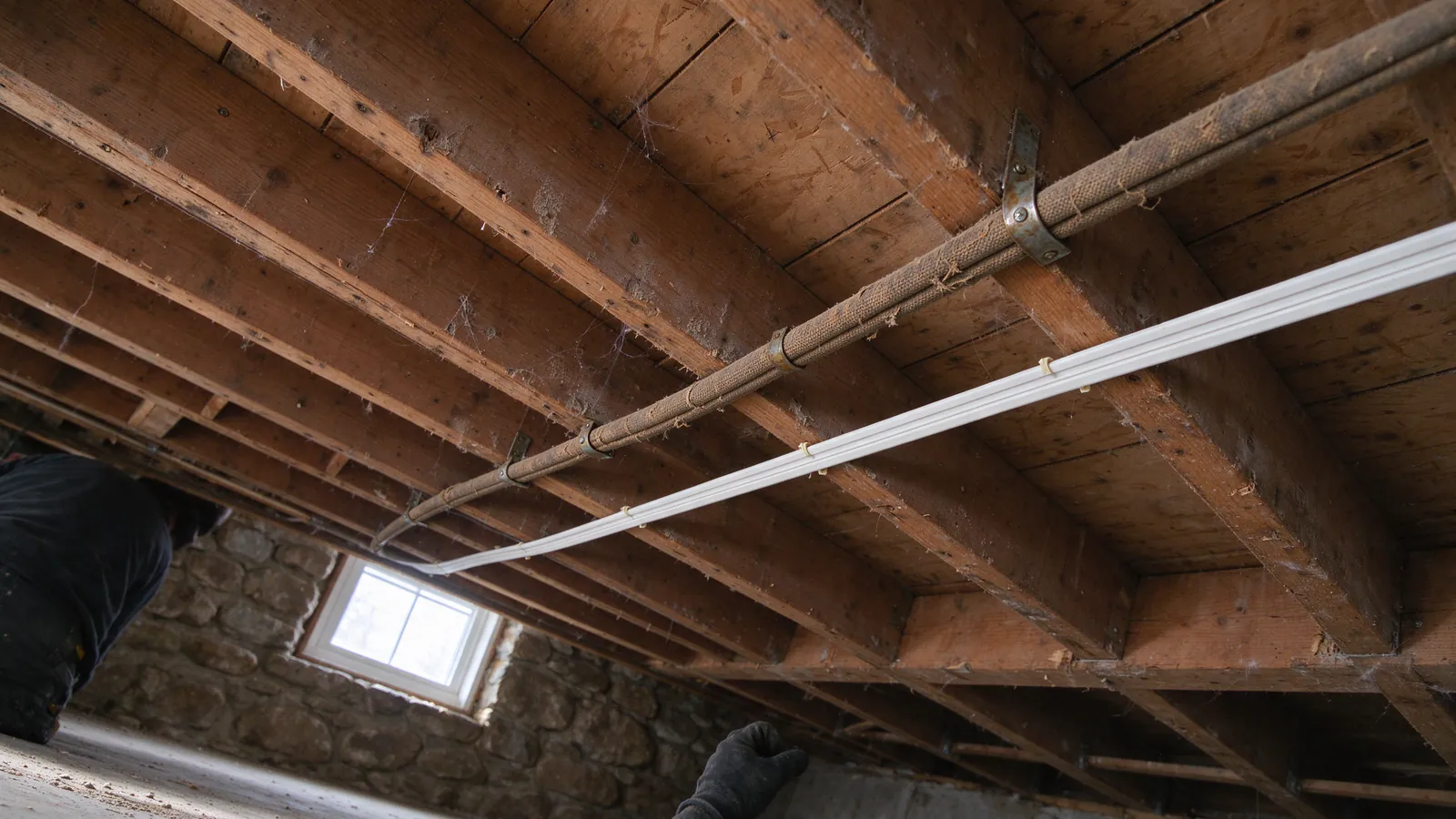
Knob and tube and cloth wiring are not two names for the same thing. Knob and tube runs each conductor on its own path, held off the wood by porcelain; cloth-sheathed cable wraps both conductors in a single woven jacket fastened along the framing. The two share rubber-and-cloth conductor insulation, and neither had a ground wire in its earliest form. Decker Boston Knob and Tube arranges inspection and replacement of every old wiring type across Boston and nearby cities, carried out by licensed and insured electricians.
In practice a Boston-area house built before 1940 rarely has just one. Original circuits, mid-century additions and a remodel or two leave several methods side by side, and the work plan depends on knowing which is which.
The four wiring types side by side
The quickest way to see the difference is to compare how each type carries its conductors and what protects them. This is a guide to the families, not a dating key: installation habits overlapped for years.
| Knob and tube | Cloth-sheathed cable | Old armored (BX) cable | Modern NM cable | |
|---|---|---|---|---|
| How conductors travel | Separately, often inches apart | Together in one fabric jacket | Together inside a spiral metal jacket | Together in a plastic jacket |
| What holds it | Porcelain knobs and tubes | Staples along framing | Straps and box connectors | Staples along framing |
| Conductor insulation | Rubber, then cloth | Rubber, then cloth | Rubber, then cloth or paper | Thermoplastic |
| Ground | None | None on early cable; a thin bare wire on some later cable | The metal jacket, if it is intact and connected | A dedicated ground wire |
| How it sheds heat | Open air around each wire | Through its jacket | Through its jacket | Through its jacket, rated for its use |
Modern NM cable is often called by the brand name Romex. The guide to knob and tube mixed with newer cable covers what happens where it was spliced onto old runs.
How to tell them apart in a Boston-area house
The layout gives knob and tube away; the jacket gives cloth cable away. The best places to look are unfinished spaces and the panel, and the identification guide has the full checklist.
In the basement and attic
- Knob and tube: two single wires following separate routes across joists, wrapped around porcelain knobs or passing through porcelain tubes, often a hand’s width or more apart.
- Cloth-sheathed cable: one flat or round cable, usually dark fabric, stapled to the side or underside of a joist and running straight into a box.
- Armored cable: a ribbed metal jacket, sometimes rusty, clamped to the framing and ending at a metal box.
At a box or fixture
This is where the two get confused. Knob and tube conductors enter a box through flexible loom, a woven protective sleeve, so each wire arrives inside its own fabric tube. Cloth-sheathed cable arrives as one jacket holding two wires. Home inspectors have asked exactly this on their own forums, because a single box can look like either. An electrician settles it by following the run back toward the panel rather than judging by the box.
Why the difference changes the work
The two types fail in different ways, so they are judged and replaced in different ways. The insulation is the shared weak point; the layout decides most of the rest.
Heat and insulation
Knob and tube was rated on the assumption of open air around each conductor. Bury it in blown-in insulation and that assumption fails. That is why Mass Save’s assessment standards treat any evidence of knob and tube as a barrier to insulation until a licensed electrician deals with it, and why the insulation barrier service exists. Cloth-sheathed cable has a jacket of its own and isn’t named in that rule, so identifying the method correctly can change what an energy assessment allows.
Grounding
None of the oldest methods has a separate ground wire. Armored cable is the exception that complicates things: its metal armor sometimes did double duty as the fault path, a path that depends on every joint along the run staying tight. The ungrounded outlet upgrade page explains how each case is handled.
Routes for the new cable
Cloth-sheathed cable already runs like modern cable, stapled along framing into boxes, so a replacement can often follow the same path through the same holes. Knob and tube took separate routes for each wire and sometimes reached rooms by paths no cable can follow now, so its replacement needs its own route plan. That route plan is a large part of what cloth wiring replacement and knob and tube replacement each cost.
How each type ages
All three old types share rubber insulation that hardens and cracks with heat and time, and cloth that frays. Where they differ is where the damage tends to show.
| Type | Where trouble tends to start |
|---|---|
| Knob and tube | Later splices made in walls without boxes, insulation packed around runs, conductors sagging off knobs onto wood |
| Cloth-sheathed cable | Brittle insulation where the cable bends into boxes or sits above hot light fixtures |
| Armored cable | Sharp jacket ends cutting into insulation at boxes, and loose or rusted jackets that no longer carry fault current |
None of these is proof of a problem in a given house. Intact, unmodified runs of any type can still be in service. The signs guide covers which symptoms are worth a prompt call.
What it means for insurers, buyers and the scope
Insurers and inspectors use the terms loosely, so get the type confirmed in writing before deciding anything. Homeowners report carriers asking about knob and tube and fuse panels at purchase or renewal, and some report short deadlines that reached cloth wiring too. None of that is a published Massachusetts rule.
A circuit map settles the mix
The useful document is a circuit-by-circuit list: which runs are knob and tube, which are cloth-sheathed or armored cable, which are modern, and where any of them join. That list decides whether the job is a few circuits, one floor, or a whole house rewire that replaces every old type at once so no one returns to the same walls twice. The partial vs full guide works through that choice, and the knob and tube inspection produces the map.
Budget
A whole-house replacement falls in a typical Boston-area budgeting range of $8,000 to $25,000 or more, and the share of each wiring type is one of the things that moves a house within it. The cost guide breaks that down.
If you’re not sure what your house has, call Decker Boston Knob and Tube at (617) 405-3599 or ask for an estimate. Tracing the circuits answers it for every room, not only the ones you can see.