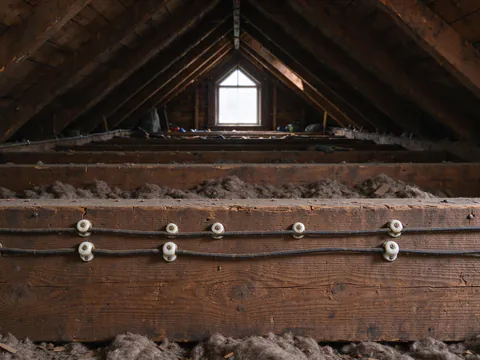

Yes. The state electrical code ties no removal requirement to a sale, and it lets working knob and tube stay in service. What the wiring changes is the buyer’s side of the deal: their inspection, their insurance and how they value the house. Decker Boston Knob and Tube arranges knob and tube assessments and replacement for Boston-area sellers, with the work done by licensed and insured electricians.
What you are obliged to tell a buyer is a legal question for your real estate attorney or agent; this guide doesn’t answer it. It covers the practical choices: replace before listing, document a scope, or set the asking price to account for the job.
Where the wiring shows up in a sale
A seller usually meets knob and tube through someone else’s process. It helps to know who is looking and what each of them needs.
- The buyer’s home inspector reports porcelain knobs in the basement or attic, two-prong outlets and a fuse panel. A visual inspection can’t tell how much is still live.
- The buyer’s insurer may ask directly about knob and tube and fuses. Homeowners report carriers allowing 30 to 60 days after closing for the new owner to take it out or prove it carries no power (insurance guide).
- The buyer’s lender may ask whatever its own loan rules require; that varies by program.
- The buyer has to budget for the work on top of the purchase, often in the weeks right after moving in.
Every one of these steps happens on a deadline, which is why unknown wiring tends to cost a seller more than known wiring.
Three ways to handle it
| Path | What you do | What a buyer sees | Trade-offs |
|---|---|---|---|
| Replace before listing | Rewire the remaining knob and tube under permit and close the walls | A closed permit, a labeled panel and a written completion summary | Takes planning, permit and inspection time and the upfront cost; the most straightforward story for buyers |
| List with a written scope | Have an electrician trace circuits and price the replacement; share the findings | A defined job with a number attached | Cheaper and faster than rewiring; the buyer still has to do the work and arrange insurance around it |
| Sell as-is and price for it | Disclose what you know and set the price with the work in mind | An unknown, valued by the buyer | Least effort; offers tend to reflect the buyer’s worst-case guess and their insurance deadline |
When replacing first makes sense
Replacing first suits a seller who has time before listing, wants a broad market including buyers who can’t absorb a project, or owns a house where only a few circuits remain. The budget follows the same drivers as any rewire: a typical Boston-area budgeting range of $8,000 to $25,000 or more for a whole house, less for a partial replacement. The cost guide breaks down what sits inside that range.
When a written scope is enough
A written scope suits a quicker sale or a house buyers already see as a renovation. It turns “old wiring” on an inspection report into specific circuits, rooms and a priced plan, which lets a buyer get an insurance quote and plan the work with confidence.
Timing a rewire around a listing
Replacement follows a fixed order, and some of it isn’t in your control. Build the timeline backward from the listing date.
- Map and scope: an electrician traces every circuit and writes up what will be replaced.
- Permit: the licensed electrician files with the local wire office. In Boston, work that begins ahead of the permit risks a doubled fee.
- Rewire and rough-in inspection: new circuits go in, and walls can’t close until the inspector of wires has seen the work, within 72 hours of notice for interior work, weekends and holidays excluded.
- Disconnect, test and label: the old runs are disconnected, the new circuits are tested, and the panel schedule is labeled.
- Patch and paint: plaster patching and paint come last, and they often take longer than the electrical work. In a house built before 1978, larger openings in painted plaster fall under the state’s lead-safe renovation rules.
Listing photos and showings work best after step five. Open walls during showings raise more questions than they answer.
What to have ready for buyers
Whichever path you choose, a short packet of records saves days of back-and-forth once an offer comes in.
- The electrician’s written findings: which circuits are knob and tube, which are live, and what couldn’t be seen without opening walls (inspection service).
- Any priced scope for remaining work.
- Permit numbers and final inspection records for past electrical work; Boston, Cambridge and Somerville publish permit records as open data.
- After a rewire, the labeled panel schedule and a written summary that no knob and tube remains in service.
- Any Mass Save assessment results that mention the wiring.
Describing the wiring accurately
Words matter in a listing and in disclosure forms. “Knob and tube removed” and “knob and tube disconnected and abandoned in the walls” are different facts, and so is “remaining knob and tube on two attic-fed circuits.” If a previous owner told you it was all gone, that is hearsay until someone traces the circuits (how live wiring is verified).
Mixed systems are the common trap: a renovated kitchen on new cable can sit on a circuit that runs on knob and tube upstream (mixed with newer cable). Ask your attorney or agent how to word what you know.
Two- and three-family sellers
In a triple-decker or two-family house, a buyer’s insurer and lender look at the whole building, but the wiring may differ unit by unit. If units are occupied, a pre-listing rewire runs floor by floor with notice to each household and planned power-off windows. Buyers of these buildings often plan to live in one unit, which makes a clean electrical record especially useful to them.
To get a written scope or plan a rewire ahead of listing, call Decker Boston Knob and Tube at (617) 405-3599 or ask for an estimate.