
Knob and tube replacement in Dorchester is rarely one family’s project. Most of the neighborhood’s pre-war housing is two- and three-family buildings, so the old wiring usually belongs to several homes, a shared stairway and one basement. Decker Boston Knob and Tube arranges that work across Dorchester, from Savin Hill and Fields Corner to Codman Square, Ashmont and Lower Mills, carried out by licensed and insured electrical contractors. It begins with a knob and tube inspection that sorts out which circuits are live and which unit each one serves.
Why a Dorchester rewire is a building, not a house
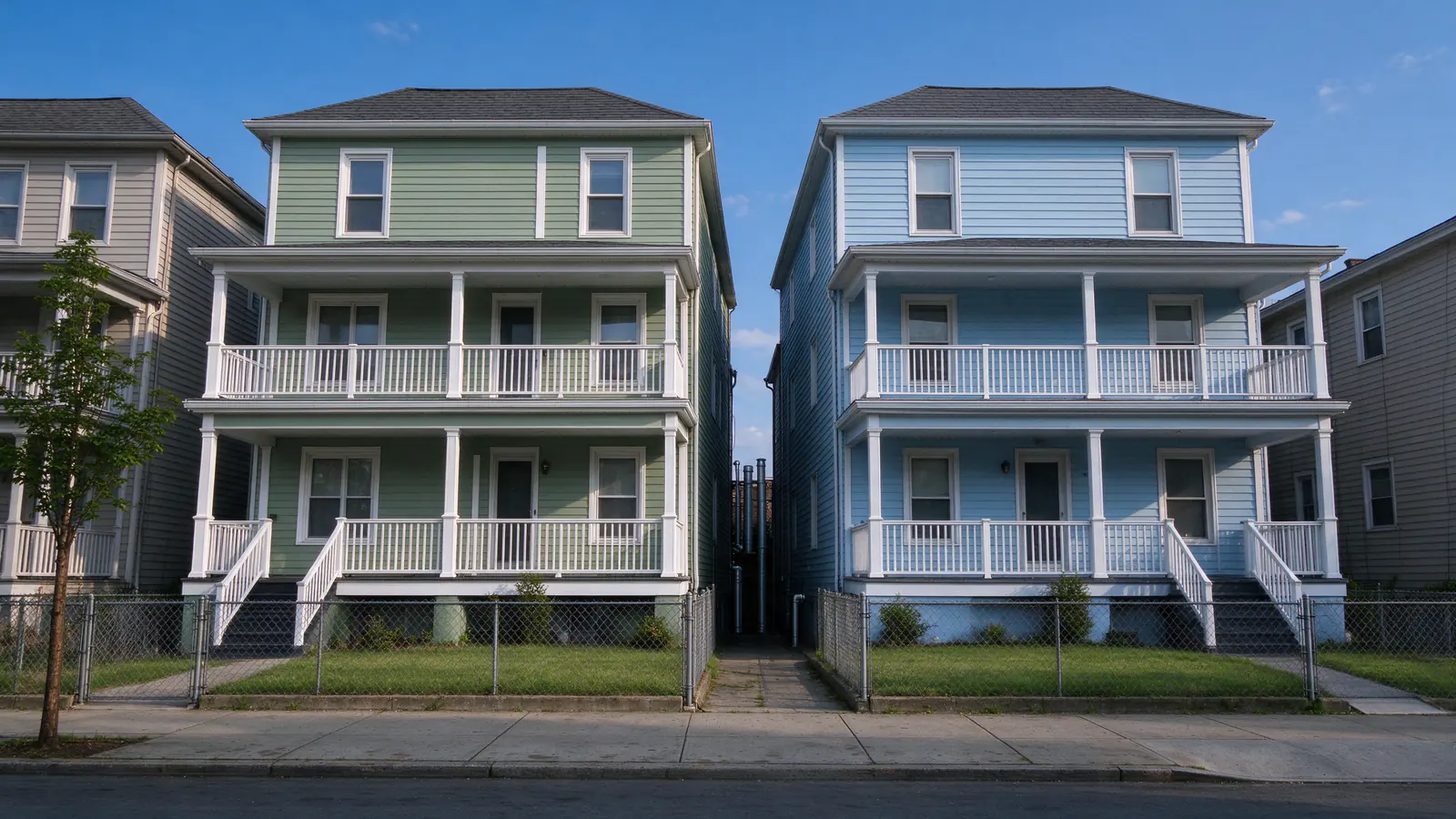
Dorchester holds Boston’s densest concentration of three- and four-unit buildings. Census figures put 43.4% of housing units in ZIP 02122 and 44.3% in 02125 in buildings of that size, against 23.5% citywide, and 60.0% of 02122’s units date from before 1940. The Boston Preservation Alliance estimates that about 15,000 triple-deckers went up in Boston between 1880 and 1930, nearly all wood-frame, following the trolley lines into Dorchester, Roxbury and Mattapan.
That building era overlaps the decades when knob and tube was standard, which is a reason to check, not proof of what a given building has. What it does mean is that a full job here is a triple-decker rewire: three dwelling units, often three meters, a common stair, and residents living on the floors not being worked on.
Three units, three meters, one stairwell
The decision in a Dorchester building is less about whether to rewire than about how to divide the work so each household keeps power and each floor ends up with a clear record.
Floor by floor
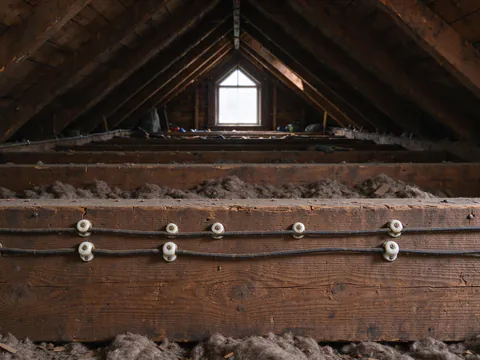
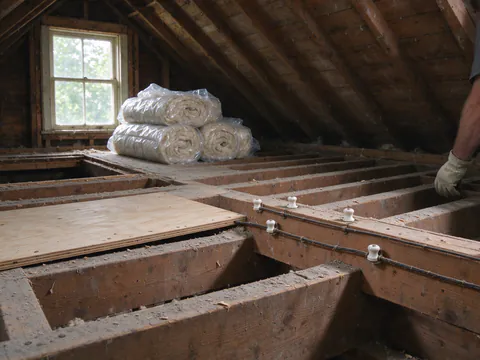
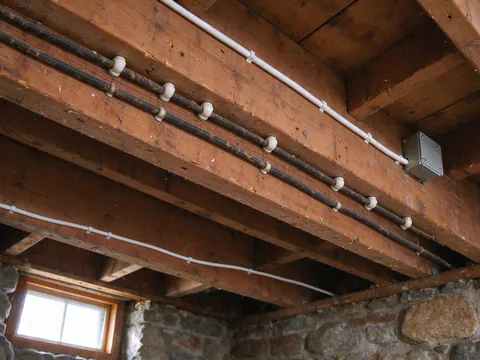
Each floor is usually its own dwelling unit, so each is usually its own stage. Where one unit was already updated, the job on that floor may be a partial replacement of whatever old circuits remain. The basement carries every unit’s circuits back to the service, and the top floor depends on the attic or, under a flat roof, on routes from below. Boston’s permit records show the pattern: a 2011 Dorchester permit in a one-to-three-family building reads “replace one water damaged knob and tube circuit on second floor. add sub panel on second floor for replacement wiring.”
The common hallway rule
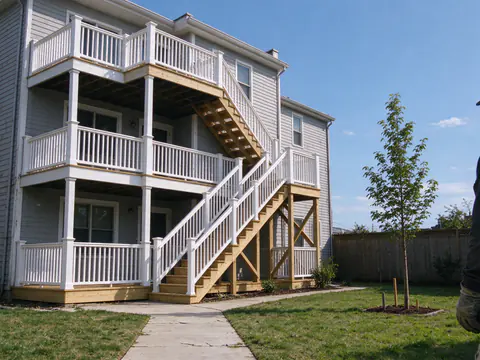
The front and back stairs are a separate scope. The Massachusetts electrical code makes an exception for existing three-family buildings: lighting in common areas on the same floor as a unit may be fed from equipment that serves one or more of the units. That can spare a three-decker a separate house panel just for the stair lights, though the layout is confirmed with the inspector building by building.
The service and the meters
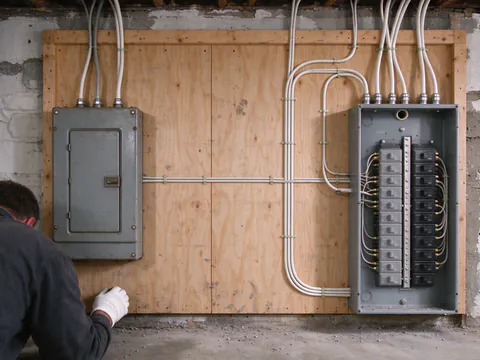
Adding circuits to three units can outgrow the service. Another 2011 Dorchester permit reads “Upgrade existing electrical service from 100 to 200 amps. Remove knob and tube wiring.” Dorchester is Eversource territory, so a service change adds an Eversource work request to the schedule. The panel and service upgrade page covers when that is needed, and the Boston cost guide shows how units, meters and a service change move the budget.
How a Dorchester job usually runs
The order follows the building, not a template, but most Dorchester jobs move through the same stages.
- The first call collects the address, how many units there are, which are owner-occupied, and what started it: an insurer, a sale or a Mass Save assessment.
- The assessment traces circuits from each meter and panel to the rooms and stairs they feed, so every unit’s scope and the common areas are written up separately.
- The licensed contractor files one Boston permit for the work, and the households get the dates for each floor and for any service shutdown in advance.
- The rough-in inspection happens before any wall or ceiling is closed. Massachusetts rules say new wiring can’t be covered until the inspector has seen it, within 72 hours of notice, weekends and holidays excluded.
- The finish is a final inspection, a labeled panel schedule for each unit and a written summary of what was replaced and what, if anything, remains.
The living at home guide covers what each household can expect on its work days.
Rewiring a Dorchester two- or three-family?
Start with which units and which stairs still run on the old circuits. The scope follows from that.
Permits, Eversource and Mass Save in Dorchester
Dorchester follows the same rules as the rest of Boston, which keeps the paperwork simple. The Boston Inspectional Services Department issues electrical permits citywide, and a homeowner must hire a licensed contractor to apply. ISD’s fee is a $20 application fee plus $1 per fixture, plug or outlet and $5 per meter when the service stays the same, or $0.25 per amp for a new or upgraded service. The Boston permit guide walks through it.
Permit records point to how much rewiring goes on here. Between November 2021 and October 2026, 54 electrical permits in ZIPs 02122, 02124 and 02125 described a rewire, plus 11 in Grove Hall’s 02121, more than any other part of the city. The city’s open dataset appears to be missing many recent permits, so treat those counts as a floor.
Mass Save often sets the deadline. An energy assessment that finds active knob and tube holds back insulation until a licensed electrician certifies the work areas, and in a three-family that can stall the whole building. Mass Save’s barrier incentive of up to $7,000 for moderate-income households covers 1 to 4 unit homes, so a three-decker qualifies by size; income and other conditions still apply. The insulation barrier service and the grants guide cover how that works.
South Boston, East Boston, Roxbury and Mattapan
The same three-decker form continues past Dorchester’s edges, with the same permit office and utility, so these neighborhoods are covered here rather than on pages of their own.
South Boston
In 02127, 35.4% of housing units are in three- and four-unit buildings. The Preservation Alliance notes South Boston’s triple-deckers are mostly flat-roofed, so top-floor cable usually can’t cross a walk-in attic and has to come up from below or through small ceiling openings.
East Boston
East Boston’s 02128 has 40.0% of its units in three- and four-unit buildings and 53.2% built before 1940, close to Dorchester’s profile. The floor-by-floor approach and the common hallway rule apply the same way.
Roxbury and Highland Park
Roxbury’s 02119 had the highest share of electrical permits describing a rewire of any Boston ZIP between November 2021 and October 2026, 16 of 97. Parts of it sit in the Highland Park Architectural Conservation District, designated in 2022, where exterior work visible from a public way goes to the Boston Landmarks Commission before permits. Interior rewiring isn’t reviewed, but a new mast or meter bank on a visible wall may be.
Mattapan
Mattapan’s 02126 is 40.9% pre-1940, with 18.5% of units in three- and four-unit buildings and 22.2% in detached houses. A detached house there is closer to a standard whole house rewire than to a multi-unit job.